

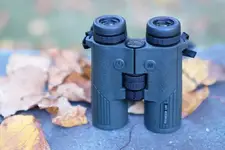
Before starting this review of Hawke Frontier LRF Laser Rangefinding Binoculars, I probably should give a little personal background…
- I’ve always been interested in optics, mainly associated with photographic cameras. I value high optical quality. But optical quality is something like accuracy in shooting, it means different things to different people, so I try to quantify it wherever possible.
- However my experience has mainly been with “single lens systems” – cameras and riflescopes, rather than binocular “twin lens systems”.
So that’s my background to this review. What did I find?

Hawke Frontier LRF Laser Rangefinding Binoculars – Product Overview
Hawke Frontier LRF Laser Rangefinding Binoculars are available in two configurations. There’s a 10 x 42 (10 x magnification, 42 mm objective diameter) and a 8 x 42 model.
We’re looking here at the 8 x 42 version. Why the lower magnification? Well, firstly it’s because 8 X magnification is easier to hold still than 10 X (we all know this from our experience with riflescopes). And “still” is an important practical component of achieving a sharp view…
Secondly, the 8 X magnification has a broader Field of View than the 10 X model. In fact, the specifications are for a 393 Feet FoV at 100 Yards. That’s 25% more than the higher-magnification model.

If you’re “glassing” the terrain, more power is not always better, but the wider FoV gives you the chance to spot something at the edges that might escape the narrower 10 X view. Plus – if you’re using these laser range finding binoculars for hunting – the scope on your air rifle probably gives you a (much?) higher magnification for sighting-in on the target.
Thirdly, optical theory and personal experience indicate that – all other things being equal – for a certain diameter objective (front) lens, a lower magnification will provide a brighter image than higher. That could be critical for viewing in low light conditions, in deep shade or at dusk.

But these are not just binoculars, they include a laser rangefinder. In fact, the rangefinder displays in the right eyepiece but you’re not aware of that in normal use. It’s just “there”, when requested, in the image you see – apparently – with both eyes.
As with other laser rangefinders, this one has a number of modes of operation. It can also display distances in Yards or Metres, at your choice. It’s also adjustable for brightness, as you would expect.
For this review, I set the mode to “Hunt”. This measures the straight line distance to the target, ignoring distractions such as long grass or brush. In addition, it also displays a second range – the horizontal distance – to accommodate for the near-certainty that your target is not at precisely the same elevation as you.
I’ve labeled the display points in this version of the photograph below.

Incidentally, I took this photograph using my iPhone and the Hawke Smartphone Spotting Scope Adapter. The image was much zoomed-in using Photoshop for display here.
At 2 Lbs 2 Oz weight, these binoculars are not exactly light – but they are about 2 Oz lighter than the 10 X model – hey, another benefit!
However that weight indicates the use of a considerable amount of high quality optical glass, plus a really solid magnesium alloy chassis. It certainly gives an immediate impression of solidity and robustness.
The “straight through” design indicates that these binoculars use a roof prism image erector system. That helps give a compact size (6 1/2 Inches length) and high quality image, at the expense of some additional weight. If you look in through the objective lens – with the laser rangefinder OFF! – you can see something of that optical system design.
Hawke Frontier LRF Laser Rangefinding Binoculars – What’s Included?
As with all Hawke products, these binoculars are well-packaged and comprehensively-equipped. Among the accessories included are front and rear eyecups, a battery (for the rangefinder), neck strap, padded carrying case and comprehensive harness for carrying the case.

Interestingly, there’s also a quality control inspection document. This is serial-numbered to the unit and confirms the optical and mechanical checks that it has passed.
Incidentally, the “Strehl Ratio” is a measure of image quality that’s not commonly discussed in consumer optics. You can read more about it here. To me, that shows that Hawke takes its optics seriously…

Rangefinder controls are very simple. There’s a “power” button that turns-on the laser rangefinder. The rangefinder automatically cuts-out after 15 seconds, so button-pushing is minimized. There’s also a “M” (Mode) button that’s used in the setup.
That’s all.
Our binoculars are rubber-armored, have water-repellant coating on the lenses and are IPX7-rated. That means that they are specified to withstand immersion in water to a depth of 1 Meter for up to 30 minutes. (I’m satisfied that they’re good for all weather use, even if I didn’t actually try an immersion test myself!)
Hawke Frontier LRF Laser Rangefinding Binoculars – Subjective Testing
First, I set-up the binoculars for my specific eyesight in the recommended way by using the diopter correction controls on the eyepieces. (Hawke describes this simply but well on page 5 of the user guide.)
Doing this, I was impressed with the click adjustment mechanism of the eyepieces. This allows for easy rotation of the eyepieces for setting, yet makes your chosen setting more difficult to dislodge during everyday handling. It also has a very pleasing tactile effect.
As shown in the photograph below, the built-in eyecups can be extended (left) for use with normal eyesight. The pushed-in position (right) is for spectacle-wearers, such as myself.
These eyecups rotate in and out using a helical thread that – again – allows for easy setting but limits inadvertent changes.

The control buttons are well-placed and easy to use. Ditto for the focusing wheel that’s ideally-placed for operation by the index finger. However I would have liked to see deeper ridging on the surface to facilitate use in inclement weather.
After several prolonged periods of glassing, I noted the following observations…
Brightness. The image seen through the binoculars appeared brighter than observed with the naked eye. This was particularly apparent in deep shade and at dusk. This made it possible to pick-up details that I otherwise could not see under such conditions. Here, of course, is a critical advantage for hunters.
High contrast. The images were sharp and detailed – as well as bright. They were definitely not washed-out and “dingy”. That’s the result of insufficient optical contrast that can be seen in low quality optics.
Resolution. The observable level of detail also seemed very high, whatever the subject. Although our natural tendency is to concentrate on the center of the image, I found that an impressive detail capability extended out to the edges of the field. (This impression is quantified by our structured testing, below).

Color correction. Neutral. Subjects appeared to be the same color when viewed through the binoculars as to my naked (plus spectacles) eyes, too. And I saw no color fringing – those “halos” of many colors – that can be produced by optical imperfections in poor quality optics.
Distortion. When looking deliberately at straight lines – fence posts and similar – straight lines really did look straight – even at the edges of the field. There was no sign that I could detect of either “barrel” or “pincushion” distortion, the optical defects that causes straight lines to look curved.

But for me, the most impressive aspect of the optical performance was the ability of these binoculars to impart a dramatic three-dimensional look to the world.
When I focused – for example – on one tree trunk in a woodland, that specific tree really “popped” out from the others around it that were just slightly less in focus.
Yes, I’ve seen this effect other binoculars, but rarely in such a pronounced manner. The result is that the subject you focus on “pops” clear of the background, making it easy to determine the range and study in detail.
Hawke Frontier LRF Laser Rangefinding Binoculars – Structured Rangefinding Test
Hawke specs indicate a rangefinding accuracy of +/- 1 Meter. This is a common specification. That’s good for long ranges – say 100 Yards plus. However, it’s not inspiring for shorter range airgun use.
The good news is that I found that the distance measurements produced by these binoculars to be much more precise than the specifications suggest.
The distances called-out by the Hawke LRF binoculars I tested very closely matched those displayed by other laser rangefinders out to 140 Yards. At short ranges they matched the results from a good, old-fashioned measuring tape, too!
These binoculars focus closer than the minimum rangefinding distance. However I was able to obtain accurate rangefinding distance measurements as close as 13.7 Yards (41 Feet).

But I will make a comment about rangefinding here…
Initially, I was producing wildly-different distance readings on trees in distant woodland. However I realized soon enough that this was the result of operator error!
It transpired that I had a tendency to move slightly as I pressed the rangefinding button. That means that I ended-up recording the distance of a different tree. Hence the difference.
The learning is to hold the binoculars very still when rangefinding so as to ensure that they are pointed exactly at the subject you want – not where you think they should be…
Hawke Frontier LRF Laser Rangefinding Binoculars – Structured Optical Test
Subjective optical testing is all well and good. But it depends on the individual person making the test. In this case me!
So I set-up the Frontier LRF binoculars at 20 Yards – checked by the rangefinder and tape – from our Hard Air Magazine resolution test target.
This test target has four USAF test targets towards the center, as you can see below.

USAF resolution test targets are widely used in the optics industry. You can read more about them here if interested. They are specifically designed for the assessment of image resolution by combining many different-sized blocks of different thickness lines. Each block on our target is 1 7/8 Inches wide.
The smallest pair of lines that you can “read” as separate bars represents the resolution. So, the smaller the sub-blocks, the higher the resolution. Simple!
Of course, all these readings depended on the optical capabilities of my own eye, plus glasses. Your mileage may vary with this type of testing, for obvious reasons.
So what did I find?
Well, I was able to resolve the blocks as indicated in the photograph above. For red, blue and black, the individual lines of each block are just 44 Thou (0.044 Inch) wide. I would describe that as an excellent result at 20 Yards!
The width of the yellow lines was slightly larger, at 62 Thou (0.062 Inch). It’s common in my experience for the yellow lines to be less visible, largely due to the lower contrast with the white background. Again, I would describe that as excellent resolution.
Now it’s important to say that this test was run in bright, afternoon daylight with the target in light shadow, as seen in the photograph above. The results will be less good under lower illumination levels.
Hawke Frontier LRF Laser Rangefinding Binoculars – Summary And Conclusions
Given the relatively low powers and limited ballistics of most air rifles, accurate range estimation is a must for accurate shooting. We all know this!
These Hawke x 42 rangefinder binoculars are suitable for use at any practical airgun hunting range and will undoubtedly help your downrange hit rate.
At not much more than 2 Lbs weight, these binoculars are also significantly lighter than any air rifle plus scope combination. This – plus the much wider field of view – makes it so much easier to survey the scene for an extended period of time than using a riflescope.
Sure, rangefinding binoculars are yet one more item to carry in the field. But they are sure to be an essential item for a successful hunt, for both finding and ranging your quarry.
Everything about these Hawke binoculars indicates that they are quality product, capable of giving many years of service. At a MSRP of $999.00, they are well priced too, for what they offer.
Even more so if you buy from Pyramyd where you’ll find them for $100 less at $899.99.
BUY FROM PYRAMYD
Hawke Frontier LRF 1800 8×42 Binocular OLED Green

The post Hawke Frontier LRF Laser Rangefinding Binoculars appeared first on Hard Air Magazine.


