Install the app
How to install the app on iOS

Follow along with the video below to see how to install our site as a web app on your home screen.

Note: This feature may not be available in some browsers.

“Clean Kills” easier said than done sometimes

PasadenaMike

Grand HAMster
3,390
1
9,363
Pasadena, CA
Airguns of Arizona - 10% discount
Country flag
No matter how much I try for a clean kill on ground squirrels for example sometimes it just doesn’t work out. Nothing is perfect. Wether it’s a squirrel on caffeine or whatever the case might be there’s always some that don’t drop like we see on YouTube (I’ve talked about YouTube videos and how I feel about them). I can’t be the only one that experiences this.
 
Yes, this can get really wild. For example, when I was a kid, my grandfather took a couple of live chickens we were going to have for supper and he cut the heads off and let them go. They ran all around and flew into the side of the house a couple of times, it was just nuts. It gave real meaning to the run around like a chicken with its head cut off saying for me. I could not believe my eyes.
 
Last edited:
@PasadenaMike I'm not sure what you consider a clean kill, but the best I can hope for on a tree squirrel is that it's dead by the time it hits the ground. That doesn't mean it's going to drop dead as soon as it's shot. I don't know what your idea(s) about death are, but death is a process. Unless you're completely separating the head from the body, it's going to be a process that you as the hunter are going to have to watch if you keep an eye on the animal. This is a contentious topic, but I have read up on the topic and killed enough of a variety of animals to form an informed opinion based upon substative data.

What you're doing is a style of hunting. Most often things are not going to go exactly as planned. Animals move, they come from directions you may not anticipate, you can have issues with your holds/scope adjustments, ballistic calculations, equipment, wind/weather, etc. Your ability to improvise or think fast can be a good determining factor of whether you have good shot or a bad one. Sometimes an animal will hardly move after being shot, but will still be alive yet immobile or in shock. Other times your shot can "puree" the brain, ceasing all voluntary movement, but the animal will violently seize and flop around for a few moments. If we're talking a shot to the lungs and/or heart (vitals) the process can take longer as the brain must be deprived of oxygen for a certain amount of time to kill the animal if it doesn't die of shock. A liver shot can take longer to bleed out and is not the best vital shot. Point being, death takes time more often than not. Don't compare what you're doing in real time to edited videos.I'm pretty sure YouTube doesn't want its content creators showing unedited videos of shot animals dying from subsonic projectile shots or by any another means.They hardly seem to want content creators to show blood any more.
 
@PasadenaMike I'm not sure what you consider a clean kill, but the best I can hope for on a tree squirrel is that it's dead by the time it hits the ground. That doesn't mean it's going to drop dead as soon as it's shot. I don't know what your idea(s) about death are, but death is a process. Unless you're completely separating the head from the body, it's going to be a process that you as the hunter are going to have to watch if you keep an eye on the animal. This is a contentious topic, but I have read up on the topic and killed enough of a variety of animals to form an informed opinion based upon substative data.

What you're doing is a style of hunting. Most often things are not going to go exactly as planned. Animals move, they come from directions you may not anticipate, you can have issues with your holds/scope adjustments, ballistic calculations, equipment, wind/weather, etc. Your ability to improvise or think fast can be a good determining factor of whether you have good shot or a bad one. Sometimes an animal will hardly move after being shot, but will still be alive yet immobile or in shock. Other times your shot can "puree" the brain, ceasing all voluntary movement, but the animal will violently sieze and flop around for a few moments. If we're talking a shot to the lungs and/or heart (vitals) the process can take longer as the brain must ber deprived of oxygen for a certain amount of time to kill the animal if it doens't die of shock. A liver shot can take longer to bleed out and is not the best vital shot. Point being, death takes time more often than not. Don't compare what you're doing in real time to edited videos.I'm pretty sure YouTube doesnt want it's content creators showing unedited videos of shot animals dying from subsonic prjectile shots or by any another means.They hardly seem to want content creators to show blood any more.
Great response thank you. Basically s&$t happens sometimes and it’s not perfect. My idea of a clean kill is Mr squirrel don’t move an inch but that’s usually rare. More common with a .35 hades than say a .22
 
Over the last few months I've dispatched approximately a dozen Large Brown Rats In my backyard. Our local municipality has been tearing up the streets replacing 80 year old WaterMain's! This has caused the the resident Norway Rat population to panic and look for new nesting area's. In my local development we have been seeing quite a few Rats during the daytime hours In and on our property foraging for food. I placed a few Squirrel feeders along my back fence with some extra plywood to add some protection (To stop over penetration Into my neighbors yard) as I proceed to target the Rats while they feed from the feeders. The distance I'm shooting from Is less than 20 yards. I use a Daisy 880 .177 pumper with a Buck Rail Moderator and a Center Point Reflex Sight with JSB Hades 10.34 grain Diabolo Pellets. I'm able to get precise head and lung shots consistently and the rodents when hit have a tendency to flip over and on their backs and make contorted movements with their legs. It kind of looks like their Break Dancing....LOL! I also use a Beeman R7 with the same .177 JSB Hades pellets and get the same results.
 
Last edited:
Great response thank you. Basically s&$t happens sometimes and it’s not perfect. My idea of a clean kill is Mr squirrel don’t move an inch but that’s usually rare. More common with a .35 hades than say a .22

@PasadenaMike I see. When I shoot an animal in the brain, many times I'm far enough away to where they will be dead or will have stopped moving by the time I walk up to them. Often times I do not get up immediately to retrieve the animal because I am after multiple animals. On larger animals I was taught to give them enough time to die without startling or stressing them further. The last thing I want them to do is to get up and try to run off. Approaching too soon can stress an animal. So I watch them through the scope If I can still see them where they fall. Sometimes they fall in a thicket or tall grass. If they seem stressed while watching, I'll shoot again if the opportunity for a follow up shot presents itself. Yes, sometimes things happen beyond our control. If that continues or if we are uncomfortable with what is occurring, we have the ability to pack it in so that we can prevent repeating the bothersome behavior so that we can avoid or correct the problem and return another day. What I meant to key in on is that few scenarios will play out exactly as we (the hunters) imagine. That speaks more to our expectations than to external factors beyond our control.

To your statement on calibers, larger calibers tend to be more forgiving in terms of shot placement. Hunting is a lot different from shooting paper or inanimate targets. I recently shot two squirrels close-range. One I completely missed the vital organs as she was shot while running along a branch over my head. When she hit the ground a few feet in front of me she was still breathing and I put the muzzle close to her head and put her down. It was a relatively swift process. Another squirrel I went from stalking to almost chasing. I shot when she paused. It was a great looking headshot to the brain below the ear at an upward angle. The shot knocked her out of a tree and onto her belly. I watched the squirrel try to push herself up and sigh before collapsing and dying. This happened in a matter of like 5-10 seconds. I was shocked to see it, but I'd seen a similar thing occur with a fox squirrel shot from a similar angle and shot placement a couple years back. All shot with .22 caliber pellets. When I hunt with a .25, things tend to play out differently. There seem to be less instances of much movement after a being shot and knocked to the earth with good shot placement. There is no substitute for piss poor shot placement. If that's going on consistently, the shooter/hunter needs to practice more. After a bad day out, I've come home and practiced target shooting and validating my DOPE before to see if I was off or if something was wrong with my equipment.
 
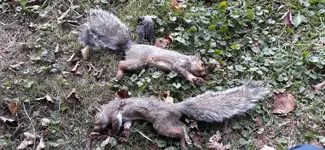
Got these 2 today, both vital hits with my .22 30fpe pcp. Both were well placed shots @ maybe 20-25Y (upper shoulder hits) with the lower one running 10Y away and thinking about going further so I shot him again. The other (top squirrel) was shot actually in the shoulder and it clearly went straight into the heart, he tumbled out of the tree straight down and didn't budge an inch. Same gun, same ammo, same hour, same animals, almost exact same shot placement, one was maybe 10Y farther out and still fairly different results! They are all on a mission to plant my property full of my neighbors walnuts from his trees....I'm not having it!
 

Attachments

  • 20241015_112235.webp
    20241015_112235.webp
    1.1 MB · Views: 7
My
Yes, this can get really wild. For example, when I was a kid, my grandfather took a couple of live chickens we were going to have for supper and he cut the heads off and let them go. They ran all around and flew into the side of the house a couple of times, it was just nuts. It gave real meaning to the run around like a chicken with its head cut off saying for me. I could not believe my eyes.
My grandpa did the same thing back in the 60s when I was a young pup. Shocking for me at the time!
 
I'm going to be controversial here and say I have different standards for game animals vs. pests. Rats, pigeons, or groundhogs I try to be as accurate as possible, but if the hit isn't perfect, I'm not concerned. Rabbit or squirrel, different story.
@Farmplinker2 When did standards enter the conversation prior to the above quote?
 
Ted’s holdover did a video on the thrashing that happens after a head shot, apparently it is a neurological reaction that occurs despite best intentions.
Ted clearly showed that a head shot causes immediate brain death and the thrashing that goes on is a reflex uncontrolled reaction. This is actually a clean kill regardless of the movement.
 
Last edited:
Ted clearly showed that a head shot causes immediate brain death and the thrashing that goes on is a reflex uncontrolled reaction. This is actually a clean kill regardless of the movement.
For the sake of discourse and further education let's get a basic understanding of what we're discussing here. Mike has raised an interesting question that is asked periodically on various forums so clarity and accuracy are important so that the information presented and contained within this thread remains valid and viable. First, I'd like to preface my statements with: I am not a scientist. I am a hunter who has read about, killing, dying, the processes of death, and observed many animals dying from various types of traumas induced by projectiles and other elements associated with hunting and killing nuisance and game animals.

The above quote in bold type is an erroneous statement and I hope it is not the verbiage used in the information presented on Ted's Holdover YoutTube channel. Head shots are not always lethal, nor do they always lead to an "instant" death. Brain shots, on the other hand, have a greater probability of doing those things, but still do not guarantee "instant" death or in the context of this conversation a "clean kill."

First let's get the language right in the discourse. If you're aiming at an animal's head, the vital organ is the brain. The face is a part of the head, as are the ears, nose, chin, cheek, and jaw. Shooting at all of these different areas with subsonic pellets or slugs are not guaranteed to ensure a swift death or death at all. You must hit certain areas of the brain to do that. On small animals shooting shots directly into certain parts of the animals head (using appropriate landmarks like between the ear and eye from a profile view) at an angle corresponding with the projectile passing through the brain greatly increases the probability of a "clean kill." The odds are increased even more when shooting substantially large calibers in proportion to the overall size of the animal. This can make up for some not so great shot placement, but is no substitute for poor shot placement.

I don't have all of the answers here and don't intend to come across that way. I'm sure others have more to add, but it would be irresponsible of me to not elaborate here. I think that most, if not all, of us should agree and work from the same basic understanding (of the importance of shooting animals in the brain for a "clean kill") within this conversation. In sum, aim for the brain and be sure that your projectile passes through or at least penetrates the skull into the brain sufficiently to destroy a significant amount of tissue in multiple lobes providing a substantial advantage above other types of "head shots." Again, "brain shots" are most desirable. Knowing something about your target animal's anatomy is important to accomplish the goal of the aforementioned "clean kill."

 
For the sake of discourse and further education let's get a basic understanding of what we're discussing here. Mike has raised an interesting question that is asked periodically on various forums so clarity and accuracy are important so that the information presented and contained within this thread remains valid and viable. First, I'd like to preface my statements with: I am not a scientist. I am a hunter who has read about, killing, dying, the processes of death, and observed many animals dying from various types of traumas induced by projectiles and other elements associated with hunting and killing nuisance and game animals.

The above quote in bold type is an erroneous statement and I hope it is not the verbiage used in the information presented on Ted's Holdover YoutTube channel. Head shots are not always lethal, nor do they always lead to an "instant" death. Brain shots, on the other hand, have a greater probability of doing those things, but still do not guarantee "instant" death or in the context of this conversation a "clean kill."

First let's get the language right in the discourse. If you're aiming at an animal's head, the vital organ is the brain. The face is a part of the head, as are the ears, nose, chin, cheek, and jaw. Shooting at all of these different areas with subsonic pellets or slugs are not guaranteed to ensure a swift death or death at all. You must hit certain areas of the brain to do that. On small animals shooting shots directly into certain parts of the animals head (using appropriate landmarks like between the ear and eye from a profile view) at an angle corresponding with the projectile passing through the brain greatly increases the probability of a "clean kill." The odds are increased even more when shooting substantially large calibers in proportion to the overall size of the animal. This can make up for some not so great shot placement, but is no substitute for poor shot placement.

I don't have all of the answers here and don't intend to come across that way. I'm sure others have more to add, but it would be irresponsible of me to not elaborate here. I think that most, if not all, of us should agree and work from the same basic understanding (of the importance of shooting animals in the brain for a "clean kill") within this conversation. In sum, aim for the brain and be sure that your projectile passes through or at least penetrates the skull into the brain sufficiently to destroy a significant amount of tissue in multiple lobes providing a substantial advantage above other types of "head shots." Again, "brain shots" are most desirable. Knowing something about your target animal's anatomy is important to accomplish the goal of the aforementioned "clean kill."
My point is that the thrashing around wildly after a head shot indicates brain death and is a clean kill. Obviously if the head shot is not into the brain it could injure but not clean kill. Odds of hitting the brain versus a larger target body area are smaller but body shots might require a followup shot to finish.
 
In regards to pest control shooting .177 for Feathers and .22 for Fur. Sounds like good advice
But I've done most of my culling with .177 but at reasonably close range (7-20 yards) I find Rats and Squirrels
to be extremely quick and fidgety which makes a head shot a little difficult. But once hit In the head between the eyes or from the side they drop rather quickly with minimal movement!
 
Even Big game and big pb guns you see the pros like buck McNally 😜 cautiously sneak up and prod with barrel to insure its fully dead .. lol

My favorite is I got the kill aim on something and just the moment I pull the trigger it flinches and now my shot ain't so much a kill shot .. but ya know ... Nothing hurts my feelings more then a maiming shot and it's in pain crawling off wile im trying to put together the Finnish it off shot ..
 

Create an account or login to comment

You must be a member in order to leave a comment

Create FREE account

Create a FREE account on our community. It's easy!

Log in

Already have an account? Log in here.

Trending in this forum

Back
Top