

Alandaledaniel
HAM Shooter

Ok, excellent information from a person who obviously knows what he is talking about. My problem is I am not well versed in working on high pressure compressors. My manuals for the several compressors I have owned [which all previous ones have failed after about one year ] do not have any instructions about how to do the detailed type of maintenance that Bchannell is talking about. All I do is follow what my manual says to do. The manual never mentions keeping the gauge block and fill line below the gun when filling. In fact, this is the first time I have ever heard of this procedure. I do watch you-tube videos on repairing various items and find them to be quite helpful; however, I do not attempt complex repairs based on those videos. I do NOT want to tear down a compressor and lube the piston, or even inspect it. There are so many unanswered questions. When reassembling the compressor how much torque is applied to the head bolts? How much lube is enough? When cleaning the compressor cylinder do I just wipe it off with a rag or do I use carburetor cleaner on it? And so forth.As I have now had in my use over six GX compressors, several CS2 and CS3 models, and have worked on all of them, so I have some insight into maintenance and use that might be of use to the members.
First, I'm a huge fan of the CS2, it is robust and simple in design and operation. Since I would never walk off and trust a CS3 or other compressor to shut off on it's own, I have to be there and watch it anyway, so no need for auto shutoff in my book. The CS3 is the same design as the CS2, with a simple addition of auto shutoff parts.
Second, these are to fill guns only and any attempt to fill large cylinders is at your own risk. Can it be done, sure! Is it advisable? That's up to you, but that is not what they're designed for. If you are judicious, it can be done, but I have the compressor to fill with, so I have no need for a large cylinder.
The CS2 is so simply designed, that if properly cared for, I can't imagine it would not last quite a long time. The electronics are simple and very well thought out, and the piston and seals are spot on.
If you maintain the compressor, you add much to your odds of it lasting, and I don't care what anyone, even the manufacturer says about that. They may say it never needs lube, but don't bet on it, especially when it's so simple. There are plenty of videos online showing how to disassemble the unit, but even that is not all that necessary. I'd check the gearbox every year or so,check and replenish the gear grease as needed, and not mess with it any more. If you pull the head, then the wrist pin, and remove the piston, clean everything well and regrease and reinstall, you've done wonders for longevity. Silicone or food grade grease for the piston, and really any good bearing/gear grease for the wrist pin. Also remove the pressure block on the bottom front and clean it of rust and install new filters. Do the same for the gauge housing. You've now spend a half hour or so and added to the life of your compressor.
In use, follow the instructions, open the bleed first, start the compressor, and close the bleed. Keep the fill line and gauge block below the gun at all times when filling so that any liquid will stay in the fill line. You will get rust in the fill line at the compressor pressure block and the gauge block, that's a given. If you vent it hard when filling is done, and open it every few months, and clean it up, you shouldn't have any problems with moisture in your guns. I also would open my airgun's cylinder every year or so for inspection. Of all the causes of explosion, which is rare, I would bet many are from unseen aluminum liners oxidizing. An inspection will tell you if your procedures are working for your climate. If you want to add a filter, it's a great idea. I'd personally stick with a filter on the high pressure line, and change the media every 3 months for peice of mind. I wouldn't fool with an inlet moisture filter, unless it's in addition to an outlet filter. Can't hurt, and may do some minimal good.
The very best advice I could give is use nitrogen fed to the compressor. No worry of any moisture, and no filters, except a cotton filter for debris. I use a 40 cu/ft cyl fed to the handle/inlet of my CX2's at 8-9psi and it works great, even fills just a tad faster too. I do a lot of shooting and use about one n2 cyl a month or so. If I'm not tuning or working on airguns, then n2 lasts longer, maybe 2 months. At $16 a exchange, that's pretty cheap, and cheaper than maintaining filters. N2 is not mandatory, obviously, but it's easy. I used strictly air for a good long time and never had a problem, but I also used a filter.
Just a little care, and these units should last and last, and for around $250, they're a steal. I have friends, who i've sold units to, and they abuse them, never use filters, and do no maintenance whatsoever, unless they ask me to do it, and those compressors are working fine, although, I did disassemble them and lube them properly and check out all the connections before letting them go.
I depend on the manufacturer telling me EXACTLY what to do to maintain the compressor. If they fail to do that can anyone reasonably expect me to get involved in tearing the machine down after one year of operation and perform maintenance that the manual fails to explain to me about how I would go about this maintenance? Can the manufacturer selling mail order expect a customer to pay the freight every year to mail the compressor back to them, pay for the service, then pay the delivery charges to get it back?
IMO, compressors are not being built well enough if all this detailed effort is required to keep them running. I want to shoot & not spend my time and money keeping my compressor running. Naturally, every machine requires maintenance. However, my lawnmower [gas] doesn’t require a tear-down every year. Sharpen the blades, clean or replace the air filter, maybe replace the spark plug? Even an oil change is fairly easy. In my experience the manuals tell the user how to do these things. Plus, information on internal combustion engines is widespread. Information on high pressure compressor maintenance is not widespread.
At this point I feel trapped. The PCP airgun shooter has to have a good compressor for today’s high pressure air guns. We are climbing to 300 bar being normal because the airgun technology is advancing rapidly and the high pressure gives the user a lot more shots. I like the idea of using higher pressure to increase my shot count. But if the compressors are going to fail after a year or so, especially if straining to reach higher fill pressures, unless extra beyond the manual maintenance is performed, what the heck? Is there any way out of this? Do I have to take a course in high pressure compressor repair? This is extremely frustrating for me. I don’t know about other PCP air gun shooters but the compressor failure problem seems to be acute. This endeavor is expensive already and replacing compressors every few years just isn’t feasible for an average person, IMO. AD2


 , 4. Hand pumps...yeah alot of work and exercise and mine still gets a reseal every 6 months it seems (10 mins and $30 or so) but I expect my Hill hand pump to last many years.
 The male fitting my dad can machine it properly but the female fitting is junk. Will be grabbing a Hill quick connect female and male end sighhh. IMO there is a hole In the market, pcp air filtering. Either they are poorly made, unrated, untested, life risking contraptions, or they are very expensive units that do the job well but may be overkill (esp on the wallet!)




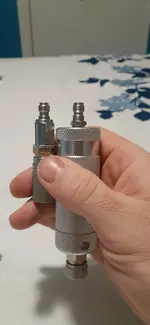


 . Idk. That suker pops loose at 3 grand and slaps you face you'll rethink on one to use next I guess


