Install the app
How to install the app on iOS

Follow along with the video below to see how to install our site as a web app on your home screen.

Note: This feature may not be available in some browsers.

Blackwolf Blackwolf and Sub-MOA Barrels Review

(as always, click on each photo to view larger)

I took a much closer look at the rear end of the chassis recently, and learned a few cool things about it.

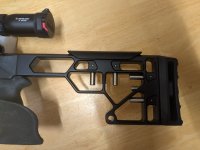
The adjustable cheek piece and butt-pad have this much range of motion. These are comparisons of max and min from both sides.
PXL_20251111_021746668.jpgPXL_20251111_021831473.jpgPXL_20251111_021937301.jpgPXL_20251111_022004538.jpg

Tool-less/push button adjust for the cheek rest and lop adjustments. Push buttons are located on the right side of the gun.

LOP goes from just under 14 inches, to just over 15 inches, based on where I have the trigger set in it's forward/rearward groove right now. So, about an inch worth of LOP adjustment there.

Cheek-rest max height goes way higher than I'll ever need it to be. I'm sure there will eventually be someone making high cap magazines for the BW, and I suppose for someone really wanting to capitalize on those mags (speed competitions perhaps?) being able to mount the scope sky-high and have the cheek piece up there in the clouds as well could be beneficial.

Both adjustable pieces can be completely removed and flipped and reinserted. For the cheek piece, it's symmetrical, near as I can tell, so flipping it doesn't get you much, righty or lefty. But, for the butt-pad, flipping it slightly changes the profile.

PXL_20251111_022156934.jpgPXL_20251111_022152575.jpg

While inspecting the butt-pad closely I realized that it has an available adjustment to drop the pad lower, via the allen bolt running through the back of it. And THIS is where flipping it has some benefit. It can be adjusted further up, or further down, depending on which way the rods are inserted into the holes, and based on personal preference.

The next photo shows the side profile of the little rubber nubs that contact the shoulder. These were aiding greatly in helping the gun to not drop out of the shoulder pocket from stool and sticks position.

PXL_20251111_022135273.jpg


The cheek-piece has a rubberized coating of some sort.

PXL_20251111_022103399.jpg


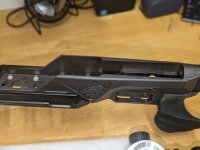
I also realized that there is an arca rail slot in the bottom of the rear end of the chassis.

PXL_20251111_022021547.jpg


So of course I added a pic rail. This photo also shows the butt-pad adjusted down, per my preference.

PXL_20251111_022711322.jpg

I've been shooting the BW without anything in that arca rail, and liking how the bottom section of the chassis is almost like a built-in bag rider. But now that I found the arca rail, Im going to run it with the little thing-a-ma-jig shown in the following photos. I filled it with lead a while back and occasionally tinker with it in various places on guns to see how it affects balance and group sizes. It will act as added bag rider height in the folded position, or a rear monopod when flipped down.

PXL_20251111_023047150.jpg

PXL_20251111_023109485.jpg

PXL_20251111_022950172.jpg


Generally, I really like the chassis stock. Well-thought out adjustments and design. Feels great when shooting from a bench, and allows my preferred finger groove grip.
 
I had to take another really close look to figure out what's aluminum and what's textured plastic.

  • The rubber coated cheepiece is plastic with the aforementioned rubber coating.
  • The buttpad where the rubberized nibs are is also plastic (this one was hard to tell).
  • The adjustable hardware on both the cheekpiece and buttstock are metal.
  • There are plastic bushings in the aluminum frame that center the steel rods on the adjustable portions.
  • The midsection of the stock is plastic. This next photo is the best representation of how to show what's plastic and what's not. Red is outlining the plastic portion.

1762922381758.png


The buttstock "tube" (ovalish shape really) that is secured to the plastic on the right of the image above is aluminum. That aluminum portion appears to extend below as well, so the grip is threaded into aluminum.

The bottleguard/underrail/arca is a big slab of aluminum, secured to the plastic with those 8 stainless bolts that can be seen in the inletting.

Here are a few more close-ups that might help.
PXL_20251112_012933380.PORTRAIT.jpgPXL_20251112_012941019.PORTRAIT.jpgPXL_20251112_013002763.PORTRAIT.jpg


From handling it for a couple weeks now, I don't see any issues in rigidity or durability. Seems to me that it would take an awful lot of force to break that plastic midsection....fall down a mountain, get runover with the UPS truck sort of trauma. From my close-up impressions of the thing, the sort of accident that could inflict damage on that plastic midsection is going to be the type to demolish the scope and bend the barrel, snap the neck of the bottle, break the barrel out of the aluminum action, etc. Catastrophic type accidents, not hard-use type activity.
 
For anyone considering buying one. I'm almost positive that the price on this configuration of the Blackwolf was just under 4k when I started the review a few weeks ago.

Someone pointed out on the other forum that they're on special right now for about $700 less than they were a few weeks ago.


Still not a cheap gun, but $700 is $700. That's a lot of ammo, or a nice scope or a new air bottle or, etc etc etc.
 
Recently realized this interesting fact...

All of the red outlined area is one single machined block.

1763273696052.png


Was already aware, but glanced around the gunroom and noted that this is the only one with this situation. I consider the Ghost, the USFT, and the Veterans some of the best airguns made, and all of them are a combination of parts bolted together to create the scope/barrel interface. Even the USFT...has a pic rail bolted to the barrel clamp/breech block.

There are some easily assumed conclusions (pros) from the above fact. I'll leave them up to you guys though.
 
I recently went to Chinatown with the pellet testing.

Tried some JTS 21.53 and 22.07 and some AEA 21.9grainers. The AEA were pretty ho-hum. But the JTS showed some promise...This was the first 10 @ 50 and the first 5 @ 100 yards...


PXL_20251114_190622252.jpg


This was one morning in the last few days prior to the wind picking up much. Shot a bunch more of both and nothing was quite as good as the groups shared above. And I think most of that is the wind. These pellets in the 20-22grain range (JSB Lights @ 20.83, AEA 21.9 and JTS 22.07 and 21.53) get absolutely eaten alive by the wind @ 100 yards. Might eventually do a BC test, but at this point I'm underwhelmed with all of them sufficiently to not even want to bother with a BC collection. They're acting like 0.044-0.046. Definitely below JSB Grands and MRDs as far as their wind resistance at 100 yards. And I've shot a couple hundred of each over the last few days. So that's not based on a small sample size. We're talking getting pushed 5+ inches when the MRDs and Grands are getting pushed 2-3" in comparable winds.

I do think their might be something to the harder lead of the JTS/AEA agreeing more with this combination of Blackwolf and SubMOA barrels. Maybe the overpowering of them isn't blowing the skirts out so bad like it probably is in the softer JSB? Maybe they're larger head size? Dunno, but I think those JTS 21.53s have the potential to be the best shooting pellet I've yet come across for the 1:22 barrel, but ONLY in really favorable conditions (no wind).

In conclusion: the 20-22grain .22 options are a fair-weather and non-competition pellet. There are far better options for wind resistance, in .22 and in .20.
 
I've been off work the last three days, and spent a couple hours each afternoon shooting the BW, mostly with the 1:22 barrel, but also a little with the 1:16 and some Altaros slugs.

And this is what I dealt with each afternoon....
1763275529076.png


So, less than favorable conditions.

The AEA 21.9s were averaging 100 yard EBR cards in the 185-195 range. There was some overlap with the JTS 21.53 and 22.07 and the JSB LIghts. Both weights of JTS were average 190-200, and the Lights were usually in the 195-210 range. The JSB Grands were in the 205-215 range. None of that is great, but...wind.

Here's an example of 25 shots of the JST 21.53 @ 100 yards. Same aim point, just letting the wind do its worst. I did this to see what the wind would do if I wasn't trying to outguess it.

PXL_20251116_064100461.jpg

And yes, some of those holes have lead smears favoring one side of the hole. Which I'm pretty sure was the gusts kicking their butts.

I shot 15 of the Altaros slugs at 100 yards. 1 five shot group with each of the 35.8, 40, and 32.3grain slugs. All three were MUCH better than I'm seeing with this pet project of making the .22 BW shoot pellets. The two groups with the lighter two slugs were 1.5" or so. And the 5 shot group with the 40 grain had 4/5 into half an inch, with the fifth shot hitting slightly lower to make the 5 shot group just under an MOA. This was with the 1:16 SubMOA barrel. So, if you want instant gratification with the Blackwolf and a SubMOA barrel, drop in the 1:16 barrel, and shoot Altaros slugs. Eventually I'll do a much more in-depth look at that twist rate barrel and the slugs. I'm wanting to figure out the pellet riddle first though.

Generally, I'm not seeing amazing accuracy from .22 pellets. And I think its b/c the BW is too much plenum for pellets in .22, as @Arzrover initially suspected. See next post. 🤓
 
Last edited:
Reducing the plenum...
As discussed here: Blackwolf - Blackwolf and Sub-MOA Barrels Review

massive plenum.
Great for 32+ grain .22 slugs, and .25 and .30 anything, maybe not so great for a guy who prefers .22 pellets less than 60fpe. And that's most all .22 pellets. (exception maybe the 34grain JSBs, but nobody seems to be able to get them to shoot worth a hoot).

So the theory originally suggested by @Arzrover was that we're simply overpowering the pellet, blasting it with too much air. That's potentially turbulence, and over-obturated skirts, and possibly even excess air screwing up the pellet by blowing it slightly askew as it leaves the barrel. Oh, and reduced efficiency and louder report, and less docile shot cycle characteristics. In other words, lots of no-goods, in the context of .22 pellets.

His idea was to stuff something in the plenum and compare the after effects to what it was doing prior.
Today I went through with that.

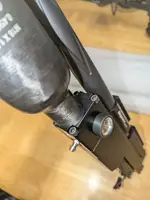
First, a bunch of photos of the block shared by the bottle, regulator, and manometers.

PXL_20251115_180909902.webpPXL_20251115_181502080.webpPXL_20251115_181515537.webpPXL_20251115_181511225.webpPXL_20251115_181535019.webpPXL_20251115_181519737.webp

They block is affixed to the gun via those four bolts. Following photos show the plenum cavity. (Just some grease where the sealing oring touches.)

PXL_20251115_181605271.webpPXL_20251115_181614676.webp

Figured out my diameter and length, and went on a hunt. Rummaged through the sprinkler system supplies out in the Conex and came up with a sprinkler riser. Described what I needed to my 12 year old and he suggested plastic bin of tinker-toy type building sets upstairs in the game closet.

Here's what's currently stuffed in there...
PXL_20251115_185025637.webp

By water displacement, that's about 8.5ccs. Starting with the published 52cc plenum size of the BW, that's good for about a 15% reduction, for a plenum in the 43.5cc area.

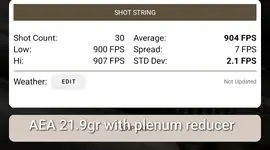
And here are 30 shots with AEAs and the reduced plenum ...
Screenshot_20251115-152237.webp

And another with the Lights...
Screenshot_20251116-002307.webp

Those are the first single digit extreme spreads I've seen from the gun, whether going with a high reg/low hammer spring or a low reg/heavy hammer spring configuration to get the speed I'm after. Prior to the plenum reduction there were a couple strings in the mid teens, but most were in the low 20s for extreme spreads.

As for losing power from the smaller plenum...
No effect with the 95bar/blue hammer spring @ min/JSB lights. Still producing the 930-940fps.
The plenum robbed some power with the 130 bar/blue hammer spring @ 6/JSB Grands for 930-940 combination. It needs a hammer spring tension of 12 (instead of 6) to get the same 930-940 from the Grands after the plenum addition. The pro here is that even with 130 bar, I can make the Grands go faster with more hammer tension. Which suggests to me that the 15% smaller plenum is still not my power limiting factor. And that's with the Grands, which are the heaviest .22 pellet that I'd have any interest in shooting.

Shot cycle feels less burpy with the low reg/heavy hammer configuration, and less excessive blast of air with the higher reg/more hammer tension/more power tunes.

So, I'm going to reduce the plenum another 7 or so CCs. That'll get me into about the same size plenum as a Ghost, 38 or so CCs.
Here are some photos of the newest plenum reduction jerry rig..
PXL_20251116_002007407.webpPXL_20251116_002014953.webpPXL_20251116_001456231~2.webpPXL_20251116_001751425~2.webp

Again, by water displacement, this is around 15ccs, which will take the 52cc plenum down to 37ish.

Now I just need some better conditions to shoot in for accuracy assessment.
 
Had just a few minutes after dinner this evening, and decided to shoot the BW as its designers intended, high power.

So of course swapped in the 1:16 barrel. Reg @ 130 bar. Blue hammer spring. 15% reduced plenum.

Only shot 17 shots, two on paper @ 30 yards, just to get close, the other fifteen shots @ 100 yards. Five of the 15 @ 100 were from the Altaros 35.8grain slugs. These are their ribbed ones, advertised as a BC of 0.15. Many consider this 35.8gr .22 Altaros NOT their best offering. The other ten were with some Corbin .219/33 grain hollow point slugs. These are also a boat tail.

The slightly heavier Altaros and the larger OD of the lighter slugs was basically a wash. "8" on the wheel for 880 with the Altaros, and "12" for 895 for the Corbin. This reg setting and spring could push the Altaros up to 915-920 @ max on the wheel, (first two zeroing shots @ 30 yards) , but it was loud and obviously wasting air.

The two orange stickers were just for aim points. Night shooting is blind shooting. I just hold dead center and see what happens. Can't see the wind flags unless I'm standing by them downrange. So no wind holds offs.

I didn't estimate enough vertical clicks of the turret, so first Altaros @ 100 hit low. I added in some clicks and shot four more. Those four are just slightly bigger than 1.25.

Next ten shots were with the 33 grain hp/bt Corbins. 9/10 are just a bit over MOA. Dunno if the wind got me on that one outlier, but in retrospect, I'm not entirely sure I didn't load at least it (and possibly others) backwards. Single-feeding in the dark is a lot easier with pellets, the skirt and head are more easily discerned by feel. Both ends of the Corbins feel similar.
PXL_20251118_053721083.webpPXL_20251118_053733877.webp

And here's what the Corbins look like...
PXL_20251118_010745385.webp


Can't complain about any of that. Blackwolf shoots just fine when asked to do what it was designed for.

(I fielded a phone call from the AOA/SubMOA rep during those 15, 100yard shots, and the call continued while I walked out to the back of my property to gather up the targets. I was given an update on some on-the-spot brainstorming/R&D with @arzover (he was visiting the shop today) and one of the in-house machinists. They whipped up some very promising prototypes for both reduction of the transfer port, as well as reducing the plenum size. As previously noted and discussed, these are optimization concepts for reduced power configurations of the Blackwolf, particularly pellets in .22, and sub20fpe tunes for field target. )
 
Had to laugh at myself about this one....the benches in the gunroom are just plain chaos these days. I normally keep them much better organized than this.
This review has resulted in pellets and slugs and barrels and cleaning supplies and notes and target examples, etc scattered everywhere.

PXL_20251120_053530860.webp

Haven't done much shooting in the last couple days. We had some windy and rainy weather move in that really dampered (and dampened) my efforts.

I did, however, take some time to dismantle the barrel assembly of the factory barrel/shroud. I took some photos of that and will share them here in the near future.
 
OEM barrel on the Blackwolf .22 HiLite

  • 28 inches (711mm) long.
  • 0.59" (15mm) diameter (standard Daystate/BRK diameter)
  • 14mm x1 threads on the muzzle end of barrel (standard for Daystate/BRK)
  • dual, bridged transfer port
  • tensioned
  • 1/2x20 threads on muzzle end of shroud
  • 5 groove polygonal rifling
  • was told that its is LWs standard rifling rate of 1:17.7, but have not verified that yet
There are some new and interesting concepts going on with this OEM barrel. The first of which is threads machined into carbon fiber. The first time I've seen that. The second is that we've got a tensioned carbon fiber barrel sleeve (in addition to an actual barrel with the aforementioned OD of 15mm) inside of the larger diameter carbon fiber shroud.

These photos are likely to illustrate all of that better.
PXL_20251120_055437389.jpg


And some close ups of the shroud centering piece...This is the piece with female 14x1 threads that mate with the male 14x1 threads of the barrel itself. The 6 slots around the circumference do technically allow some air to discharge back into the shroud.
PXL_20251120_053911023.jpg

PXL_20251120_053938412.jpg


Note the wrench flats on the aluminum piece above...and on this brass piece below...that's the tensioning. (rear shroud collar loosened and slid back in this photo)
PXL_20251120_054335029.jpg


And this is where the shroud collar would sit when ready to install in the gun...This photo also shows the threads machined into the carbon fiber shroud.
PXL_20251120_053753563.jpg


All of that allows a few options....
Of course, run it as intended.
Or, use a 14x1 to 1/2x20 adaptor to omit either the shroud, and/or the carbon fiber tensioning barrel sleeve.
Some mocked up photos of either of those options...
PXL_20251120_054711456.jpg

PXL_20251120_055652624.jpg


I did not attempt to unthread the brass transfer port piece from the steel barrel. I'm curious about the transition from the brass to the barrel, and will try to get some internal images if I can get a borrowed borescope to function.

I have not shot anything with this barrel yet. So no input on accuracy potential yet.

The Blackwolf becomes VERY long with a 28" barrel, plus even a short moderator. For my uses, that long of a gun is a dedicated target rifle, in this case, benchrest.
 
I think you would be remiss to not refer to the Ghost from time to time in the review of the Black Wolf. Since I own a Ghost everytime you mention a spec or feature my brain right away compares it to the Ghost lol.
Love where this review is going, definitely interested to see if you can get it down to 20fpe....might need a 17in barrel!?
Excited to see some big numbers too.
35 shots with the Grands makes more sense, thanks for looking into that lol👍, i suck at counting my shots when I shoot, but if I count afterwards its always above 50 on the paper.
I can attest that both the 17" and the 23" BW barrels in .177 can be made to go below <20 fpe by simply changing the FAC T.P. to the non FAC T.P. with white springs, regs at 125 jsb 13.4's are moving at 815 fps.
 
Some Blackwolf goodies arrived yesterday...

The prototypes for the plenum and transfer port reducers were delivered.

The .177 probe arrived as well.

I haven't installed the plenum or transfer port reducers yet, but did find some time last night to do a caliber swap, from .22 to .177. Very easy process, less than 5 minutes. Daystate America's video does a better job than I can of explaining the steps...
To view this content we will need your consent to set third party cookies.
For more detailed information, see our cookies page.


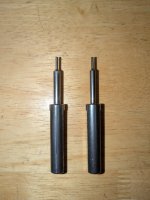
I thought it interesting (and convenient) that the probe comes out the front of the breech, instead of the rear.

.22 on the left, and .177 on the right. Both obviously pin style probes...
PXL_20251122_024449129.jpg


For now I'm running the .177 configuration like this...
1763827558108.webp


MUCH lighter. Total length under 42 inches as above. So more manageable in OAL as well.

I didn't do any shooting for accuracy yet, but did run some over the chronograph in the garage. I was mostly curious for some sort of baseline. As a reminder, this .177 barrel has a 19fpe appropriate transfer port, so I was curious to see what consistency would look like using the same settings it was on before....the blue hammer spring, and a reg pressure of 130 bar. And my homebrew 15% reduction in plenum. Way too much spring and probably too much reg pressure for 19fpe, again, just wanted a baseline comparison. This particular .177 barrel is 19.5inches long.

JSB .177/10.34 first...
10 shots, all with hammer spring tension wheel at MIN
  • Hi of 991.5
  • Lo of 981.2
  • Ave of 987.5 - about 22.5fpe
  • SD of 2.1
  • ES of 10.3

NSA 15.5grain next... (at least I THINK these are early NSAs, random little baggy I've had floating around for a long time). Didn't run very many at any one setting, just a couple at MIN and a couple at MAX
MIN = 820fps
MAX = 865-870fps = just under 26fpe

NSA 12.6 Howlers last...
MIN = 905-910 = about 23fpe
max = 920-925 = about 24fpe


I'm liking to see that ES with the ten of the JSB 10.34s. With the over-sprung and over-reg'd nature of that configuration (for 10.34s)...for it to still be tight suggests that we're on the right track with the idea of reducing the transfer port size when shooting .22 pellets. If that trend carries over to the .22 pellet barrels, we should see a much tighter ES, and less wasted air and less overpowering the projectile, and, most importantly, greater accuracy (theoretically).

As for those 20ish shots over the chrono in the garage last night? Shot cycle is CRISP!!! Nice and snappy sound to the report. MUCH improved shot cycle compared to trying to run .22 pellets with too much air flow.

Upcoming testing will be with the .177. A couple of airgun buddies are having a bunch of fun with .177 slugs lately, and experiencing some impressive accuracy, so I'll start there. After that .177 slug testing, I'll circle back around to a sub20fpe tune with pellets, focusing on the 10.34s probably. I might even try to shoot this at a local field target match before sending the barrel on to its eventual owner, @cavedweller. Once that's done, I'll return to the .22 barrels.
 
Last edited:
What you say is true but a lot of guys as ive read on agn are like you and having trouble finding a tune for 18-25 gr that works well and as you have mentioned the plenum might be the difference that and the size of the ports. I know i can get the ghost to very close to 100 fpe in 30 and to 72 fpe in 22 with 700 mm barrel and 40 gr slugs but isn’t the ghost plenum only half the size of the blackwolf or there about? I don’t really know how big it is. Do you think you could have something printed to insert in the plenum to help with lighter rounds?
Daystate has a FAC and non FAC T.P. For the barrels. AOA used the non FAC TP to slow the 17” and 23” (.177) barrels down to <20 fpe. White spring, regulator at 125.. jsb13.4’s moving at 812-820.
IMG_0577.webpIMG_0575.webp
 
Some Blackwolf goodies arrived yesterday...

The prototypes for the plenum and transfer port reducers were delivered.

The .177 probe arrived as well.

I haven't installed the plenum or transfer port reducers yet, but did find some time last night to do a caliber swap, from .22 to .177. Very easy process, less than 5 minutes. Daystate America's video does a better job than I can of explaining the steps...
To view this content we will need your consent to set third party cookies.
For more detailed information, see our cookies page.


I thought it interesting (and convenient) that the probe comes out the front of the breech, instead of the rear.

.22 on the left, and .177 on the right. Both obviously pin style probes...
PXL_20251122_024449129.jpg


For now I'm running the .177 configuration like this...
View attachment 17530


MUCH lighter. Total length under 42 inches as above. So more manageable in OAL as well.

I didn't do any shooting for accuracy yet, but did run some over the chronograph in the garage. I was mostly curious for some sort of baseline. As a reminder, this .177 barrel has a 19fpe appropriate transfer port, so I was curious to see what consistency would look like using the same settings it was on before....the blue hammer spring, and a reg pressure of 130 bar. And my homebrew 15% reduction in plenum. Way too much spring and probably too much reg pressure for 19fpe, again, just wanted a baseline comparison. This particular .177 barrel is 19.5inches long.

JSB .177/10.34 first...
10 shots, all with hammer spring tension wheel at MIN
  • Hi of 991.5
  • Lo of 981.2
  • Ave of 987.5 - about 22.5fpe
  • SD of 2.1
  • ES of 10.3

NSA 15.5grain next... (at least I THINK these are early NSAs, random little baggy I've had floating around for a long time). Didn't run very many at any one setting, just a couple at MIN and a couple at MAX
MIN = 820fps
MAX = 865-870fps = just under 26fpe

NSA 12.6 Howlers last...
MIN = 905-910 = about 23fpe
max = 920-925 = about 24fpe


I'm liking to see that ES with the ten of the JSB 10.34s. With the over-sprung and over-reg'd nature of that configuration (for 10.34s)...for it to still be tight suggests that we're on the right track with the idea of reducing the transfer port size when shooting .22 pellets. If that trend carries over to the .22 pellet barrels, we should see a much tighter ES, and less wasted air and less overpowering the projectile, and, most importantly, greater accuracy (theoretically).

As for those 20ish shots over the chrono in the garage last night? Shot cycle is CRISP!!! Nice and snappy sound to the report. MUCH improved shot cycle compared to trying to run .22 pellets with too much air flow.

Upcoming testing will be with the .177. A couple of airgun buddies are having a bunch of fun with .177 slugs lately, and experiencing some impressive accuracy, so I'll start there. After that .177 slug testing, I'll circle back around to a sub20fpe tune with pellets, focusing on the 10.34s probably. I might even try to shoot this at a local field target match before sending the barrel on to its eventual owner, @cavedweller. Once that's done, I'll return to the .22 barrels.
💪🤩💪
 
(as always, click on each photo to view larger)

I took a much closer look at the rear end of the chassis recently, and learned a few cool things about it.

The adjustable cheek piece and butt-pad have this much range of motion. These are comparisons of max and min from both sides.

PXL_20251111_021746668.jpgPXL_20251111_021831473.jpgPXL_20251111_021937301.jpgPXL_20251111_022004538.jpg

Tool-less/push button adjust for the cheek rest and lop adjustments. Push buttons are located on the right side of the gun.

LOP goes from just under 14 inches, to just over 15 inches, based on where I have the trigger set in it's forward/rearward groove right now. So, about an inch worth of LOP adjustment there.

Cheek-rest max height goes way higher than I'll ever need it to be. I'm sure there will eventually be someone making high cap magazines for the BW, and I suppose for someone really wanting to capitalize on those mags (speed competitions perhaps?) being able to mount the scope sky-high and have the cheek piece up there in the clouds as well could be beneficial.

Both adjustable pieces can be completely removed and flipped and reinserted. For the cheek piece, it's symmetrical, near as I can tell, so flipping it doesn't get you much, righty or lefty. But, for the butt-pad, flipping it slightly changes the profile.

PXL_20251111_022156934.jpgPXL_20251111_022152575.jpg

While inspecting the butt-pad closely I realized that it has an available adjustment to drop the pad lower, via the allen bolt running through the back of it. And THIS is where flipping it has some benefit. It can be adjusted further up, or further down, depending on which way the rods are inserted into the holes, and based on personal preference.

The next photo shows the side profile of the little rubber nubs that contact the shoulder. These were aiding greatly in helping the gun to not drop out of the shoulder pocket from stool and sticks position.

PXL_20251111_022135273.jpg


The cheek-piece has a rubberized coating of some sort.

PXL_20251111_022103399.jpg


I also realized that there is an arca rail slot in the bottom of the rear end of the chassis.

PXL_20251111_022021547.jpg


So of course I added a pic rail. This photo also shows the butt-pad adjusted down, per my preference.

PXL_20251111_022711322.jpg

I've been shooting the BW without anything in that arca rail, and liking how the bottom section of the chassis is almost like a built-in bag rider. But now that I found the arca rail, Im going to run it with the little thing-a-ma-jig shown in the following photos. I filled it with lead a while back and occasionally tinker with it in various places on guns to see how it affects balance and group sizes. It will act as added bag rider height in the folded position, or a rear monopod when flipped down.

PXL_20251111_023047150.jpg

PXL_20251111_023109485.jpg

PXL_20251111_022950172.jpg


Generally, I really like the chassis stock. Well-thought out adjustments and design. Feels great when shooting from a bench, and allows my preferred finger groove grip.
Have you noticed any muzzle flip?
 
Have you noticed any muzzle flip?
All but those 20ish shots last night have been with the SubMOA barrels. And those barrels are STOUT (heavy). My assumption is that there's just so much overall weight that muzzle flip hasnt been a noticeable occurrence.

I'll add that I haven't been shooting it with the bipod feet raised high like in those images you quoted. I lower them down and I pulled that little rear monopod thing off too. That gets the gun closer to the bench. Overall a very bench-friendly gun.
 

Create an account or login to comment

You must be a member in order to leave a comment

Create FREE account

Create a FREE account on our community. It's easy!

Log in

Already have an account? Log in here.

Trending in this forum

Back
Top