Install the app
How to install the app on iOS

Follow along with the video below to see how to install our site as a web app on your home screen.

Note: This feature may not be available in some browsers.

Maximum point blank range?

Moose

HAM Specialist
89
208
Central Wisconsin
HAM Points
922.25
Country flag
My understanding of MPBR is that it is the amount of allowed variation of accuracy for the tuned accuracy in the +/- Y axis. Is this correct? Is this a parameter that is established by the user? Are the +/- variables tuned to your specs? Does this also include the X axis? More questions to follow!
 
It is a bad idea for airguns. Sorry, there, I said it. Range your target, get exactly where you should aim figured out, shoot your target. MPBR for a chipmunk is so small, and the the trajectory of some pellets is so loopy, that it doesn't make sense to bother with. MPBR is set by your personal opinion for how much you are willing to be off in a particular zone for a quick shot. That is the bad option for me, never strive for speed over accuracy. Plan your kill shots better, don't have time for that, don't shoot.
 
We need a confused icon in this selection of Emojis🤣... Moose would you be willing to explain in some more detail?
This explanation was copied from the "Shooters Calculator.com" website.
Here is an example: Let's say you are deer hunting. The vital zone of deer is roughly 8 inches. Using the calculator it tells you that you should zero your rifle at 250 yards and that the MPBR is 300 yards. That means that if you aim at the center of the vital zone of a deer at any range between 0 and 300 yards, you will hit the vital zone. This means that you do not need to worry about any bullet drop or holding over if the animal is within the MPBR.

One description of the MPBR concept that has been used a lot over the years is to visualize shooting with your barrel centered inside an imaginary pipe. The size of the target determines the size of the pipe. The maximum point blank range is the furthest distance at which a bullet fired from a rifle will stay inside the pipe without hitting the top or the bottom.

If you'd said that at first I'd not developed a bloody bald spot on my head from scratching it figuring out the first posting .. 😜. Oh well it's just peroxide and bandages now ..lol
 
It is a bad idea for airguns. Sorry, there, I said it. Range your target, get exactly where you should aim figured out, shoot your target. MPBR for a chipmunk is so small, and the the trajectory of some pellets is so loopy, that it doesn't make sense to bother with. MPBR is set by your personal opinion for how much you are willing to be off in a particular zone for a quick shot. That is the bad option for me, never strive for speed over accuracy. Plan your kill shots better, don't have time for that, don't shoot.
Thank you Pumacarl. You did an outstanding job of laying out the reasoning why the MPBR theory should not be used for this application. And I would have agreed with you before about 8 years ago. Around that time, I developed a sight that can hold close tolerance precision targeting at close range. Imagine using a 17HMR (PB) holding +/- 1/2" MPBR from 0 Yards-100 Yards using no hold over or hold under at any point. I have used this system very effectively teaching kids to shoot ant size targets from 2 to 15 yards with .177 CO2 Diana pellet pistols. They have about an 80% success rate after 5 shots. The shooting community is not very open about new ideas and have a lot of doubts. Manufacturers are not very open to new ideas. I have been to 2 Shot Shows and 4 NRA national shows. Thanks for listening and I hope to keep learning from everyone on this Blog! We may need more Emojis!
 
Yeah Moose, I get what it is, I use to use it, and I think it was and is, a bad idea. You should always strive to shoot exactly where you aim, everything else will chip away at precision: shake, wind, target movement, heart rate, breathing, ammo, trigger pull, everything, why throw away more precision to a whole kill zone by just assuming you would be inside of it if you got "everything else" perfect? That is a HUGE assumption, bigger than any kill zone, and you know what they say about assuming...
 
Thank you Pumacarl. You did an outstanding job of laying out the reasoning why the MPBR theory should not be used for this application. And I would have agreed with you before about 8 years ago. Around that time, I developed a sight that can hold close tolerance precision targeting at close range. Imagine using a 17HMR (PB) holding +/- 1/2" MPBR from 0 Yards-100 Yards using no hold over or hold under at any point. I have used this system very effectively teaching kids to shoot ant size targets from 2 to 15 yards with .177 CO2 Diana pellet pistols. They have about an 80% success rate after 5 shots. The shooting community is not very open about new ideas and have a lot of doubts. Manufacturers are not very open to new ideas. I have been to 2 Shot Shows and 4 NRA national shows. Thanks for listening and I hope to keep learning from everyone on this Blog! We may need more Emojis!
Moose, I understand what you are doing, and why, especially with kids as it is hard to keep their attention unless they are having fun/success, but, my point is why settle for 80%? In turn, I would have agreed with you 8 years ago, before I got a modern pcp, when I was actually shooting a 17HMR, but not now shooting an airgun. Inside an airgun's effective range they don't have the flat trajectory of the powderburners but have the consistency along their flight path to basically shoot hole in hole in perfect conditions or with perfect calculation. So let's say we are shooting for an ear hole, or an "X" why would I want be 'about' right, when I can be 'exactly' right? So many things can throw off the comparitively slow, arching trajectory pellet, that you should be aiming for a 100% hit rate and take what you actually get. Between good accurate airguns, laser range finders, Strelok ballistic apps, Kestral's, etc., there is no reason for any compromise, which is what MPBR is, and that is what many shooters are not open too, zero compromise. Then they blame their gun when they miss. Let kids have their fun, but there is no excuse for an adult missing anymore other than they didn't care to take, or have the time to make, a good shot. jmo
 
The bottom of the center point of my reticle is at 1 MOA, with a 25 yard zero I pretty much hold dead on for my kills from 25 to 50 yards. So in essence a MPBR of 50 yards, beyond that appreciable hold overs are necessary.
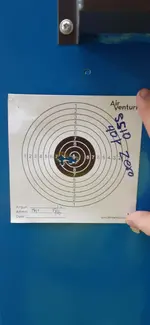
I was thinking same thing for my S510 also (the only gun of my 4 that I have perfectly mapped out to 60Y) She's my hunter....@ 20 to 40Y scope cross hair = dead. @ 45 it's starting to drop and 50 is almost an inch down. My kill zones are 2 inches at most so I would agree with Pumacarl in that the target is so small, for this to be of much/any value? I want near perfection....(Perfection being mostly unobtainable which is why it's so addictive😆) Here's my S-510 zero check, shot this last night, breeze right to left, hence the shots walking over. She is deadly. The black circle is 1 and 7/8 and I guess most kill zones being an 8, 9, or 10 ring hit. So we have 1 probably wounded bird and 9 dead. I could see this formula/theory being more useful for HMRs or centerfires though for sure!

 

Attachments

  • 20240702_191210.webp
    20240702_191210.webp
    91.5 KB · Views: 3
I was thinking same thing for my S510 also (the only gun of my 4 that I have perfectly mapped out to 60Y) She's my hunter....@ 20 to 40Y scope cross hair = dead. @ 45 it's starting to drop and 50 is almost an inch down. My kill zones are 2 inches at most so I would agree with Pumacarl in that the target is so small, for this to be of much/any value? I want near perfection....(Perfection being mostly unobtainable which is why it's so addictive😆) Here's my S-510 zero check, shot this last night, breeze right to left, hence the shots walking over. She is deadly. The black circle is 1 and 7/8 and I guess most kill zones being an 8, 9, or 10 ring hit. So we have 1 probably wounded bird and 9 dead. I could see this formula/theory being more useful for HMRs or centerfires though for sure!
My MPBR is tested almost daily on targets no bigger than a chipmunks head at ranges from 25 to 50 yards. No guessing involved at all… Holdover’s for shots past 50 yards. My gun, scope and I are in tune together. I took out two pest birds with my Ghost Carbine at 60 yards, DRT kills yesterday evening…🙏
 
Last edited:
All the good shooters on this blog have years of experience. Most have high end equipment. Many use the MPBR method very effectively with the conventional theory sights available to them. The posts seem to show that 20–25-yard range is their first or near zero. Hold over would be required to make precision shots at less than these yardages. The system that I have developed does not use hold-over or under at any distance out to second or far zero. The system is adjustable for hold over according to you level of precision you need. New shooters starting out prefer to shoot at distances that are close range (3-15Yards). Effective air gun range for ultra-low cost units would seldom exceed 30 yards. As an example, Hameditor has reviewed a number of good entry level units at these closer ranges. My system makes it easier for new shooters to become more proficient and accurate in a shorter period of time and at a lower cost. This system is designed for people that do not know anything about shooting. It is hard to find a blog where the members don't know anything. I would be happy to explain more to those that are interested. Everybody have a good day, whether you want to or not. ;)
 
Thing is most air guns got a loping trajectory arc. Fps and energy loss is quick .. anyway on irons I shoot a wid gambit on one hold bullseye size at a range using 6 o'clock hold you can stay in a mpbr +/- I guess . I guess it all can have a mpbr it just what's the margin in your guns trajectory arc. 10m to 50 y ? Just 25 - 40 yard ? Changing pellets or weights adds on or takes off .. ?

Honestly I don't see a formula it's just practicing and experience with that gun and it's best pellet.
 
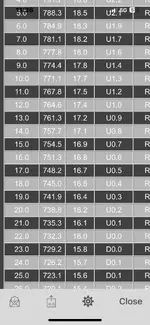
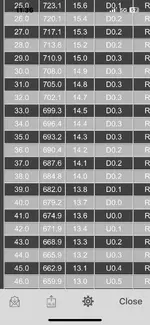
All you have to do is reference a ballistics calculator like strelok or chair gun. Here’s an example of my ft gun. It shows distance in first column velocity column 2 energy column 3 and inch drop from center cross hair column 4.
IMG_4467.webpIMG_4468.webp
 
All you have to do is reference a ballistics calculator like strelok or chair gun. Here’s an example of my ft gun. It shows distance in first column velocity column 2 energy column 3 and inch drop from center cross hair column 4.
View attachment 7012View attachment 7013
Thanks for the screen shot. My comments are not meant to offend anyone. Is this strelok or chairgun? I have not used either one. The first column is the distance from the barrel end to the target. Is there any distance shorter than 4 feet? The fourth column is the holdover of 2.2" at 4 feet. At 22-23 yards is first or near zero. The hold off indicator changes from U to D. What do these designate? The designation of D3 does not change from 29-35 yards. The second or far zero is at 40-41 yards and the D-U designation changes again. Us Graybeards would be able to work with this data. But, you have given me an excellent example how difficult this task is to explain to a new shooter or kid under 12 years old. Plus, the shooter would need a phone for the app, stay within cell range and a laser range finder. As a kid we just went out in the woods. Please find the humor in how complicated we have made for new shooters.
 

Create an account or login to comment

You must be a member in order to leave a comment

Create FREE account

Create a FREE account on our community. It's easy!

Log in

Already have an account? Log in here.

Trending in this forum

Back
Top