

Miles_M
HAM Specialist

I am going to try to explain how gyroscopic stability works. It is a relatively simple phenomenon, easy to demonstrate in a 3D environment, but not easy to show on a 2D screen. Some people misunderstand what gyroscopic stability does to their pellets. Gyroscopic stability does not keep a pellet or any other spin stabilized projectile pointing in the same direction as the barrel. Gyroscopic stability turns a projectile to face directly into the airflow. In this way, a projectile can follow the curve of a trajectory.
If there is gross gyroscopic over stability, then the projectile has problems in being able to turn to follow the trajectory and will try to keep pointing in the direction of the barrel. However, the levels of gyroscopic over stability required to reach this state are unlikely to be attained by pellets or any other airgun fired projectile unless it is fired straight up into the air or from the top of Mount Everest. Some pellets fired at long range and high speed can suffer from a low degree of gyroscopic over stability which slows down how quickly the pellet can turn to face the airflow direction causing flight problems
In order to try to explain how spin stabilization works, I want you to imagine a pellet which is not pointing directly into the airflow, it is at an angle of yaw (fig 1). The angle is shown as being vertically up, but it could be in any direction.
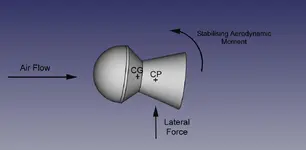
Figure 1
The object of any type of stabilization is to try to reduce the angle of yaw. Spin stabilization achieves this through a feedback system. For a pellet at yaw a lateral force is created by the airflow around the body usually centred at a point behind the centre of gravity (CG) called the centre of pressure (CP). The lateral force produces an aerodynamic moment about the CG. It is the aerodynamic moment which is important.
It is a popular misconception that stability is dependent on forces. It is not. Stability is all about moments about the CG, not forces. Yes, forces are required but only in that they are one component of the moment, the other being the distance between the CP and the CG. If you had an infinite force acting through the CG, it would make no contribution to stability, as the moment about the CG would be zero. Similarly, gyroscopes react to moments, not forces when they change their attitude.
When a spinning projectile is subjected to an aerodynamic moment as in figure 1 the gyroscopic reaction is to cause the projectile to yaw about the CG, not in the same direction as the applied moment as you would expect, but in a direction at ninety degrees as shown in figure 2.
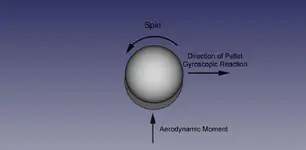
Figure 2
In figure 2 you are looking directly at the front of the pellet coming towards you with right hand spin. As a result of the movement of the pellet about the CG, we now have the original vertical yaw angle from figure 1 and a second yaw angle caused by the gyroscopic reaction at ninety degrees to the original angle as seen in figure 3.
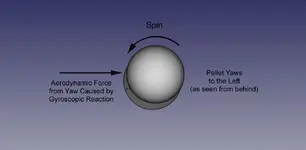
Figure 3
The pellet now has a sideways yaw angle as well as the original vertical one. As a result of the new yaw angle to the side, the pellet will have a new aerodynamic side force, causing a side aerodynamic moment about the pellet CG. This new aerodynamic moment will produce a gyroscopic reaction in a vertical direction, as can be seen in figure 4.
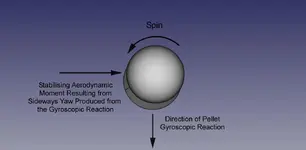
Figure 4
As can be seen in figure 4 the gyroscopic reaction to the new sideways aerodynamic moment is to reduce the original vertical yaw angle. The reduction in the vertical angle will in turn reduce the sideways yaw angle as the aerodynamic moment is getting less, reducing the gyroscopic reaction. Thus, both yaw angles are reducing (figure 5) and the pellet is getting closer to pointing directly into the airflow as a stable pellet should.
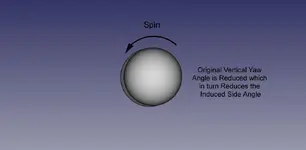
Figure 5
All the figures have shown how a spinning pellet reacts. Pellets are usually aerodynamically stable, i.e. the CP lies behind the CG. Slugs and bullets are generally aerodynamically unstable and have a CP in front of the CG. This causes differences, but the fundamental mechanism remains the same. For example, if we are looking at our pellet from the back as it flies away from us, an upwards vertical yaw will cause the pellet to yaw to the left as a result of the gyroscopic reaction. A slug or bullet will yaw to the right, not the left, as a result of being aerodynamically unstable.
If there is gross gyroscopic over stability, then the projectile has problems in being able to turn to follow the trajectory and will try to keep pointing in the direction of the barrel. However, the levels of gyroscopic over stability required to reach this state are unlikely to be attained by pellets or any other airgun fired projectile unless it is fired straight up into the air or from the top of Mount Everest. Some pellets fired at long range and high speed can suffer from a low degree of gyroscopic over stability which slows down how quickly the pellet can turn to face the airflow direction causing flight problems
In order to try to explain how spin stabilization works, I want you to imagine a pellet which is not pointing directly into the airflow, it is at an angle of yaw (fig 1). The angle is shown as being vertically up, but it could be in any direction.
Figure 1
The object of any type of stabilization is to try to reduce the angle of yaw. Spin stabilization achieves this through a feedback system. For a pellet at yaw a lateral force is created by the airflow around the body usually centred at a point behind the centre of gravity (CG) called the centre of pressure (CP). The lateral force produces an aerodynamic moment about the CG. It is the aerodynamic moment which is important.
It is a popular misconception that stability is dependent on forces. It is not. Stability is all about moments about the CG, not forces. Yes, forces are required but only in that they are one component of the moment, the other being the distance between the CP and the CG. If you had an infinite force acting through the CG, it would make no contribution to stability, as the moment about the CG would be zero. Similarly, gyroscopes react to moments, not forces when they change their attitude.
When a spinning projectile is subjected to an aerodynamic moment as in figure 1 the gyroscopic reaction is to cause the projectile to yaw about the CG, not in the same direction as the applied moment as you would expect, but in a direction at ninety degrees as shown in figure 2.
Figure 2
In figure 2 you are looking directly at the front of the pellet coming towards you with right hand spin. As a result of the movement of the pellet about the CG, we now have the original vertical yaw angle from figure 1 and a second yaw angle caused by the gyroscopic reaction at ninety degrees to the original angle as seen in figure 3.
Figure 3
The pellet now has a sideways yaw angle as well as the original vertical one. As a result of the new yaw angle to the side, the pellet will have a new aerodynamic side force, causing a side aerodynamic moment about the pellet CG. This new aerodynamic moment will produce a gyroscopic reaction in a vertical direction, as can be seen in figure 4.
Figure 4
As can be seen in figure 4 the gyroscopic reaction to the new sideways aerodynamic moment is to reduce the original vertical yaw angle. The reduction in the vertical angle will in turn reduce the sideways yaw angle as the aerodynamic moment is getting less, reducing the gyroscopic reaction. Thus, both yaw angles are reducing (figure 5) and the pellet is getting closer to pointing directly into the airflow as a stable pellet should.
Figure 5
All the figures have shown how a spinning pellet reacts. Pellets are usually aerodynamically stable, i.e. the CP lies behind the CG. Slugs and bullets are generally aerodynamically unstable and have a CP in front of the CG. This causes differences, but the fundamental mechanism remains the same. For example, if we are looking at our pellet from the back as it flies away from us, an upwards vertical yaw will cause the pellet to yaw to the left as a result of the gyroscopic reaction. A slug or bullet will yaw to the right, not the left, as a result of being aerodynamically unstable.