


Miles_M
HAM Specialist

Following a recent question and discussion on spin drift for slugs, I was asked if I could post this old thread from a UK forum. I wrote it for sub 12FPE guns using pellets, so the speeds are low and slugs are not considered. The general effects are the same at high speeds and for slugs. The only difference is that slugs drift to the right from a right-hand twist barrel, whereas pellets drift to the left. I hope to be able to expand the post to include slugs and to increase the speeds and ranges for pellets in the not too distant future.
In this thread, I will try to explain what spin drift is and where it comes from. The first thing to say is that it has nothing to do with Coriolis effects, which you sometimes see claimed. Spin drift is simply a property of any high spin rate projectile caused by the gyroscopic reaction of the projectile falling towards the earth. To explain spin drift, we need to look at how gyroscopic stability works, which is not easy to explain in simple terms.
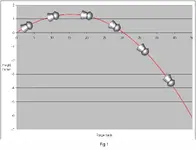
Take a look at figure 1 which is a view from the side of a typical .22 pellet trajectory out to 50 yards with a zero at around 30 yards (it is not exactly 30 yards as I couldn’t be bothered to fiddle around with the program to make it exactly 30 yards just for a picture).
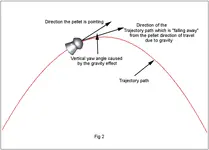
As soon as the pellet leaves the barrel it starts to be pulled towards the ground by gravity, causing the trajectory to curve down. This means that the air is not approaching the pellet head on, it is coming from slightly below due to the trajectory curving away from the pellet. Figure 2 tries to show what is happening. The curvature of the trajectory is producing a small vertical angle, known as yaw, between the pellet and the airflow.
The gyroscopic reaction to the aerodynamic moment caused by the air not approaching the pellet head on will cause the pellet to yaw slightly to the left or right, giving us what is called the yaw of repose. Of course, if the pellet is yawed sideways then the air is approaching slightly from one side and the gyroscopic reaction to that is to make the pellet yaw downwards, thus reducing the initial vertical yaw. This is the basis for gyroscopic stability and the way it reduces any initial yaw. Since the trajectory is always falling away from the pellet producing a vertical yaw in the same direction, the resultant side yaw angle will also always be in the same direction.
As there is now a sideways yaw angle between the pellet and the airflow which is always pointing in the same direction, a side force will be produced which will accelerate the pellet sideways for the length of its trajectory. It is this side force which produces the spin drift on any spinning projectile. It does not have anything to do with Magnus, despite what you may have read elsewhere.
You may have noticed that I have been somewhat unclear on the exact direction of the spin drift force. This is because it can be either to the left or the right, depending on a couple of things, namely the aerodynamic stability of the projectile and the direction of the spin. For an aerodynamically unstable projectile (most bullets, shells etc.) a right hand spin will cause the projectile to drift to the right. For an aerodynamically stable projectile (most conventional pellets) a right hand spin will cause the projectile to drift to the left. The size of the horizontal yaw angle and thus the amount of drift will depend on many things, including twist rates and the mechanical and aerodynamic properties of the pellet. One of the main aerodynamic parameters affecting the amount size of the yaw angle is an aerodynamic coefficient called C M alpha, normally shortened to Cma. If Cma is positive, we have an aerodynamically unstable projectile, whereas if Cma is negative, we have an aerodynamically stable projectile. Figure 3 shows the effect on the drift of varying the value of Cma for a typical pellet shape. The horizontal scale is the spin drift in inches, and the vertical scale is the range in yards. The vertical axis is the barrel line of fire. The diagram is for a .177 pellet fired at around 12 FPE.

The numbers identifying the separate curves represent the values of Cma. You can see how changing from a negative to a positive value of Cma changes the direction of the spin drift.
Twist rate will also have a direct effect on the size of the spin drift. For aerodynamically stable pellets, a low twist rate could be used just to reduce pellet dispersion, reducing the spin drift. For aerodynamically unstable pellets there will be a minimum twist rate needed to provide gyroscopic stability which will be higher than that just needed to improve dispersion on the aerodynamically stable pellets. The aerodynamically unstable pellets (slugs) will thus tend to have a minimum spin drift, whereas a pellet with aerodynamic stability and no spin will have no spin drift.
But what does it mean to you, the shooter? It means that as you look through your sights the pellet will only truly be in the position you are viewing at one point which is your zero range. Figures 4 and 5 will hopefully help to explain.
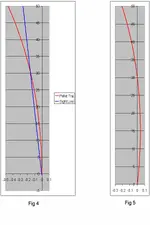
Again, the horizontal numbers are the drift in inches and the vertical numbers are the range in yards. This time the values are for a .22 pellet but, do not take them as being exact as the value of Cma will change depending on what design of pellet you are using.
In figure 4 the red line represents the pellet trajectory relative to the barrel and the line along which the barrel is pointing (vertical axis). The blue line represents the sight line, which is not looking straight down the barrel as the pellet follows a curved trajectory and your sight is angled off to intersect the pellet at the zero range. The zero range is approximately 30 yards again. You can see how the pellet is offset from your sight line at all other ranges. Figure 5 shows how much the pellet is offset depending on the range. In this figure, the vertical axis is your sight line.
The first thing that strikes you is that the offset values in figure 5 are relatively small. Even at 50 yards, you are only looking at an error less than the pellet diameter. When this is combined with all the other errors such as wind speed etc. then it is a small part of the total error.
If you take a more severe case and half the value for Cma then the error at 50 yards is approximately doubled, but, it is still less than the error given by a 1mph cross wind on the same pellet at the same range.
So should you worry about it? No, the effects are relatively small and will go unnoticed in most cases. Where you may see an effect is in extreme range shooting, but, as you presumably won’t be using a 30 yard zero for such shooting, the effect will be reduced as far as you the shooter is concerned since you will be automatically compensating with the longer zero range. You will mainly notice the effect when the target range is much longer than the zero range. You may see a change in the POI when you change from one pellet make to another, but again, it should be small unless you change from a stable to an unstable pellet design.
The other time you may notice something is when the wind drift on your pellet appears to be worse if the wind comes from say right to left than it is if the wind comes the left to right. This is due to the difference between the sight line and the pellet drift, shown above. Suppose the pellet is in a 1mph cross wind. The pellet trajectory will move by about half an inch at 50 yards left or right, depending on the wind direction. So, if the wind is from right to left the POI will be around 0.7 inches from the sight line, but if the wind is from left to right the POI will only be 0.3 inches away from your sight line causing you to think the wind has less effect on the pellet trajectory. It doesn’t, it just appears to.
In this thread, I will try to explain what spin drift is and where it comes from. The first thing to say is that it has nothing to do with Coriolis effects, which you sometimes see claimed. Spin drift is simply a property of any high spin rate projectile caused by the gyroscopic reaction of the projectile falling towards the earth. To explain spin drift, we need to look at how gyroscopic stability works, which is not easy to explain in simple terms.
Take a look at figure 1 which is a view from the side of a typical .22 pellet trajectory out to 50 yards with a zero at around 30 yards (it is not exactly 30 yards as I couldn’t be bothered to fiddle around with the program to make it exactly 30 yards just for a picture).
As soon as the pellet leaves the barrel it starts to be pulled towards the ground by gravity, causing the trajectory to curve down. This means that the air is not approaching the pellet head on, it is coming from slightly below due to the trajectory curving away from the pellet. Figure 2 tries to show what is happening. The curvature of the trajectory is producing a small vertical angle, known as yaw, between the pellet and the airflow.
The gyroscopic reaction to the aerodynamic moment caused by the air not approaching the pellet head on will cause the pellet to yaw slightly to the left or right, giving us what is called the yaw of repose. Of course, if the pellet is yawed sideways then the air is approaching slightly from one side and the gyroscopic reaction to that is to make the pellet yaw downwards, thus reducing the initial vertical yaw. This is the basis for gyroscopic stability and the way it reduces any initial yaw. Since the trajectory is always falling away from the pellet producing a vertical yaw in the same direction, the resultant side yaw angle will also always be in the same direction.
As there is now a sideways yaw angle between the pellet and the airflow which is always pointing in the same direction, a side force will be produced which will accelerate the pellet sideways for the length of its trajectory. It is this side force which produces the spin drift on any spinning projectile. It does not have anything to do with Magnus, despite what you may have read elsewhere.
You may have noticed that I have been somewhat unclear on the exact direction of the spin drift force. This is because it can be either to the left or the right, depending on a couple of things, namely the aerodynamic stability of the projectile and the direction of the spin. For an aerodynamically unstable projectile (most bullets, shells etc.) a right hand spin will cause the projectile to drift to the right. For an aerodynamically stable projectile (most conventional pellets) a right hand spin will cause the projectile to drift to the left. The size of the horizontal yaw angle and thus the amount of drift will depend on many things, including twist rates and the mechanical and aerodynamic properties of the pellet. One of the main aerodynamic parameters affecting the amount size of the yaw angle is an aerodynamic coefficient called C M alpha, normally shortened to Cma. If Cma is positive, we have an aerodynamically unstable projectile, whereas if Cma is negative, we have an aerodynamically stable projectile. Figure 3 shows the effect on the drift of varying the value of Cma for a typical pellet shape. The horizontal scale is the spin drift in inches, and the vertical scale is the range in yards. The vertical axis is the barrel line of fire. The diagram is for a .177 pellet fired at around 12 FPE.
The numbers identifying the separate curves represent the values of Cma. You can see how changing from a negative to a positive value of Cma changes the direction of the spin drift.
Twist rate will also have a direct effect on the size of the spin drift. For aerodynamically stable pellets, a low twist rate could be used just to reduce pellet dispersion, reducing the spin drift. For aerodynamically unstable pellets there will be a minimum twist rate needed to provide gyroscopic stability which will be higher than that just needed to improve dispersion on the aerodynamically stable pellets. The aerodynamically unstable pellets (slugs) will thus tend to have a minimum spin drift, whereas a pellet with aerodynamic stability and no spin will have no spin drift.
But what does it mean to you, the shooter? It means that as you look through your sights the pellet will only truly be in the position you are viewing at one point which is your zero range. Figures 4 and 5 will hopefully help to explain.
Again, the horizontal numbers are the drift in inches and the vertical numbers are the range in yards. This time the values are for a .22 pellet but, do not take them as being exact as the value of Cma will change depending on what design of pellet you are using.
In figure 4 the red line represents the pellet trajectory relative to the barrel and the line along which the barrel is pointing (vertical axis). The blue line represents the sight line, which is not looking straight down the barrel as the pellet follows a curved trajectory and your sight is angled off to intersect the pellet at the zero range. The zero range is approximately 30 yards again. You can see how the pellet is offset from your sight line at all other ranges. Figure 5 shows how much the pellet is offset depending on the range. In this figure, the vertical axis is your sight line.
The first thing that strikes you is that the offset values in figure 5 are relatively small. Even at 50 yards, you are only looking at an error less than the pellet diameter. When this is combined with all the other errors such as wind speed etc. then it is a small part of the total error.
If you take a more severe case and half the value for Cma then the error at 50 yards is approximately doubled, but, it is still less than the error given by a 1mph cross wind on the same pellet at the same range.
So should you worry about it? No, the effects are relatively small and will go unnoticed in most cases. Where you may see an effect is in extreme range shooting, but, as you presumably won’t be using a 30 yard zero for such shooting, the effect will be reduced as far as you the shooter is concerned since you will be automatically compensating with the longer zero range. You will mainly notice the effect when the target range is much longer than the zero range. You may see a change in the POI when you change from one pellet make to another, but again, it should be small unless you change from a stable to an unstable pellet design.
The other time you may notice something is when the wind drift on your pellet appears to be worse if the wind comes from say right to left than it is if the wind comes the left to right. This is due to the difference between the sight line and the pellet drift, shown above. Suppose the pellet is in a 1mph cross wind. The pellet trajectory will move by about half an inch at 50 yards left or right, depending on the wind direction. So, if the wind is from right to left the POI will be around 0.7 inches from the sight line, but if the wind is from left to right the POI will only be 0.3 inches away from your sight line causing you to think the wind has less effect on the pellet trajectory. It doesn’t, it just appears to.








 I generally am with Mike on this, if my guns are happy (accurate) I'm happy. It's when things are off that I explore deeper, as to what is up. It is nice having some (much more experienced than me) people on this forum to bounce an idea of if ever needed!


