


Miles_M
HAM Specialist

Last edited:
I have previously tried to explain the different types of stability used by pellets. Here I hope to be able to debunk a very common myth on pellet aerodynamic stability, and that is the myth that pellets are drag stabilized.
In a video by one of the leading air rifle video producers, he went to great lengths to explain pellet aerodynamic stability and how it differs from slugs. Unfortunately, he just repeated everything else which has been said before. Fig 1 below is close to one of his main diagrams and is typical of many diagrams used to explain drag stability on pellets.

Fig 1
The claim is that the drag pulls back on the pellet due to the centre of pressure (CP) being behind the centre of gravity (CG) thus making the pellet stable. This is complete bunkum based on a total lack of knowledge on the basics of aerodynamic stability. It also fails to explain why a wadcutter pellet is apparently still stable despite the vast majority of its drag being at the front rather than the back of the pellet, or why a slug is unstable despite most of its drag coming from base drag just like a pellet.
Before we get into the true aerodynamic stability of pellets, I need to explain a few basic definitions. First is the CP. On any projectile moving through the air, there are not just one or two forces acting on it. The air is working all over of the object, producing forces of differing sizes and directions everywhere on the object's surface. To simplify things we create an artificial point in the object which we call the centre of pressure (CP), where, if we sum all the different forces to produce one total force, we can say that if that total force were to act through that point it would produce the same force and moment about the centre of gravity as all the individual forces acting over the object (fig 2).
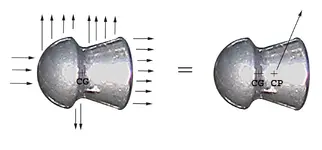
Fig 2
The other terms which need defining are lift and drag. Drag in particular is a commonly used term without many of its users knowing exactly what it is. In fig 2 you can see that I have drawn a force acting through the CP at an angle to the pellet. This single force is usually split up into two separate forces acting at right angles to each other, commonly referred to as lift and drag (fig 3).
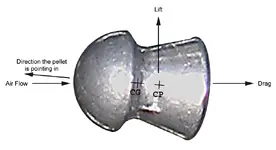
Fig 3
The drag is defined as the force acting in the direction of the air flow, and the lift is the force acting at right angles to the air flow. The slightest yaw angle will produce a lift force facing in the same direction as the yaw angle, which can be in any direction. The yaw angle of the pellet is not relevant, the lift always acts at right angles to the airflow and the drag in the line of the airflow. The lift is often shown as acting vertically, but on a projectile, as mentioned above, it can act up, down sideways or any combination of the directions which are at right angles to the air flow. It is the forces acting at right angles to the airflow which principally define the position of the CP, drag has very little effect.
Aerodynamic stability does not depend on forces, aerodynamic stability is a function of the aerodynamic moments about the CG. Aerodynamic moments are derived from the product of the force multiplied by the distance between the CG and the line of action of the force. If a force acts through the CG it does not matter how large it is, it cannot produce a stabilizing or destabilizing moment as there is no distance between its line of action and the CG. This is something many presenters do not seem to understand, as they constantly talk about forces.
Pellets, like all unguided projectiles, can only be accurate if the yaw angles are kept small. In the case of pellets, the angles need to be 1 degree or less after leaving the barrel. This means that the distance between any drag force line of action and the CG is minute. The line of action of the lift force going through the CP however is relatively very large, enabling the lift forces to produce stabilizing moments. The diagram (fig 4) shows the length of the relative distances if the pellet were at 5 degrees, i.e. five times greater than normal.
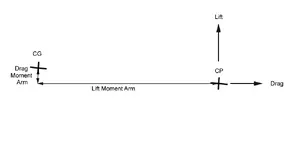
Fig 4
Now, some will argue that the drag at very low angles is much greater than the lift. This is true, but there is another problem about where the line of action for the drag force actually lies and which component of drag it is which could be providing any stabilizing moment. To look at this, it is convenient to look at the forces in another way.
When modelling pellet trajectories using the complex models or looking at pellet stability, it is rare that lift and drag are used. Instead, what are called normal and axial forces are used. The normal and axial forces are the same as the lift and drag, except that they use the pellet as the reference rather than the air flow direction (fig 5). They give a better representation of the forces and moments acting on the pellet and make it easier to understand.
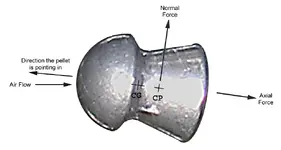
Fig 5
If you compare the two diagrams you can see that the normal force provides the majority of the lift and the axial force provides the majority of the drag and hence at small angles, because it acts directly through the CG, most of the drag cannot provide a stabilizing moment. It has been shown in wind tunnel tests that the axial force does not change in magnitude until large angles of yaw are obtained, so any change in drag at low yaw angles is caused by the tiny component of normal force in the drag direction. The normal force component acting in the drag direction is going to be much smaller than the component acting in the lift direction, further reducing any stabilizing moment contribution.
Some people have tried to explain drag stability by claiming that when a pellet is at yaw, the frontal area is greater as the air will be able to hit more of the flare than it could see before, thus producing a correcting force on the flare. If your pellet was travelling at 6000ft/sec in the upper atmosphere, this argument would have some validity. The subsonic aerodynamics of pellets work in a totally different way through suction forces, not high pressure impact forces.
This is why the correct term is flare stabilized, not drag stabilized as it is the lift produced by the flare which gives the dominant stabilizing moment, not the drag and certainly not as in fig 1. True drag stabilization requires a completely different type of stabilizing device, which you wouldn’t want on your pellets.
In a video by one of the leading air rifle video producers, he went to great lengths to explain pellet aerodynamic stability and how it differs from slugs. Unfortunately, he just repeated everything else which has been said before. Fig 1 below is close to one of his main diagrams and is typical of many diagrams used to explain drag stability on pellets.
Fig 1
The claim is that the drag pulls back on the pellet due to the centre of pressure (CP) being behind the centre of gravity (CG) thus making the pellet stable. This is complete bunkum based on a total lack of knowledge on the basics of aerodynamic stability. It also fails to explain why a wadcutter pellet is apparently still stable despite the vast majority of its drag being at the front rather than the back of the pellet, or why a slug is unstable despite most of its drag coming from base drag just like a pellet.
Before we get into the true aerodynamic stability of pellets, I need to explain a few basic definitions. First is the CP. On any projectile moving through the air, there are not just one or two forces acting on it. The air is working all over of the object, producing forces of differing sizes and directions everywhere on the object's surface. To simplify things we create an artificial point in the object which we call the centre of pressure (CP), where, if we sum all the different forces to produce one total force, we can say that if that total force were to act through that point it would produce the same force and moment about the centre of gravity as all the individual forces acting over the object (fig 2).
Fig 2
The other terms which need defining are lift and drag. Drag in particular is a commonly used term without many of its users knowing exactly what it is. In fig 2 you can see that I have drawn a force acting through the CP at an angle to the pellet. This single force is usually split up into two separate forces acting at right angles to each other, commonly referred to as lift and drag (fig 3).
Fig 3
The drag is defined as the force acting in the direction of the air flow, and the lift is the force acting at right angles to the air flow. The slightest yaw angle will produce a lift force facing in the same direction as the yaw angle, which can be in any direction. The yaw angle of the pellet is not relevant, the lift always acts at right angles to the airflow and the drag in the line of the airflow. The lift is often shown as acting vertically, but on a projectile, as mentioned above, it can act up, down sideways or any combination of the directions which are at right angles to the air flow. It is the forces acting at right angles to the airflow which principally define the position of the CP, drag has very little effect.
Aerodynamic stability does not depend on forces, aerodynamic stability is a function of the aerodynamic moments about the CG. Aerodynamic moments are derived from the product of the force multiplied by the distance between the CG and the line of action of the force. If a force acts through the CG it does not matter how large it is, it cannot produce a stabilizing or destabilizing moment as there is no distance between its line of action and the CG. This is something many presenters do not seem to understand, as they constantly talk about forces.
Pellets, like all unguided projectiles, can only be accurate if the yaw angles are kept small. In the case of pellets, the angles need to be 1 degree or less after leaving the barrel. This means that the distance between any drag force line of action and the CG is minute. The line of action of the lift force going through the CP however is relatively very large, enabling the lift forces to produce stabilizing moments. The diagram (fig 4) shows the length of the relative distances if the pellet were at 5 degrees, i.e. five times greater than normal.
Fig 4
Now, some will argue that the drag at very low angles is much greater than the lift. This is true, but there is another problem about where the line of action for the drag force actually lies and which component of drag it is which could be providing any stabilizing moment. To look at this, it is convenient to look at the forces in another way.
When modelling pellet trajectories using the complex models or looking at pellet stability, it is rare that lift and drag are used. Instead, what are called normal and axial forces are used. The normal and axial forces are the same as the lift and drag, except that they use the pellet as the reference rather than the air flow direction (fig 5). They give a better representation of the forces and moments acting on the pellet and make it easier to understand.
Fig 5
If you compare the two diagrams you can see that the normal force provides the majority of the lift and the axial force provides the majority of the drag and hence at small angles, because it acts directly through the CG, most of the drag cannot provide a stabilizing moment. It has been shown in wind tunnel tests that the axial force does not change in magnitude until large angles of yaw are obtained, so any change in drag at low yaw angles is caused by the tiny component of normal force in the drag direction. The normal force component acting in the drag direction is going to be much smaller than the component acting in the lift direction, further reducing any stabilizing moment contribution.
Some people have tried to explain drag stability by claiming that when a pellet is at yaw, the frontal area is greater as the air will be able to hit more of the flare than it could see before, thus producing a correcting force on the flare. If your pellet was travelling at 6000ft/sec in the upper atmosphere, this argument would have some validity. The subsonic aerodynamics of pellets work in a totally different way through suction forces, not high pressure impact forces.
This is why the correct term is flare stabilized, not drag stabilized as it is the lift produced by the flare which gives the dominant stabilizing moment, not the drag and certainly not as in fig 1. True drag stabilization requires a completely different type of stabilizing device, which you wouldn’t want on your pellets.