Install the app
How to install the app on iOS

Follow along with the video below to see how to install our site as a web app on your home screen.

Note: This feature may not be available in some browsers.

Others My Experience With Mid‑Tier Compressors (And Why the $300–$1,000 Market Never Really Improves)

Grunt64

HAM Ranger
650
2,124
HAM Points
2,869.00
Country flag
Over the years I’ve owned a fair number of compressors in that $300–$1,000 range — Vevors, Yong Hengs, and even one of the “premium” Tuxing models with the sealed radiator cooling system, auto‑stop, and all the bells and whistles. It looked impressive on the outside, but it still failed at the same weak point they all share: the connecting rod.

I had bought an Assurance plan through Amazon, and the failure happened inside the warranty window. But once it broke, neither Tuxing nor Assurance would stand behind it. Assurance eventually told me the policy should never have been sold in the first place, refunded the plan, and I was left stuck with a dead compressor.

After that, I changed my approach. When I ordered my second unit, I bought the stripped‑down version and added my own FASTTOBUY external cylinder and filtration. That setup has been far more reliable than the expensive one ever was. The truth is, the filtration and moisture control you add yourself is always better than whatever these machines claim to have internally.

And that leads to the bigger point:There’s a reason the $300–$1,000 compressor market never really improves. All of these units — no matter the shell, display, radiator, or marketing language — share the same internal parts. Same rods, same pistons, same bearings, same tiny separator. The price difference is mostly the housing and the features, not the internals.

There’s no real jump in quality until you hit the $3,000–$5,000 industrial tier. That’s where you finally get forged rods, proper bearings, real filtration, and actual support. Everything below that is just variations of the same design, and that $300–$1,000 range is probably where most of the profit is made. It’s cheap enough for most shooters to buy, expensive enough for the manufacturers to make money, and unreliable enough that people end up buying another one. For what it’s worth, I’ve always run a proper reciprocating compressor oil, not motor oil, and I keep my operating temps below 120 degrees. I rotate compressors, change oil regularly, and use external filtration. In other words, I don’t abuse these machines — I maintain them the way they’re supposed to be maintained. Even with all that, the “premium” unit still failed at the connecting rod, which tells you the weak point isn’t the user, it’s the design.

That’s been my experience, and I figured others here might have seen the same pattern.
 
I paid less than $120 for mine. It's been happily pumping my guns for over a year. When it dies I have another one ready to replace it. If I get a year out of each, I consider it money well spent. I'll be dead before I rack up a $3000 total. I understand why someone might need an expensive compressor, but I don't.
 
I paid less than $120 for mine. It's been happily pumping my guns for over a year. When it dies I have another one ready to replace it. If I get a year out of each, I consider it money well spent. I'll be dead before I rack up a $3000 total. I understand why someone might need an expensive compressor, but I don't.
Glad it’s working for you. I’m curious though, where are you finding a PCP compressor for $120? Everything I’ve seen in that price range is either a tire‑inflator style pump or a small single‑stage unit that tops out around 3,000 psi. If you’ve got a source for a true 4,500‑psi PCP compressor at that price, a lot of folks here would want to know.
 
I completely agree with the OP. I bought an Alkin 3 years ago and haven’t had issues since. Before that I went through the cost of an Alkin in cheap compressors. Yong Hengs, a GX, an Air Venturi, Tuxing , etc. it really seems like all the high speed compressors are just a YH design with stuff slapped onto it to make it seem fancier - but still the same basic no QC lower quality internals.

The newer GX CS4 with its 5800psi fill seems to be lasting longer for many people. Maybe because 4500psi fills don’t stress it as much?
 
Glad it’s working for you. I’m curious though, where are you finding a PCP compressor for $120? Everything I’ve seen in that price range is either a tire‑inflator style pump or a small single‑stage unit that tops out around 3,000 psi. If you’ve got a source for a true 4,500‑psi PCP compressor at that price, a lot of folks here would want to know.
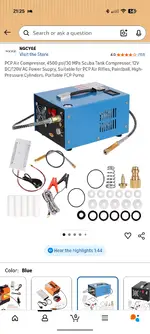
It came from Amazon. Looks like it's $150 now but mine were on sale when I got them. I'm aware they aren't going to last but I'm not using them daily and none of my guns are over 250 bar. I do have a 15ci 4500 psi bottle but I never fill it completely.
 

Attachments

  • Screenshot_20260210-212514.webp
    Screenshot_20260210-212514.webp
    100.9 KB · Views: 5
Good post. I use Yong Hengs and did have to work on them within a two year window, but since then they have just kept working with no problems, for years now. The only thing that I would add is that using Water Wetter does help keep the operating temperature down and maybe that's why I've had no problems for quite a while now. I used to use fresh cold water, but relooping a 5 gallon bucket of distilled water with water wetter in it has worked better.
 
Good post. I use Yong Hengs and did have to work on them within a two year window, but since then they have just kept working with no problems, for years now. The only thing that I would add is that using Water Wetter does help keep the operating temperature down and maybe that's why I've had no problems for quite a while now. I used to use fresh cold water, but relooping a 5 gallon bucket of distilled water with water wetter in it has worked better.
Keeping compressor temperatures down is one of the most important factors in how long these mid‑tier units actually last, because heat is what destroys seals, valves, and oil long before the hour meter does. While every brand has its own quirks, the basic rule is the same across the entire $300–$1,000 class: the cooler it runs, the longer it lives. That’s why staying under roughly 120 degrees is a solid guideline, not because 120 is a magic number, but because wear starts increasing fast once you climb past that point. I pre‑chill my water, keep the room cool, and shut the compressor down when it hits that temperature, and it’s made a noticeable difference in reliability and service life.
 
Mine show the temp in Celsius but I don't think I've ever seen it get over 40. It only takes a couple of minutes to top my guns off usually. I guess I've been following the 120 degree rule and didn't know it. I'll really pay close attention to it now though. Thanks for the tip!
 
Keeping compressor temperatures down is one of the most important factors in how long these mid‑tier units actually last, because heat is what destroys seals, valves, and oil long before the hour meter does. While every brand has its own quirks, the basic rule is the same across the entire $300–$1,000 class: the cooler it runs, the longer it lives. That’s why staying under roughly 120 degrees is a solid guideline, not because 120 is a magic number, but because wear starts increasing fast once you climb past that point. I pre‑chill my water, keep the room cool, and shut the compressor down when it hits that temperature, and it’s made a noticeable difference in reliability and service life.
You are lucky that you can get your compressor to stay at 120. Mine have always done most of their work at around 145 and once they started up from there I would shut down shy of 160. That was with fresh running cold water 60ish degrees. With a bucket of water wetter treated distilled water at room temp it usually runs at 140-5 and stays there. I shut off every 20 minutes anyway because I don't trust any of the guages for the most part. At least the YH do fill quickly. I've got 3, one new in the box, and the other two have been working for years now w/o a problem, and since I'm not looking for any new problems, I'm just going to keep them.
 
Good post. I use Yong Hengs and did have to work on them within a two year window, but since then they have just kept working with no problems, for years now. The only thing that I would add is that using Water Wetter does help keep the operating temperature down and maybe that's why I've had no problems for quite a while now. I used to use fresh cold water, but relooping a 5 gallon bucket of distilled water with water wetter in it has worked better.
A YH‑style compressor running 140–160°F isn’t unusual if the cooling water is only room temperature or treated with Water Wetter. Water Wetter helps with heat transfer, but it doesn’t actually lower the starting temperature of the coolant. I run a different setup: about 3 gallons of water in a cooler, then I pack the rest with large ice blocks I make ahead of time and let it sit until the water drops to around 40°F before I even start the fill. Starting that cold gives the compressor a much bigger thermal buffer, which is why mine stays closer to 120°F. Same basic compressor design — just a colder starting point makes a big difference in how fast the heat climbs.
 
I agree with the statements about temperature. But one must consider it is not one over-arching factor that will guarantee your compressor will last longer. So I don't want less experienced airgunners to read this thread and have a bad QC compressor break even if they keep temps down to 120-130F and get angry about it.

I've been through a few YH over the years. First one I cooled with the pump that came with it using a 5gal bucket, half dozen frozen water bottles and the temp would get pretty high pretty quick. I think I burned through 2 this way with neither making it past the 20 hours mark. (This was noob PCP me 7-8 years ago)

More recently, before my Aklin, I purchased two more. I hosed them directly from a cold water tap with a constant water feed and it was much easier to keep temps down under 40C. But I could tell one of the two YH had a bad vibration right ootb. At the 5 hour mark the crankcase literally split in two. The second one is sitting in backup in case I have Alkin issues and it's made it to around 20 hours running ok.

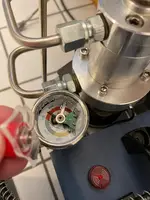
Another YH issue was the auto shutoff arcing in the gauge (it is 120v line voltage), burning a hole in the Venturi tube and sending the gauge cover into the cieling.
YongHeng - 1 (1).webp

My point is just there are a lot of things that can and do go wrong outside of just temperature on these lower cost units. Reed valves tend to get carbonized and start leaking on the high pressure stages after a while requiring maintenance when the pump stops building full pressure. Etc, etc, etc.....
 
I agree with the statements about temperature. But one must consider it is not one over-arching factor that will guarantee your compressor will last longer. So I don't want less experienced airgunners to read this thread and have a bad QC compressor break even if they keep temps down to 120-130F and get angry about it.

I've been through a few YH over the years. First one I cooled with the pump that came with it using a 5gal bucket, half dozen frozen water bottles and the temp would get pretty high pretty quick. I think I burned through 2 this way with neither making it past the 20 hours mark. (This was noob PCP me 7-8 years ago)

More recently, before my Aklin, I purchased two more. I hosed them directly from a cold water tap with a constant water feed and it was much easier to keep temps down under 40C. But I could tell one of the two YH had a bad vibration right ootb. At the 5 hour mark the crankcase literally split in two. The second one is sitting in backup in case I have Alkin issues and it's made it to around 20 hours running ok.

Another YH issue was the auto shutoff arcing in the gauge (it is 120v line voltage), burning a hole in the Venturi tube and sending the gauge cover into the cieling.
View attachment 19408

Absolutely — and that’s why I brought up QC earlier. These mid‑tier compressors can fail for a dozen different reasons, and a bad unit will die no matter how well someone treats it.

My point about temperature was just aimed at the user‑controlled side of the equation. Keeping heat down won’t fix a bad crankcase, a bad rod, or a bad auto‑shutoff, but it does reduce stress on the parts that are sensitive to heat.

Between QC, vibration, reed valves, and electrical issues, there’s definitely more than one failure point. Heat is just the one thing the user can manage consistently. Also, I never ever trust auto shut offs.
 
And that leads to the bigger point:There’s a reason the $300–$1,000 compressor market never really improves. All of these units — no matter the shell, display, radiator, or marketing language — share the same internal parts. Same rods, same pistons, same bearings, same tiny separator. The price difference is mostly the housing and the features, not the internals.

There’s no real jump in quality until you hit the $3,000–$5,000 industrial tier. That’s where you finally get forged rods, proper bearings, real filtration, and actual support. Everything below that is just variations of the same design, and that $300–$1,000 range is probably where most of the profit is made. It’s cheap enough for most shooters to buy, expensive enough for the manufacturers to make money, and unreliable enough that people end up buying another one. For what it’s worth, I’ve always run a proper reciprocating compressor oil, not motor oil, and I keep my operating temps below 120 degrees. I rotate compressors, change oil regularly, and use external filtration. In other words, I don’t abuse these machines — I maintain them the way they’re supposed to be maintained. Even with all that, the “premium” unit still failed at the connecting rod, which tells you the weak point isn’t the user, it’s the design.
Great post, but I think you are missing one important category...true mid-tier compressors! The folks that don't want to mess around with the low dollar stuff, warranties, etc but can't afford the big $3000+ ones either. 2 good options i think of are the Hill Evo and Carette 2 compressors (both around 2K) Neither are super fast but are decently affordable for someone who is into pcps for the long haul. Rebuild able and backed by dealers if repairing your own stuff isn’t your cup of tea.
 
Great post, but I think you are missing one important category...true mid-tier compressors! The folks that don't want to mess around with the low dollar stuff, warranties, etc but can't afford the big $3000+ ones either. 2 good options i think of are the Hill Evo and Carette 2 compressors (both around 2K) Neither are super fast but are decently affordable for someone who is into pcps for the long haul. Rebuild able and backed by dealers if repairing your own stuff isn’t your cup of tea.
I really considered getting an Air Charger, but I seem to have got the YH down at this point, so why replace what isn't broke? Plus, I know them, and I can tell just by the sound if something is up. It doesn't hurt that all three are under $1K too. I'm not likely to be down and w/o air anytime soon. I regret not getting an F10 Shoebox while they were still supported, slow and cold was the way to go. I have never been in a rush to fill anyway. I can't believe nobody ever picked up on that idea and ran with it, since Shoebox shutdown.
 
Great post, but I think you are missing one important category...true mid-tier compressors! The folks that don't want to mess around with the low dollar stuff, warranties, etc but can't afford the big $3000+ ones either. 2 good options i think of are the Hill Evo and Carette 2 compressors (both around 2K) Neither are super fast but are decently affordable for someone who is into pcps for the long haul. Rebuild able and backed by dealers if repairing your own stuff isn’t your cup of tea.
I get what you’re saying, but the Hill EVO and Carette aren’t really a separate category — they’re just slower, more expensive versions of the same basic small‑reciprocating design. They don’t solve the core issues that hold the $300–$1,000 compressors back.
The Hill is well‑supported, but it’s still slow, still needs rebuilds, and still shares the same fundamental weak points. And Carette is barely available anymore, which makes long‑term support questionable.

They’re options, sure , but they’re not a different tier in terms of design or durability. They just sit in the middle price‑wise.
 
I’ve had luck finding heavy duty compressors on marketplace in my neck of the woods. Found a killer deal on a daystate superleggero virtually brand new for less than half what aoa sells them for. Then a month later my brother bought a Bauer Oceanus EB-1 for a price that you’d be stupid not to buy it. Sold the daystate immediately 😂

Great deals are out there, just gotta keep your eyes peeled on the classifieds, CL, FB, etc
 
I get what you’re saying, but the Hill EVO and Carette aren’t really a separate category — they’re just slower, more expensive versions of the same basic small‑reciprocating design. They don’t solve the core issues that hold the $300–$1,000 compressors back.
The Hill is well‑supported, but it’s still slow, still needs rebuilds, and still shares the same fundamental weak points. And Carette is barely available anymore, which makes long‑term support questionable.

They’re options, sure , but they’re not a different tier in terms of design or durability. They just sit in the middle price‑wise.
I can't speak to the Carette but I own the Hill and in my mind 10 years from now (after a rebuild or 2) it will still be here, chugging slowly along lol🤞. The companies history, product support, maintenance & repair videos, etc sealed the deal for me. Build quality inside and out is solid, there isn't a chinese made part on it i am told.
The Hill is "affordable" because of its small size and lack of speed.
It would be nice to see the pcp industry focus more on the 'mid tier' compressors for sure; smart designs, quality internals, easy to service, etc. I am seeing more "Gen 2" versions out there so upgrades are happening at least! (ex. Umarex ReadyAir G2)
I also considered the Alteros booster pump and running it off my 5hp 60gal shop compressor....
 

Create an account or login to comment

You must be a member in order to leave a comment

Create FREE account

Create a FREE account on our community. It's easy!

Log in

Already have an account? Log in here.

Trending in this forum

Back
Top