

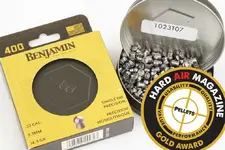
VALUE FOR MONEY
At a MSRP of $19.99 for a tin of 400 these domed-head, 14.3 Grain Benjamin Match Grade Pellets work out to a price of 5 Cents each. This is a fair cost for mid-weight, domed .22 caliber airgun pellets at the time of writing.
This is also a very fair price for the quality on offer. Sure, it’s about double that for regular Crosman Hollowpoints. However, the consistency is much superior and is comparable with that of other pellets from quality manufacturers at a similar price.
Of course, if you order in bulk from Pyramyd Air, Airgun Depot or other leading online airgun dealer, you’ll be able to buy four tins for the price of three, reducing the individual pellet price to 3.75 Cents.
Also many US shooters will be happy to know that these Benjamin Match Grade .22 Caliber 14.3 Grain pellets are manufactured in the USA, at Velocity Outdoors’ headquarters in Bloomfield, NY.
BUY FROM PYRAMYD
Benjamin Single Die Pellets .22 Cal, 14.3 Grain, Domed, 400ct 0.22

TEST DATA SUMMARY
| Price per Pellet | 5.00 cents |
| Most Common Weight | 14.29 Grains |
| Pellets at That Common Weight | 18% |
| Variation in Pellet Weight (Smallest to Largest) | 1.40% |
| Most Common Head Diameter | 5.53 mm |
| Pellets at That Common Diameter | 68% |
| Variation in Diameter (Smallest to Largest) | 0.18% |
| Most Common Length | 6.78 mm |
| Pellets at That Common Length | 38% |
| Variation in Length (Smallest to Largest) | 1.63% |
COMPARISON TO MAKERS CLAIMS
The Benjamin Match Grade .22 Caliber 14.3 Grain pellets tested by HAM had an average weight of exactly 14.40 Grains.
That’s excellent performance, however – paradoxically – there was no single individual pellet that actually had that weight! See the “Consistency” section below for details.
The manufacturer claims that there are 400 pellets in a tin. The sample tin tested by HAM contained 417 pellets. That’s a 4% over-count. Thanks Benjamin!

The manufacturer claims that you can “Aim and fire with confidence, knowing the head size, shape, and weight will be identical from pellet to pellet.”
Well, the HAM testers have to say that this claim employs some Marketing hyperbole! “Identical” is a bit much. However the level of manufacturing consistency shown in HAM testing does mean that you can – in fact – “aim and fire with confidence”.
It is clear from our testing that Benjamin Match Grade .22 Caliber 14.3 Grain pellets are manufactured to very consistent standards.
It’s tough to gain a HAM Gold Award in pellets, but these Benjamins manage it easily.
Interestingly, the manufacturer makes no Ballistic Coefficient claims for these pellets. However independent HAM testing to our standard protocols result in a BC of 0.028. Benjamin should make this a claim as it’s pretty good figure!
CONSISTENCY
Manufacturing consistency is critically important for downrange accuracy. That’s why HAM Tester Doug Wall spends so much time weighing and measuring each individual pellet!
We need to be explicit that good manufacturing consistency does NOT guarantee that a particular barrel will “like” a certain pellet. However, it does mean that – if compatible with the barrel – the shot-to-shot accuracy on target will be better with consistently-manufactured pellets than those with less consistency.
A key component of airgun pellet manufacturing consistency is head diameter. Here the Benjamin Match Grade .22 Caliber 14.3 Grain pellets give excellent results!
First, let’s look at the head diameter. This is a critical measurement when determining manufacturing consistency.
As with the 10.5 Grain .177 caliber Benjamin Match Grade pellets previously tested by HAM, the difference between the largest and smallest head diameters measured in this test review was just 0.01 mm.
All of the tested pellets had a head diameter of either 5.52 or 5.53 mm. That means that the larger pellets had a head diameter of just about one third of one thousandth of an inch smaller than the others.
That’s outstanding!

The results from the .177 caliber Benjamin testing were repeated in a very similar manner when it came to weight.
Again, the weight of the Benjamin Match Grade .22 Caliber 14.3 Grain pellets tested by HAM was also well-controlled. While none of the tested pellets actually weighed 14.30 Grains, that was the average weight of the tested sample. The most common weight was 14.29 Grains, as can be seen from the chart below.
The difference between the lightest and heaviest pellets tested was just 1.40%. Again, this was a much better than average figure, indicating well-controlled, consistent manufacturing.

The average pellet length was 6.78 mm. That was also the most common length tested. As the chart below shows, 19 out of 50 were 6.78 mm long (that’s 38%, which is well above average).

The difference in length between the shortest and longest Benjamin Match Grade .22 Caliber 14.3 Grain pellets tested by HAM measured by HAM was 1.63%. Again, this was well above average.
DIRTINESS
Again, another strong score for these Benjamin pellets was achieved for dirtiness.
There was a remarkably small amount of the inevitable lead dust and debris present in the tin of pellets tested by HAM. The photograph below shows the amount of dirt washed-off during our standard washing protocol from the full tin of 417 pellets.
In fact, the level of dirt per 100 pellets – the way we measure it at HAM – was just 0.11 Grains. That’s well below average.
As can be seen from the photograph most of this was dust. There was almost none of the relatively large semi-circular lead shavings that it’s not uncommon to find in pellet tins.

The manufacturer’s web page also states that “longer tumbling times minimizes flash”. As we can see below, these sample pellets do show very little flash. That’s a probable reason for the lack of semi-circular lead shavings noted above.

DOWNRANGE PERFORMANCE
During HAM Ballistic Coefficient testing, Benjamin Match Grade .22 Caliber 14.3 Grain pellets achieved a BC of 0.028.
This is a good value for a domed pellet, both in general and compared to other Velocity Outdoor pellets. For example, the BC for the 14.3 Grain Crosman Premier Hollow Point pellets is 0.023.
As the Chairgun graph below shows, Muzzle Energy has halved at around 83 Yards downrange (50% KE). By comparison, Muzzle Energy for the 14.3 Grain Crosman Premier Hollow Point pellets tested by HAM halved at just 55 Yards.
Flatter shooting and increased hitting power downrange are the benefits of the improved Ballistic Coefficient!

HUNTING USE
In HAM’s standard “soap penetration test”, tester Doug Wall found that the domed Benjamin Match Grade Pellets penetrated 44mm into the soap block.
That’s 1 mm more than the results from testing Crosman Premier 14.3 Grain Hollowpoints and indicative of the benefits of a higher Ballistic Coefficient at a similar pellet weight and velocity.

As we can see, the 8 mm diameter “wound channel” was straight and there was little sign that the Benjamin Match Grade 14.3 Grain pellet expanded hugely when giving up its energy to the soap.
The original diameter of the pellet was 5.53 mm. After carefully removing from the soap bar, the head diameter measured 5.57 mm.
The length prior to firing was 6.78 mm. On removal from the soap block, it was 6.51 mm.
BUYING AND OWNING
Although this HAM test review was undertaken on “full production” pellets, they were not for retail sale at this time. However, they will be very soon and – undoubtedly – will be available very widely due to Velocity Outdoors’ huge distribution network.
Look for them to be available from Airguns of Arizona, Airgun Depot, Pyramyd Air and more, together with the Benjamin Airguns website.

The pellets themselves are packaged in a typical Crosman/Benjamin 3-Inch diameter screw-topped tin. There’s a foam disk in the tin to limit movement and damage in transit.
As you can see from the photograph above, the batch number is indicated on a label stuck to the underside of the lid. These pellets are packed with 12 tins to one box. The batch number is also shown on the box, so all of the pellets in that box are from the same batch.
There were no damaged or mal-formed pellets in the tins tested by HAM. These domed Benjamin Match Grade Pellets share the traditional Crosman/Benjamin attributes of using a hard lead alloy, together with a fairly thick skirt design.
Both of these factors mean that damage in transit is relatively unlikely to occur. You – the user – benefit from a very high percentage of usable pellets in the tin.
TEST DATA


For background details on HAM’s Pellet Test Review methodology, check out this link.
Chairgun is a product of Hawke Sports Optics LLC and is used with permission. Check out http://www.hawkeoptics.com
BUY FROM PYRAMYD
Benjamin Single Die Pellets .22 Cal, 14.3 Grain, Domed, 400ct 0.22
Understanding HAM Pellet Awards
HAM Pellet Awards come from the most rigorous, professional and comprehensive pellet testing by any independent publication. They are the result of much precise measurement and analysis using high precision measuring devices and highly-experienced testers.
Note that accuracy is a product of the complete “system” of airgun, scope, atmospheric conditions and shooter ability – not the pellet alone.
This means that no pellet test review can predict the accuracy of a particular pellet with YOUR individual air rifle. That’s why we do not measure accuracy in these pellet tests.
What HAM Pellet Awards do recognize is manufacturing consistency. Inconsistent pellets definitely will be inaccurate, consistent pellets are much more likely to be accurate.
HAM Awards also recognize value. There’s considerable variation in the price of airgun pellets. This means that an 8 cent pellet needs to score higher than a 2 cent pellet to achieve an award.
For full details of the HAM Pellet Award scoring methodology, please check out our Pellet Testing page.
For a full listing of HAM-tested Ballistic Coefficients, please see our Ballistic Coefficients page.
This entire article including scoring, data etc is Copyright Hard Air Magazine and may NOT in part or in whole be reproduced in any electronic or printed medium without prior permission from the publisher.
The post Benjamin Match Grade .22 Caliber 14.3 Grain Pellets Test Review appeared first on Hard Air Magazine.