
I find it interesting that the blackwolf and ghost are built on the same basic action with the exception of bullpup and conventional rifle and im interested to see just what their differences are.I'm not trying to make this a Ghost versus Blackwolf discussion. They're both awesome guns, and both excel in different uses. Even in my numbers above showing relative efficiency, they're pretty dang close.
The Ghost for me is a better general use and pesting platform. It's also amazing to shoot offhand. Due to length, I don't expect the Blackwolf to be nearly as good for pesting, and it dang sure won't be as good for close-quarters work. I've already found the Blackwolf to be easier to shoot from a bench than the Ghost. And I expect that trend to continue for field target as well.
I'm not replacing my Ghosts. They are the best I've come across for prairie dog shooting, something I do A LOT of.. Some of that is my personal affinity for shorter guns over longer guns, and some of that is the nature of how I shoot the pdogs. When Bobby came up to shoot pdogs and bring me the BW, he chose a Delta Wolf for the day, for all the same reasons that I chose the Ghost.
So far the Blackwolf is settling nicely into a better target shooting platform than the Ghost. The improved trigger and the length/weight/ergonomics and the shot cycle are very conducive to very precise work. And those improvements are married to a much longer OAL than the bullpup Ghost.
As is always the case, pros and cons with each platform. I greatly enjoy both the Ghost and the Blackwolf, and each offers something that the other doesn't, for those of us that really enjoy airguns.
So, I'll probably continue to make comparison statements, just b/c it's a frame of reference for many of us that own Ghosts. Please understand that when those comparisons favor the BW, I'm not trying to belittle or denigrate the Ghost, but again, they're just to give a frame of reference.

Install the app
How to install the app on iOS
Follow along with the video below to see how to install our site as a web app on your home screen.

Note: This feature may not be available in some browsers.
You are using an out of date browser. It may not display this or other websites correctly.
You should upgrade or use an alternative browser.
You should upgrade or use an alternative browser.
Blackwolf Blackwolf and Sub-MOA Barrels Review
- Thread starter Franklink
- Start date
- Latest activity Latest activity:
- Replies 287
- Views 25K

Centercut
HAM Sniper

It seems similar, same hammer springs, looks to be same valve and hammer tension adjust. But the Black Wolf is considerably more powerful than the Ghost. I’d say very close in power potential to the FX Dynamic/Panthera platform.I find it interesting that the blackwolf and ghost are built on the same basic action with the exception of bullpup and conventional rifle and im interested to see just what their differences are.
- Original poster
- #63
It seems similar, same hammer springs, looks to be same valve and hammer tension adjust. But the Black Wolf is considerably more powerful than the Ghost. I’d say very close in power potential to the FX Dynamic/Panthera platform.
Different valve. Similar though.
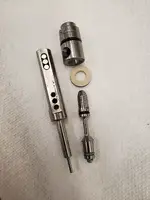
There's also the matter of the titanium valve stem that we haven't yet discussed.
Valve next to probe, photo credit to @Arzrover

- Original poster
- #64
I find it interesting that the blackwolf and ghost are built on the same basic action with the exception of bullpup and conventional rifle and im interested to see just what their differences are.
I'll get a photo of the action out of the chassis. It's a very different action than the Ghost. Surprisingly not a lot to it.
I haven't pulled the valve yet, but if I understood Bobby correctly, valve comes out the front of the gun, not the rear like it does with the Ghost.
The BW action, when outside of the chassis, looks much more like a Red Wolf action than a Ghost action.
Centercut
HAM Sniper
Thanks Cole. I have the .30 Black Wolf and the power is amazing. Just looking at that monster transfer port gives the first hint. Mine is the .30 LW 23 inch barrel and it’s very good. Great review!Different valve. Similar though.
There's also the matter of the titanium valve stem that we haven't yet discussed.
Valve next to probe, photo credit to @Arzrover
View attachment 16923View attachment 16924
- Original poster
- #66
I'll get a photo of the action out of the chassis. It's a very different action than the Ghost. Surprisingly not a lot to it.
I haven't pulled the valve yet, but if I understood Bobby correctly, valve comes out the front of the gun, not the rear like it does with the Ghost.
The BW action, when outside of the chassis, looks much more like a Red Wolf action than a Ghost action.
Found one on my phone. Not the greatest photo, but......there's more bottle there than action.

- Original poster
- #67
Lots of power. The sub20 fpe experiment I'd like to pull is not what the gun was designed for. At least not the USA versions. I just want to see how it'll do as a field target gun, and then we'll go back to the high power testing, as it appears that's what the gun was made for. I commented earlier that the only gun ive come across with more readily available horsepower is the Air Force Condor platform.Thanks Cole. I have the .30 Black Wolf and the power is amazing. Just looking at that monster transfer port gives the first hint. Mine is the .30 LW 23 inch barrel and it’s very good. Great review!
How much power are you getting from the 30?It seems similar, same hammer springs, looks to be same valve and hammer tension adjust. But the Black Wolf is considerably more powerful than the Ghost. I’d say very close in power potential to the FX Dynamic/Panthera platform.
Centercut
HAM Sniper
As much as I want. I had to go to the blue (.22 cal) spring just to lower power enough to shoot the AEA 45s at 940, and that’s with reg at 130 bar. It’ll easily shoot them over 1000 fps. It wouldn’t surprise me if it maxed out over 110 fpe.How much power are you getting from the 30?
- Original poster
- #71
Last edited:
The Blackwolf is what happens when a Red Wolf momma and a Ghost daddy love each other very much......Yea i guess i should have worded that differently. What i meant was is the same basic idea but designed as bullpup and regular rifle.

Danman
Grand HAMster

I think you would be remiss to not refer to the Ghost from time to time in the review of the Black Wolf. Since I own a Ghost everytime you mention a spec or feature my brain right away compares it to the Ghost lol.
Love where this review is going, definitely interested to see if you can get it down to 20fpe....might need a 17in barrel!?
Excited to see some big numbers too.
35 shots with the Grands makes more sense, thanks for looking into that lol , i suck at counting my shots when I shoot, but if I count afterwards its always above 50 on the paper.
Love where this review is going, definitely interested to see if you can get it down to 20fpe....might need a 17in barrel!?
Excited to see some big numbers too.
35 shots with the Grands makes more sense, thanks for looking into that lol
, i suck at counting my shots when I shoot, but if I count afterwards its always above 50 on the paper.- Original poster
- #73
Here's part of why I'm saying the Blackwolf is the product of a Red Wolf mother and a Ghost father...
Best I could find online showing the RW action out of a stock...this is from a Daystate video.
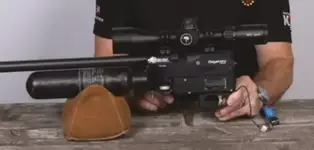
And then a Ghost and BW action.

Large bolt/small bolt shared between RW and BW.
Power wheel and hammer springs shared by Ghost and BW
Similar cartridge valve design shared by BW and Ghost
Top down barrel set screws shared by RW and BW.
Etc etc.
Quite the pedigree.
Best I could find online showing the RW action out of a stock...this is from a Daystate video.
And then a Ghost and BW action.
Large bolt/small bolt shared between RW and BW.
Power wheel and hammer springs shared by Ghost and BW
Similar cartridge valve design shared by BW and Ghost
Top down barrel set screws shared by RW and BW.
Etc etc.
Quite the pedigree.

Billm
Grand HAMster
Should be a winner then 
- Original poster
- #75
Little bit of shooting late tonight...mostly still learning the rifle.
Everything with reg pressure of 105 BAR.
JSB LIghts .22/20.83 @ MIN = 970 (almost comical how easy this gun makes power)
JSB MRDs .22/25.4 @ MIN = 884
" "@ 2 = 890
@ 4 = 902
@ 5 = 911
@ 10 = 913
I went up til the hammer spring quit doing much, and that was 10 with blue hammer spring. So that got us to the 105 bar reg setting being the limiting factor. 46-47fpe with a reg pressure of 105 bar is pretty crazy. 105 bar is just barely over 1500psi.
Was mostly wanting to gather fps output, relative to settings, but also shot the below at paper at 50 yards.
Left side is all sighters, right side is labeled. Group's not centered b/c I was just holding dead center.
High point is the 0.23" 5 shot group with the 20.83s @ 970fps. That's 0.44moa.

From there I went to 100 yards, and things fell apart within the firsr five shots. Two possibilities: 1. the MRDS and the 1:22 don't play well at 900fps, 2. Dirty barrel. I'm leaning towards dirty barrel. and with that assumption.... When this 1:22 SubMOA barrel is ready for a clean, it's like somebody flipped a switch and the accuracy is just...gone. Something like 250 shots since the last clean, mostly pellets. Everything lubed liberally.
So I cleaned it.
Got some light lead glitter on the first patch, not nearly as bad as it was with the unlubed slugs, but definitely some glitter.


Bout like last time, it got to clean patches fairly quickly. But I don't like cleaning barrels every 200-300 shots so I secured permission from SubMOA a few days ago to lap and polish this barrel. Over the last 8 or so years, Ive slowly worked up the courage to be more and more aggressive with barrels. So I got after it with some 280 grit clover, and finished it off with lots and lots of polishing with JB bore paste. Pushed a handful of varieties of projectiles through afterwards to satisfy my concerns about opening up the bore too much. And I didn't. Still getting evidence of a ring of contact at the pellet head.
Got it back together and will be hunting a sub20fpe tune next. The sub20 is just a temporary project, not the final end goal. This gun really seems best suited for high power, and it's looking like that will be the bulk of the project.
Everything with reg pressure of 105 BAR.
JSB LIghts .22/20.83 @ MIN = 970 (almost comical how easy this gun makes power)
JSB MRDs .22/25.4 @ MIN = 884
" "@ 2 = 890
@ 4 = 902
@ 5 = 911
@ 10 = 913
I went up til the hammer spring quit doing much, and that was 10 with blue hammer spring. So that got us to the 105 bar reg setting being the limiting factor. 46-47fpe with a reg pressure of 105 bar is pretty crazy. 105 bar is just barely over 1500psi.
Was mostly wanting to gather fps output, relative to settings, but also shot the below at paper at 50 yards.
Left side is all sighters, right side is labeled. Group's not centered b/c I was just holding dead center.
High point is the 0.23" 5 shot group with the 20.83s @ 970fps. That's 0.44moa.
From there I went to 100 yards, and things fell apart within the firsr five shots. Two possibilities: 1. the MRDS and the 1:22 don't play well at 900fps, 2. Dirty barrel. I'm leaning towards dirty barrel. and with that assumption.... When this 1:22 SubMOA barrel is ready for a clean, it's like somebody flipped a switch and the accuracy is just...gone. Something like 250 shots since the last clean, mostly pellets. Everything lubed liberally.
So I cleaned it.
Got some light lead glitter on the first patch, not nearly as bad as it was with the unlubed slugs, but definitely some glitter.
Bout like last time, it got to clean patches fairly quickly. But I don't like cleaning barrels every 200-300 shots so I secured permission from SubMOA a few days ago to lap and polish this barrel. Over the last 8 or so years, Ive slowly worked up the courage to be more and more aggressive with barrels. So I got after it with some 280 grit clover, and finished it off with lots and lots of polishing with JB bore paste. Pushed a handful of varieties of projectiles through afterwards to satisfy my concerns about opening up the bore too much. And I didn't. Still getting evidence of a ring of contact at the pellet head.
Got it back together and will be hunting a sub20fpe tune next. The sub20 is just a temporary project, not the final end goal. This gun really seems best suited for high power, and it's looking like that will be the bulk of the project.
- Original poster
- #76
Well, sub20 in .22 with the SubMOA barrels is possible.
But not with even the lightest OEM hammer spring that I have available, the white one. Even with a low reg pressure I couldn't get lower than about 25fpe with the white spring.
Took a reg pressure of 70-75bar, and a home brew hammer spring. MUCH shorter than OEM, with power wheel on 7. Putting it to 8 jumps me up to 840fps. And to complete the jerry rig, that short spring needed shimmed with two washers on the hammer spring guide. Lol, shook my head through the process, felt like baling wire and duct tape on a $4k rifle. On the order of rattle canning it with some Krylon.
This is a ten shot average with JSB RS 13.43grainers.

That makes it 19.23fps.
Low of 789, high of 812, for an ES of 23fps. Not the MOST consistent, but consistent enough for field target work.
Sure cocks easy, can hardly feel any hammer spring in there. Lol
looks bigger diameter than OEM in this photo, but it's the same OD.

But it gets me field target legal. I'll see what the accuracy/precision is like at this tune tomorrow.
But not with even the lightest OEM hammer spring that I have available, the white one. Even with a low reg pressure I couldn't get lower than about 25fpe with the white spring.
Took a reg pressure of 70-75bar, and a home brew hammer spring. MUCH shorter than OEM, with power wheel on 7. Putting it to 8 jumps me up to 840fps. And to complete the jerry rig, that short spring needed shimmed with two washers on the hammer spring guide. Lol, shook my head through the process, felt like baling wire and duct tape on a $4k rifle. On the order of rattle canning it with some Krylon.
This is a ten shot average with JSB RS 13.43grainers.
That makes it 19.23fps.
Low of 789, high of 812, for an ES of 23fps. Not the MOST consistent, but consistent enough for field target work.
Sure cocks easy, can hardly feel any hammer spring in there. Lol
looks bigger diameter than OEM in this photo, but it's the same OD.
But it gets me field target legal. I'll see what the accuracy/precision is like at this tune tomorrow.
- Original poster
- #77
Had high hopes for lots of shooting yesterday, and doping out 10-55 yards with the sub20tune, but it just didn't work out.
I did however, get to do a little shooting, all from stool and sticks. This is with JSB .22/13.43gr pellets, averaging around 800fps, just just shy of 20fpe, 1:22 SubMOA barrel.
Reg pressure of 70-75 bar with non-Daystate hammer spring.
Boxed off area is sighters, bottom two groups are @ 30 yards. Middle right and top right are @ 50 yards. The top right group is 10 shots into 5/8" @ 50 yards.
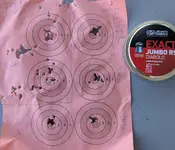
I normally like to shoot all the shots in a group in sequence, without sighters breaking it up, but the wind eats these 13.43grain pellets ALIVE, and I was needing lots of sighters to get groups like this.
I was pleasantly surprised to see this accuracy. With correct wind reads, pellets are all landing in tidy little groups, overlapping or touching holes.
This is what 80 shots looks like on a reg pressure from 240-185. Keeping the reg pressure of 70-75bar in mind, this is likely the kind of tune where you can shoot more than half of a 500 count tin of pellets without refilling. Considering the home brew tune, and a plenum about 5x too big for this, and an overbored-for-low power transfer port.....not too bad.


I like how the BW feels from shooting sticks. I made a couple slight changes in that regard. Added a single low profile scope ring on the under rail to act as a bipod stop. Also swapped scopes to an Athlon Midas Tac that would allow me to shoot in Hunter class (the scope I had on it wouldn't). The mounts that were on the Midas Tac are actually too low now. Scope bell isn't hitting the barrel but I can't comfortably get low enough on the cheekweld with the cheek piece in place. But, I ound that I can just pull the cheek piece off and get even lower than I need. The chassis takes a dip right there where the cheek hits when in shooting position. So...by pulling the adjustable cheek piece off, a VERY low-to-bore scope mount is possible, for those that find that desirable.
With my work schedule I don't know if I'll have time between now and the match on Saturday to get enough dope and practice to feel comfortable using it for a match.
I did however, get to do a little shooting, all from stool and sticks. This is with JSB .22/13.43gr pellets, averaging around 800fps, just just shy of 20fpe, 1:22 SubMOA barrel.
Reg pressure of 70-75 bar with non-Daystate hammer spring.
Boxed off area is sighters, bottom two groups are @ 30 yards. Middle right and top right are @ 50 yards. The top right group is 10 shots into 5/8" @ 50 yards.
I normally like to shoot all the shots in a group in sequence, without sighters breaking it up, but the wind eats these 13.43grain pellets ALIVE, and I was needing lots of sighters to get groups like this.
I was pleasantly surprised to see this accuracy. With correct wind reads, pellets are all landing in tidy little groups, overlapping or touching holes.
This is what 80 shots looks like on a reg pressure from 240-185. Keeping the reg pressure of 70-75bar in mind, this is likely the kind of tune where you can shoot more than half of a 500 count tin of pellets without refilling. Considering the home brew tune, and a plenum about 5x too big for this, and an overbored-for-low power transfer port.....not too bad.
I like how the BW feels from shooting sticks. I made a couple slight changes in that regard. Added a single low profile scope ring on the under rail to act as a bipod stop. Also swapped scopes to an Athlon Midas Tac that would allow me to shoot in Hunter class (the scope I had on it wouldn't). The mounts that were on the Midas Tac are actually too low now. Scope bell isn't hitting the barrel but I can't comfortably get low enough on the cheekweld with the cheek piece in place. But, I ound that I can just pull the cheek piece off and get even lower than I need. The chassis takes a dip right there where the cheek hits when in shooting position. So...by pulling the adjustable cheek piece off, a VERY low-to-bore scope mount is possible, for those that find that desirable.
With my work schedule I don't know if I'll have time between now and the match on Saturday to get enough dope and practice to feel comfortable using it for a match.
- Original poster
- #78
Last edited:
SubMOA: A Glimpse Behind The Scenes
On October 30th of 2023 (4 days shy of exactly two years ago), I was approached by one of the SubMOA owners to do barrel testing for them, and report back my findings. The premise was simple: tell them what speeds and projectiles worked through the various prototype barrels I was testing, and at what distances. "Worked" being, what resulted in accuracy and precision. They also wanted info on cleaning regimens, lubes used, leading trends, etc. Basically, everything. They would then take that real-world feedback and make adjustments to their processes.
In the last two years, they've sent me .22 barrels, machined to fit a couple different platforms. Specifically .22 for me because that's where my interest lies.
Their focus became .30 barrels when they secured contracts to fulfill orders for the followong well-known airgun manufacturers: Western, US-Made Edguns, and American Air Arms. SubMOA barrels have since become OEM barrels for those manufacturers, with others inquiring as well.
While there are various ways to make gun barrels, SubMOA makes theirs through the process known as "cut rifling." The other two most common processes to make airgun barrels are: hammer forged, and buttoned. Both hammer forging and pulling a button through a blank impart enormous stresses on the steel. Barrels made through cut-rifling do not undergo the stresses induced from displaced material (steel) the way buttons and hammer forging does. Additionally, cut-rifling has the potential to be a more precise method. While there has been a steep learning curve to get there (which SubMOA themselves will and has admitted to me), barrels made by cut-rifling have the potential to drastically raise the bar.
I toured the SubMOA factory about a year ago. While not being an engineer by trade, I was impressed by the various pieces of machinery that go into the process. They showed me the tools used for cutting the rifling, rifle blanks being cut, the equipment that machines the barrel to fit whatever gun it's going into. As well as the air gauges they use to ensure the barrel is within specs throughout the process. And the lapping machine that's been mentioned here a few times in the last couple days.
Their lapping machine addresses the barrels vertically. It is automated, and any combination of strokes and speeds can be programmed into what it does to the barrel....ie, more strokes at the breech end versus the bore end? Done. Faster, longer strokes versus shorter, slower strokes? Done. Full length taper? Done. The lapping interface is a bronze brush, loaded with abrasive. Their lapping machine even has programmed "recipes" as specified/requested by the airgun manufacturer buying the barrels.
The machine lapping has the capacity to produce an excellent result, but hand lapping can provide the slightly better finish to get someone on a podium, or at least give them the confidence to do so. Or in my case, to satisfy the desire to extend cleaning intervals.
As for my part in all that, these SubMOA guys want data! Nearly daily texts and a couple phone calls per week have been flying back and forth between us, enquiring about my latest findings. They have mentioned multiple times that they can make any change at any time. Faster/slower twist rates, bore size, more/less pronounced rifling, etc. I've been telling them I need to do a full assessment of these current barrels before we go making changes to parameters. The point with that though, is that the capacity for incredibly fast response times is there. If something I discover suggests a particular change to the rifling profile would be a huge improvement... I don't doubt they'd have one with those changes on the machine by the end of the business day.
In conversation last week I was told that their goal is 1/4" groups at 100 yards. While potentially possible with slugs, I suspect that the nature of pellets are going to make that a lofty goal indeed. But that's the mindset these guys are taking to the barrel making process. Perfection or bust.
When they sent me this gun and these barrels they told me to share it all. To involve the public in the process of barrel testing and to let you guys in on the data gathering. And that's what's happening.
Last thing...the SubMOA owners and operators are airgunners. Theyre just as interested in wringing out every last drop of accuracy potential as the rest of us. I've been at matches where they brought a new prototype barrel, fresh off the machines, to run it through its paces in a real-world testing environment. The same people running the machines at SubMOA during the week are out on the weekends shooting the barrels, both for enjoyment and data gathering.
On October 30th of 2023 (4 days shy of exactly two years ago), I was approached by one of the SubMOA owners to do barrel testing for them, and report back my findings. The premise was simple: tell them what speeds and projectiles worked through the various prototype barrels I was testing, and at what distances. "Worked" being, what resulted in accuracy and precision. They also wanted info on cleaning regimens, lubes used, leading trends, etc. Basically, everything. They would then take that real-world feedback and make adjustments to their processes.
In the last two years, they've sent me .22 barrels, machined to fit a couple different platforms. Specifically .22 for me because that's where my interest lies.
Their focus became .30 barrels when they secured contracts to fulfill orders for the followong well-known airgun manufacturers: Western, US-Made Edguns, and American Air Arms. SubMOA barrels have since become OEM barrels for those manufacturers, with others inquiring as well.
While there are various ways to make gun barrels, SubMOA makes theirs through the process known as "cut rifling." The other two most common processes to make airgun barrels are: hammer forged, and buttoned. Both hammer forging and pulling a button through a blank impart enormous stresses on the steel. Barrels made through cut-rifling do not undergo the stresses induced from displaced material (steel) the way buttons and hammer forging does. Additionally, cut-rifling has the potential to be a more precise method. While there has been a steep learning curve to get there (which SubMOA themselves will and has admitted to me), barrels made by cut-rifling have the potential to drastically raise the bar.
I toured the SubMOA factory about a year ago. While not being an engineer by trade, I was impressed by the various pieces of machinery that go into the process. They showed me the tools used for cutting the rifling, rifle blanks being cut, the equipment that machines the barrel to fit whatever gun it's going into. As well as the air gauges they use to ensure the barrel is within specs throughout the process. And the lapping machine that's been mentioned here a few times in the last couple days.
Their lapping machine addresses the barrels vertically. It is automated, and any combination of strokes and speeds can be programmed into what it does to the barrel....ie, more strokes at the breech end versus the bore end? Done. Faster, longer strokes versus shorter, slower strokes? Done. Full length taper? Done. The lapping interface is a bronze brush, loaded with abrasive. Their lapping machine even has programmed "recipes" as specified/requested by the airgun manufacturer buying the barrels.
The machine lapping has the capacity to produce an excellent result, but hand lapping can provide the slightly better finish to get someone on a podium, or at least give them the confidence to do so.
Or in my case, to satisfy the desire to extend cleaning intervals.As for my part in all that, these SubMOA guys want data! Nearly daily texts and a couple phone calls per week have been flying back and forth between us, enquiring about my latest findings. They have mentioned multiple times that they can make any change at any time. Faster/slower twist rates, bore size, more/less pronounced rifling, etc. I've been telling them I need to do a full assessment of these current barrels before we go making changes to parameters. The point with that though, is that the capacity for incredibly fast response times is there. If something I discover suggests a particular change to the rifling profile would be a huge improvement... I don't doubt they'd have one with those changes on the machine by the end of the business day.
In conversation last week I was told that their goal is 1/4" groups at 100 yards. While potentially possible with slugs, I suspect that the nature of pellets are going to make that a lofty goal indeed. But that's the mindset these guys are taking to the barrel making process. Perfection or bust.
When they sent me this gun and these barrels they told me to share it all. To involve the public in the process of barrel testing and to let you guys in on the data gathering. And that's what's happening.
Last thing...the SubMOA owners and operators are airgunners. Theyre just as interested in wringing out every last drop of accuracy potential as the rest of us. I've been at matches where they brought a new prototype barrel, fresh off the machines, to run it through its paces in a real-world testing environment. The same people running the machines at SubMOA during the week are out on the weekends shooting the barrels, both for enjoyment and data gathering.
- Original poster
- #80
Last edited:
So how about sharing some of the better results or possibly changes you recommend.
You guys have seen everything I've shot from these last two SubMOA barrels. They're the first ones I've been sent that are production barrels. Everything prior was prototypes. Barrels with the exact specs of these two are available for purchase. And the point I was trying to get across is that, while these are production barrels, the SubMOA guys aren't done. They don't seem to be viewing this as having a definite endpoint. Ie, perpetual improvements are their mindset.
As for my testing....My last couple pay periods have had 95 or more hours each. Between my real job, and my family, I don't have tons of spare time. So testing will occur as time is available. In fact, I just found out that my ten hr shift tomorrow is now a 14hr shift. It was going to be 11am to 9 pm but now it's 7am to 9pm.
So why am I testing if I don't have much time for it? Well, first off, I enjoy it. It's my escape. My detox from the stresses of life. I also think a large part of it why I was asked to do it is my analytical personality. Maybe some of it is me not having a tendency to sugarcoat stuff. Some of it is probably how easy I can test @ long range, just off my back porch.
So, I'll continue to shoot, taking notes, comparing tunes, and results. And sharing all of it. Maybe we'll stumble upon something amazing. Maybe not.
For high points so far with the 1:22 barrel....I'm thinking I need to revisit the combination of JSB Lights and the low reg pressure, at 970ish fps. They put 5 into 0.23 of an inch @ 50yards. The Altaros 32.5s? were also worthy of a revisit.
As I noted in the original post, the combinations are....overwhelming.
Similar threads
- Replies
- 6
- Views
- 690

- Replies
- 28
- Views
- 2K

- Replies
- 11
- Views
- 307
- Replies
- 4
- Views
- 585

- Replies
- 0
- Views
- 62


