

Miles_M
HAM Specialist

This is the first of a series of threads explaining the different types of projectile stability used by pellets. Many of you may have seen them on other forums, but there may be some who have not seen them before.
Quite often you will see someone mentioning stability, talking about how pellets go unstable as they slow down or are more accurate because they are more stable. But what is stability with regard to pellets, and how does it affect how a pellet flies?
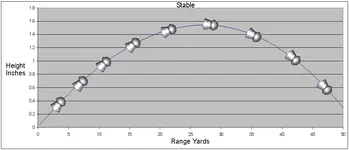
A stable pellet is not one which comes out of the barrel and keeps pointing in the same direction. A stable pellet is one which comes out of the barrel and attempts to point directly into the airflow direction. As the pellet flies along its trajectory, the direction of the airflow will change, but a stable pellet will try to change the way in which it is pointing to stay with the airflow as below.
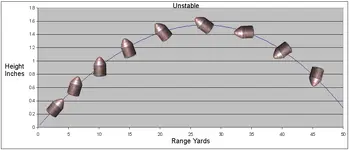
An unstable pellet will not point in the direction of the airflow and may eventually tumble, as shown here.
As far as pellets are concerned, there are actually three types of stability acting on them and affecting their flight. If we just think of normal dome type diabolo pellets they are what we call aero/gyro stabilized, that is, they rely on aerodynamic and gyroscopic stability. The third stability type pellets need is dynamic stability, this is not the same as gyroscopic stability.
To try to explain the difference between the different types of stability, think about a weight hanging on the end of a piece of string.
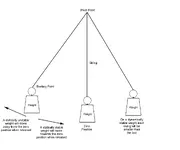
If you do not touch the weight, it will just hang down under the string. This is its zero yaw position, the position it likes to sit in. This is equivalent to a stable pellet pointing into the airflow. If you pull the weight slightly to one side and let it go, if it is stable, it will swing back towards its zero yaw position. This is because the forces and moments produced by the weight and the string are trying to push the weight back to its original position. If the weight and string were an unstable system, then as soon as we release the weight, it would move away from its zero yaw position. This type of stability is called static stability. The forces and moments on the weight and string are equivalent to the effects of aerodynamic and gyroscopic stability on a pellet. On most pellets, both the aerodynamic and gyroscopic stability will try to make the pellet face the air flow in which it is travelling as it moves along its trajectory. Aerodynamic and gyroscopic stability are both regarded as static stability.
When we have pulled our weight to one side and let it go, the first time it reaches its zero yaw position, it does not stop but goes on the other side until it eventually stops and then returns just like the pendulum on a clock. Because, unlike a clock, we don’t have a spring helping the weight to move, our weight will keep doing this with each swing getting a little smaller until it eventually stops at the zero yaw position. This is because the weight and string are dynamically stable, so the size of the swing reduces each time until there is nothing left. If the weight had neutral dynamic stability, it would keep on going, with each swing being the same size as the one before. This is what the spring on a clock is doing to the pendulum. The spring provides just enough force to keep the pendulum going with the same size swing until of course the spring winds down and the clock stops. If the weight and the string were dynamically unstable, the swings would get bigger until eventually the weight would go in a complete circle even though it is statically stable. Pellets have dynamic stability as well, though it is not quite so clear-cut.
When we fire a pellet, it is highly unlikely that it will be pointing exactly in the direction of the air flow. This is due to many things including wind, barrel vibrations, pellet manufacturing problems etc. The angle between the direction in which the pellet is pointing and that in which the airflow is moving is known as the yaw angle.
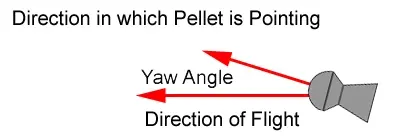
It is the yaw angle which the stability of the pellet will try to reduce. The diagrams below illustrate the effects on the yaw angle for the different stability states. First, we have a pellet which is both aerodynamically and gyroscopically unstable. That is, it is statically unstable.
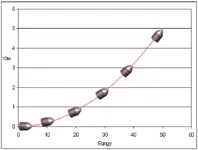
Here, the pellet yaw angle will just increase until the pellet eventually faces backwards and tumbles.
Next is a pellet which is statically stable but dynamically unstable.
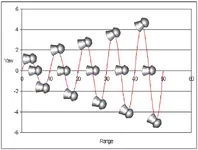
In this case the yaw swings through zero, but each swing gets bigger, and the pellet will eventually go sideways. Next, is a pellet which is statically stable but dynamically neutrally stable. Here, the swings of the pellet through zero yaw are always the same.
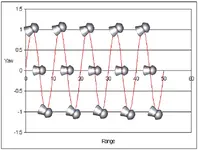
Last, is the situation we want, which is a pellet which is stable both statically and dynamically. The pellet swings through zero yaw, and each swing is smaller than its predecessor.
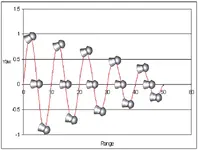
In reality most conventional pellets appear to be aerodynamically stable at speeds well below the speed of sound (1116.5ft/sec), that is, if we fired one from a smooth bore barrel it will continue to point in the direction of the trajectory. However, its aerodynamic stability is marginal and at high speeds disappears completely. Also, no pellet, or any other projectile, is made completely symmetrical and any differences from one side of the pellet to the other will produce an aerodynamic side force which will cause it to try to fly on a curved path. To reduce the effects of any projectile asymmetry, pellets and most other aerodynamically stable projectiles are given some spin so that the side force is not pointing in the same direction all the time. This will make the pellet wobble a bit but will not produce the curved flight path. The spin rate needed for this is very low, much less than is needed for gyroscopic stability.
Pellets are usually given much higher spin rates than those associated with reducing side force effects. This is because of the marginal aerodynamic stability. The spin rates of pellets are chosen to give a degree of gyroscopic stability in addition to the aerodynamic stability. This is why we say they are aero/gyro stabilized.
From the reported behaviour of pellets, they would seem to have pretty much neutral dynamic stability, possibly changing to dynamic instability at high speeds and long ranges. The change in dynamic instability is due to the increase in pellet spin rate relative to the pellet forward speed as the range increases. This apparent increase in spin rate is due to the pellet losing forward speed much quicker than it loses spin. The pellets are still statically stable, in fact the static stability has normally increased particularly at long ranges which in itself can produce strange flight effects, but the dynamic stability is also adversely affecting the pellet flight, allowing maximum yaw angles to increase.
Quite often you will see someone mentioning stability, talking about how pellets go unstable as they slow down or are more accurate because they are more stable. But what is stability with regard to pellets, and how does it affect how a pellet flies?
A stable pellet is not one which comes out of the barrel and keeps pointing in the same direction. A stable pellet is one which comes out of the barrel and attempts to point directly into the airflow direction. As the pellet flies along its trajectory, the direction of the airflow will change, but a stable pellet will try to change the way in which it is pointing to stay with the airflow as below.
An unstable pellet will not point in the direction of the airflow and may eventually tumble, as shown here.
As far as pellets are concerned, there are actually three types of stability acting on them and affecting their flight. If we just think of normal dome type diabolo pellets they are what we call aero/gyro stabilized, that is, they rely on aerodynamic and gyroscopic stability. The third stability type pellets need is dynamic stability, this is not the same as gyroscopic stability.
To try to explain the difference between the different types of stability, think about a weight hanging on the end of a piece of string.
If you do not touch the weight, it will just hang down under the string. This is its zero yaw position, the position it likes to sit in. This is equivalent to a stable pellet pointing into the airflow. If you pull the weight slightly to one side and let it go, if it is stable, it will swing back towards its zero yaw position. This is because the forces and moments produced by the weight and the string are trying to push the weight back to its original position. If the weight and string were an unstable system, then as soon as we release the weight, it would move away from its zero yaw position. This type of stability is called static stability. The forces and moments on the weight and string are equivalent to the effects of aerodynamic and gyroscopic stability on a pellet. On most pellets, both the aerodynamic and gyroscopic stability will try to make the pellet face the air flow in which it is travelling as it moves along its trajectory. Aerodynamic and gyroscopic stability are both regarded as static stability.
When we have pulled our weight to one side and let it go, the first time it reaches its zero yaw position, it does not stop but goes on the other side until it eventually stops and then returns just like the pendulum on a clock. Because, unlike a clock, we don’t have a spring helping the weight to move, our weight will keep doing this with each swing getting a little smaller until it eventually stops at the zero yaw position. This is because the weight and string are dynamically stable, so the size of the swing reduces each time until there is nothing left. If the weight had neutral dynamic stability, it would keep on going, with each swing being the same size as the one before. This is what the spring on a clock is doing to the pendulum. The spring provides just enough force to keep the pendulum going with the same size swing until of course the spring winds down and the clock stops. If the weight and the string were dynamically unstable, the swings would get bigger until eventually the weight would go in a complete circle even though it is statically stable. Pellets have dynamic stability as well, though it is not quite so clear-cut.
When we fire a pellet, it is highly unlikely that it will be pointing exactly in the direction of the air flow. This is due to many things including wind, barrel vibrations, pellet manufacturing problems etc. The angle between the direction in which the pellet is pointing and that in which the airflow is moving is known as the yaw angle.
It is the yaw angle which the stability of the pellet will try to reduce. The diagrams below illustrate the effects on the yaw angle for the different stability states. First, we have a pellet which is both aerodynamically and gyroscopically unstable. That is, it is statically unstable.
Here, the pellet yaw angle will just increase until the pellet eventually faces backwards and tumbles.
Next is a pellet which is statically stable but dynamically unstable.
In this case the yaw swings through zero, but each swing gets bigger, and the pellet will eventually go sideways. Next, is a pellet which is statically stable but dynamically neutrally stable. Here, the swings of the pellet through zero yaw are always the same.
Last, is the situation we want, which is a pellet which is stable both statically and dynamically. The pellet swings through zero yaw, and each swing is smaller than its predecessor.
In reality most conventional pellets appear to be aerodynamically stable at speeds well below the speed of sound (1116.5ft/sec), that is, if we fired one from a smooth bore barrel it will continue to point in the direction of the trajectory. However, its aerodynamic stability is marginal and at high speeds disappears completely. Also, no pellet, or any other projectile, is made completely symmetrical and any differences from one side of the pellet to the other will produce an aerodynamic side force which will cause it to try to fly on a curved path. To reduce the effects of any projectile asymmetry, pellets and most other aerodynamically stable projectiles are given some spin so that the side force is not pointing in the same direction all the time. This will make the pellet wobble a bit but will not produce the curved flight path. The spin rate needed for this is very low, much less than is needed for gyroscopic stability.
Pellets are usually given much higher spin rates than those associated with reducing side force effects. This is because of the marginal aerodynamic stability. The spin rates of pellets are chosen to give a degree of gyroscopic stability in addition to the aerodynamic stability. This is why we say they are aero/gyro stabilized.
From the reported behaviour of pellets, they would seem to have pretty much neutral dynamic stability, possibly changing to dynamic instability at high speeds and long ranges. The change in dynamic instability is due to the increase in pellet spin rate relative to the pellet forward speed as the range increases. This apparent increase in spin rate is due to the pellet losing forward speed much quicker than it loses spin. The pellets are still statically stable, in fact the static stability has normally increased particularly at long ranges which in itself can produce strange flight effects, but the dynamic stability is also adversely affecting the pellet flight, allowing maximum yaw angles to increase.