

Miles_M
HAM Specialist

This was the first of the 12 FPE threads I created years ago for UK forums. They tend to follow on from each other, so I will post them all in this thread in the order they were created, or some may not make sense. It may take me a while to do it.
There are plenty of videos on YouTube which will tell you anything you want to know about your gun and pellets, including rifle twist rates, but they cannot go into the detail. Scientific experiments on twist rates are virtually impossible to carry out since you cannot eliminate the other sources of error which will have a primary effect on your results. This is where modelling has to take over, as we can set up any experiment we want inside a computer.
The data was produced using a six degree of freedom program which, at the time of the original post, was new and had metric output. There are some problems with the output for pellets where the units are only to the nearest millimetre, but we can get some preliminary results.
I have been modelling the effects of the centre of gravity (C of G) not being exactly on the centreline of the pellet. In fact, I assumed it was 0.1mm (around 4 thou in real units) off the centreline and then carried out a lot of runs to see the effect on the group size at 50 metres range. I had to use 50 metres and not 50 yards, as the model works in metres and I hadn’t had time to change it. The aerodynamic data was the same as I have used for other modelling work I have posted, and is strictly only applicable to the AAField type pellets in .22 calibre. The muzzle velocity was 585ft/sec, which gives just barely over 12FPE.
If you fire a pellet which is a perfect fit in your barrel but with an offset C of G there are two sources of error. One is the effect of the G of G offset during the pellet flight, and the other is due to what happens to the pellet as it leaves the barrel. Now, what happens to the pellet as it leaves the barrel is not exactly clear. When the front of the pellet leaves the barrel, the C of G will start to move sideways due to the rotation of the pellet and the offset distance from the centreline. The back of the pellet is still in the gun barrel and cannot move sideways, so the pellet will start to yaw away from pointing in the straight ahead direction. At some point the back of the pellet will also leave the barrel and is free to move sideways, but it will not move sideways if the yaw rate of the pellet is high enough for the sideways movement of the C of G. Someone, who knows far more than me about theoretical ballistics, suggested that the best approximation is to assume the rotational momentum of the offset C of G is entirely transferred into the yaw momentum so that we can calculate an initial yawing rate for the pellet. This is what I have done for the following results involving yaw rates.
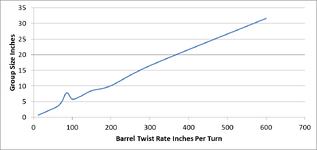
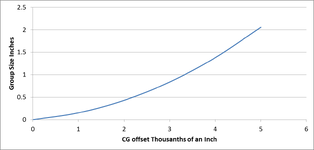
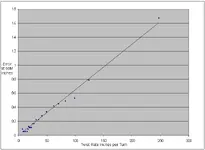
The first set of results are for a pellet which leaves the barrel perfectly, i.e. no yaw rate, but which has an offset C of G (I would like to see someone try to set that up in an experiment). So this is purely down to the effect of the offset C of G on the pellet flight. The figure shows how the error at 50 metres will change depending on the barrel twist rate. Each point represents a result from the model, and the line is just a best fit for the data. In this case, a straight line represents it fairly well. It shows how as pellet spin rates get higher, i.e. fewer inches per turn, the error due to the offset itself gets to be insignificant.
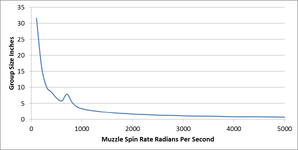
As I said above, the pure offset error is only half of the total effect. There is also the effect of the initial yaw rate created as the pellet leaves the barrel. The second figure shows the effect of barrel twist rates on the error caused by the initial yaw rate.
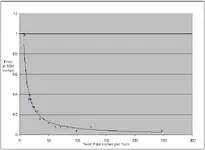
In this case, the best line fit is a curve which is very close to being proportional to the reciprocal of the barrel twist rate. In this case, again as you would expect, the error gets worse as we increase the spin rate of the pellet and thus the initial yaw rates on barrel exit.
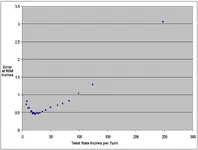
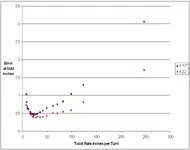
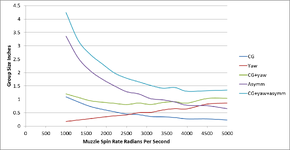
So it would appear that there are two conflicting results from the two components of the total error. If we combine both the C of G offset effects and the initial yaw rate effects, we get the result shown below.
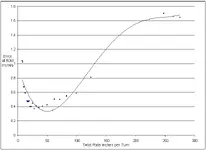
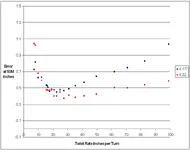
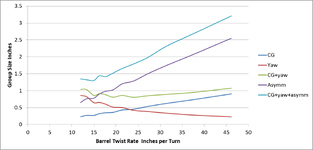
In this case the line is a not very good best fit as the relationship is fairly complex. It does show that there is a range of values for barrel twist rates which will minimize the effects of pellet offset C of G. The area of interest which encompasses most of the current barrel twist rates is shown in more detail below.
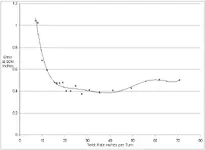
It would appear that there is a fairly flat area for twist rates between about 16 inches per turn up to 50 inches per turn. These values coincide well with the currently used common twist rates, which have evolved over time. It looks like very small gains could be made by going for twist rates around 35 inches per turn, but the gains are very small. You must remember that the results are for only one pellet type, calibre and one velocity. Changing any one of these variables could change the optimum value.
You should also remember that, going to the lower twist rate, could reduce the variety of pellet designs which could be used in the gun and would eliminate the possibility of many gyroscopically stabilized slugs. Finally, an offset C of G is not the only source of error in a gun pellet combination, others may require greater or lesser twist rates and have a bigger effect at the target.
There are plenty of videos on YouTube which will tell you anything you want to know about your gun and pellets, including rifle twist rates, but they cannot go into the detail. Scientific experiments on twist rates are virtually impossible to carry out since you cannot eliminate the other sources of error which will have a primary effect on your results. This is where modelling has to take over, as we can set up any experiment we want inside a computer.
The data was produced using a six degree of freedom program which, at the time of the original post, was new and had metric output. There are some problems with the output for pellets where the units are only to the nearest millimetre, but we can get some preliminary results.
I have been modelling the effects of the centre of gravity (C of G) not being exactly on the centreline of the pellet. In fact, I assumed it was 0.1mm (around 4 thou in real units) off the centreline and then carried out a lot of runs to see the effect on the group size at 50 metres range. I had to use 50 metres and not 50 yards, as the model works in metres and I hadn’t had time to change it. The aerodynamic data was the same as I have used for other modelling work I have posted, and is strictly only applicable to the AAField type pellets in .22 calibre. The muzzle velocity was 585ft/sec, which gives just barely over 12FPE.
If you fire a pellet which is a perfect fit in your barrel but with an offset C of G there are two sources of error. One is the effect of the G of G offset during the pellet flight, and the other is due to what happens to the pellet as it leaves the barrel. Now, what happens to the pellet as it leaves the barrel is not exactly clear. When the front of the pellet leaves the barrel, the C of G will start to move sideways due to the rotation of the pellet and the offset distance from the centreline. The back of the pellet is still in the gun barrel and cannot move sideways, so the pellet will start to yaw away from pointing in the straight ahead direction. At some point the back of the pellet will also leave the barrel and is free to move sideways, but it will not move sideways if the yaw rate of the pellet is high enough for the sideways movement of the C of G. Someone, who knows far more than me about theoretical ballistics, suggested that the best approximation is to assume the rotational momentum of the offset C of G is entirely transferred into the yaw momentum so that we can calculate an initial yawing rate for the pellet. This is what I have done for the following results involving yaw rates.
The first set of results are for a pellet which leaves the barrel perfectly, i.e. no yaw rate, but which has an offset C of G (I would like to see someone try to set that up in an experiment). So this is purely down to the effect of the offset C of G on the pellet flight. The figure shows how the error at 50 metres will change depending on the barrel twist rate. Each point represents a result from the model, and the line is just a best fit for the data. In this case, a straight line represents it fairly well. It shows how as pellet spin rates get higher, i.e. fewer inches per turn, the error due to the offset itself gets to be insignificant.
As I said above, the pure offset error is only half of the total effect. There is also the effect of the initial yaw rate created as the pellet leaves the barrel. The second figure shows the effect of barrel twist rates on the error caused by the initial yaw rate.
In this case, the best line fit is a curve which is very close to being proportional to the reciprocal of the barrel twist rate. In this case, again as you would expect, the error gets worse as we increase the spin rate of the pellet and thus the initial yaw rates on barrel exit.
So it would appear that there are two conflicting results from the two components of the total error. If we combine both the C of G offset effects and the initial yaw rate effects, we get the result shown below.
In this case the line is a not very good best fit as the relationship is fairly complex. It does show that there is a range of values for barrel twist rates which will minimize the effects of pellet offset C of G. The area of interest which encompasses most of the current barrel twist rates is shown in more detail below.
It would appear that there is a fairly flat area for twist rates between about 16 inches per turn up to 50 inches per turn. These values coincide well with the currently used common twist rates, which have evolved over time. It looks like very small gains could be made by going for twist rates around 35 inches per turn, but the gains are very small. You must remember that the results are for only one pellet type, calibre and one velocity. Changing any one of these variables could change the optimum value.
You should also remember that, going to the lower twist rate, could reduce the variety of pellet designs which could be used in the gun and would eliminate the possibility of many gyroscopically stabilized slugs. Finally, an offset C of G is not the only source of error in a gun pellet combination, others may require greater or lesser twist rates and have a bigger effect at the target.