

Billm
Grand HAMster

@SILENT SQUIRREL
I’ve been using my DNT 225R Digital scope for about 5 months. This not a review , merely some of my observations while using it. I’ve shot several thousands pellets/slugs using it in that time. It has been perched mostly on a BRK Ghost HP .25, but has also seen duty on my BRK Sonoran .30 and my Barra 250z .22. I may have tried it on my Air Force TalonP .25, I can’t remember. In my opinion it would make a potent lightweight pesting gun when mounted on a TalonP, along with a butt stock.
The TNC225R is a digital 5-20x scope, with night vision, ir illumination, laser range finder, thermal imaging and push button ballistics calculation. It also has built-in video recording. It currently sells for $1,330 USD.
First of all it works.
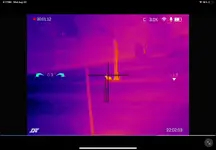
I’ve used the thermal imaging to detect rabbits, an armadillo out to 120yds - furthest clear area on my property. I detected 2” mice at 60+ yards with the thermal. The thermal is low resolution, I can sometimes make out the rabbit ears, but not always. The idea is not to identify and shoot your prey using low resolution thermal. It is intended to give you a fast means to locate prey using the thermal and then with the push of a button you can switch to night vision and id and then take your shot. It is quick as you can quickly pan and watch for hot spots.
The night vision is excellent. Using the ir illumination I can see my 1 acre like it is daylight, albeit in black and white. I can also spot critters using the night vision and infrared , by looking for their eyes. I actually saw the eyes of the mice using night vision first and then confirmed they were warm blooded with the thermal.
The laser rangefinder is convenient, but not always accurate. It has difficulty ranging smaller objects and has difficulty ranging my steel backstop. Fair enough, it’s steel and although painted maybe it’s reflecting the laser. Except my hand held Leupold laser rangefinder has no issues and it’s almost 20 years old. Having said all of this, it is still useable and maybe only an issue with mine.
When you take the time to ensure the ballistic information is correct, it is accurate and effective.
The ballistics setup is not intuitive and takes a little bit of getting used to. There’s five rifle/sight-in profiles lettered A-E and there’s five ballistic profiles lettered A-E and they’re not the same.
I absolutely love using this scope at night, it is really good for the price.
I’ve used it a lot during the day in bright Florida sunshine. It does not excel at target shooting in bright daylight. It’s a combination of not being able to cope with high contrast, flare (it has no lens hood) and pixelation caused by digital zoom. I cannot see a 5” target at 100 yds in the afternoon. As in, you just see an overexposed white background. But, it’s not designed to be a benchrest scope, I like to use it during the day because the video recording is awesome for troubleshooting my shooting. I have lots of issues with poor form and the video recording helps me to see where the actual point of aim was when fired and follow through. Again it’s really designed as a night scope and it does that really well. I’m not on if those lucky shooters that can see their pellet flight. But, at night the infrared lights up the pellet and makes it easy to see.
Before I got carried away, I originally started this post to say the following: if you take the time to calculate your correct ballistic coefficient (BC) and enter in the correct projectile information into the ballistic profile, the built-in ballistic calculator works well. You find your target using thermal, push a button and switch to night vision and verify the target. Then hit the rangefinder button and range the target, push the button again for an aiming solution. Depending on what you select in the setup, the scope will either move your reticle to the calculated aim point or provide a secondary aim point on the scope. I’ve used both and they both work. I now prefer the secondary holdover point.
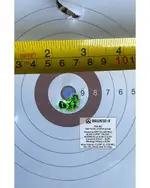
Today, took chrono readings at the muzzle of my ghost and st 50yds and came up with a BC of .052 for the AEA .25 33.95 gr pellets. I then shot a group at the sight-in distance if 50yds then ranged my 100 yd target and let it calculate a holdover and fired a second group. The second group was almost correct for elevation and had a wind driven left to right spread. The steel target is at 102-103 yds. I need to tweak the BC a little bit. The DNT app also has a BC confirmation function that I have not tried.
In my opinion it’s an excellent low light shooting solution that works as an all round scope with some daylight limitations. Remember, it’s just my opinion lol.
I’ve been using my DNT 225R Digital scope for about 5 months. This not a review , merely some of my observations while using it. I’ve shot several thousands pellets/slugs using it in that time. It has been perched mostly on a BRK Ghost HP .25, but has also seen duty on my BRK Sonoran .30 and my Barra 250z .22. I may have tried it on my Air Force TalonP .25, I can’t remember. In my opinion it would make a potent lightweight pesting gun when mounted on a TalonP, along with a butt stock.
The TNC225R is a digital 5-20x scope, with night vision, ir illumination, laser range finder, thermal imaging and push button ballistics calculation. It also has built-in video recording. It currently sells for $1,330 USD.
First of all it works.
I’ve used the thermal imaging to detect rabbits, an armadillo out to 120yds - furthest clear area on my property. I detected 2” mice at 60+ yards with the thermal. The thermal is low resolution, I can sometimes make out the rabbit ears, but not always. The idea is not to identify and shoot your prey using low resolution thermal. It is intended to give you a fast means to locate prey using the thermal and then with the push of a button you can switch to night vision and id and then take your shot. It is quick as you can quickly pan and watch for hot spots.
The night vision is excellent. Using the ir illumination I can see my 1 acre like it is daylight, albeit in black and white. I can also spot critters using the night vision and infrared , by looking for their eyes. I actually saw the eyes of the mice using night vision first and then confirmed they were warm blooded with the thermal.
The laser rangefinder is convenient, but not always accurate. It has difficulty ranging smaller objects and has difficulty ranging my steel backstop. Fair enough, it’s steel and although painted maybe it’s reflecting the laser. Except my hand held Leupold laser rangefinder has no issues and it’s almost 20 years old. Having said all of this, it is still useable and maybe only an issue with mine.
When you take the time to ensure the ballistic information is correct, it is accurate and effective.
The ballistics setup is not intuitive and takes a little bit of getting used to. There’s five rifle/sight-in profiles lettered A-E and there’s five ballistic profiles lettered A-E and they’re not the same.
I absolutely love using this scope at night, it is really good for the price.
I’ve used it a lot during the day in bright Florida sunshine. It does not excel at target shooting in bright daylight. It’s a combination of not being able to cope with high contrast, flare (it has no lens hood) and pixelation caused by digital zoom. I cannot see a 5” target at 100 yds in the afternoon. As in, you just see an overexposed white background. But, it’s not designed to be a benchrest scope, I like to use it during the day because the video recording is awesome for troubleshooting my shooting. I have lots of issues with poor form and the video recording helps me to see where the actual point of aim was when fired and follow through. Again it’s really designed as a night scope and it does that really well. I’m not on if those lucky shooters that can see their pellet flight. But, at night the infrared lights up the pellet and makes it easy to see.
Before I got carried away, I originally started this post to say the following: if you take the time to calculate your correct ballistic coefficient (BC) and enter in the correct projectile information into the ballistic profile, the built-in ballistic calculator works well. You find your target using thermal, push a button and switch to night vision and verify the target. Then hit the rangefinder button and range the target, push the button again for an aiming solution. Depending on what you select in the setup, the scope will either move your reticle to the calculated aim point or provide a secondary aim point on the scope. I’ve used both and they both work. I now prefer the secondary holdover point.
Today, took chrono readings at the muzzle of my ghost and st 50yds and came up with a BC of .052 for the AEA .25 33.95 gr pellets. I then shot a group at the sight-in distance if 50yds then ranged my 100 yd target and let it calculate a holdover and fired a second group. The second group was almost correct for elevation and had a wind driven left to right spread. The steel target is at 102-103 yds. I need to tweak the BC a little bit. The DNT app also has a BC confirmation function that I have not tried.
In my opinion it’s an excellent low light shooting solution that works as an all round scope with some daylight limitations. Remember, it’s just my opinion lol.