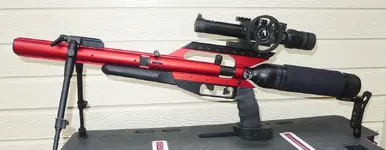


I bought an Air Force Condor on their 4th of July sale, paying $395 for a 24inch barreled .20. Yes, in 2024 I bought an Airforce Condor, a gun that has mostly been unchanged since 2004 when it was first produced. And yes, that makes it a 20 year old design, and yet somehow it offers some features and aspects that are only found in the Airforce line of guns.
I'm not going to try to make a case for the Airforce guns being the "best" gun currently available. Many of the advancements made in airguns in the last 20 years are exactly that, advancements. But I am planning on periodically sharing the process of getting to know my new gun, and my opinions and impressions and thoughts as I do so. Much of what I learn and am going to share can be found scattered throughout the internet, representing 20 years worth of guys that have "been there, done that." So I understand that possibly none of this will be "breaking news."
So why did I buy a gun that is arguably outdated and considered by many to be "less than"? Simple answer is because it was a good enough deal to finally push me over the edge to satisfy the curiosity I've had about the gun since I got into airguns around 2010. More complicated answer is because I wanted to, which opens up the can of worms about how all of these airguns we own and shoot and enjoy and spend so much time and money on are wants, not needs.
From a financial standpoint, my new on-sale Condor was only slightly more than the going rate of buying a Lothar blank and having it machined to fit a gun. But for that $395 I got the whole gun, WITH a Lothar barrel, not JUST the barrel.
So why a .20, well, back to wants and needs. It's simply my favorite caliber and that's the caliber I wanted. In the interest of purchase justification, this Condor will allow me to revisit the .20/25.4gr experiment I was working on a while back. That was .22 Monster RDs sized down to .20. None of my other .20s could push them very fast. I will also be able to see how the .20/18.9gr slugs do at faster speeds. I've shot A LOT of those 18.9s @ 870-925 and they're really dang good there, so I'm curious to see how they are at even faster speeds.
And that's where the Condor, even for a 20 year old design, still has the upper hand on many of the more recently released airgun designs: power. As I was debating the decision to buy this gun I did some internet searching, and like I said before, found a veritable plethora of info. In all that I stumbled on a video of Ton Jones shooting a .25 and getting 1200fps with 34grain pellets, in a stock Condor. That is some serious power! Many of the airguns used at the top levels of competition aren't that powerful. And of course that much speed for that particular pellet is simply silly, as that's not where they shine anyway, but the fact that it could push them that fast was somewhat surprising to me. And THEN he swapped a smaller transfer port into the gun and was still getting 1000fps with that same .25/34grain. And this was on pressures from 3000 down to 2000, which is much easier to attain that than the big 250+ bar fill guns so common today.
So the gun arrived late yesterday evening. First order of business was to pull the barrel and figure out what I had. Of course the brown/red cosmolene needed removed first. Pushed a couple pellets through and figured out that the first 2.5 or so inches where the 16mm blank is turned down so much had a much larger bore than the rest of the barrel. Turning them down opens them up. So there was the same feel as a choke right at the point the barrel OD is the full 16mm. Then steady resistance, than the choke, and it's a heck of a choke. So all the important features of a barrel are there, gradual increase of tightness till the choke, it's just currently in exaggerated steps. And that's fine, I can work with that. Some focused polished with aggressive abrasives at a later date can smooth all that up to make it somewhat tapered from breech to muzzle. I was also surprised to find more shallow grooves/less aggressive lands than what I consider normal for a 12 groove Lothar barrel, and that's probably a good thing.
Barrel is fixed in a method I've not seen before. For years the typical airgun configuration was barrels glued into the breech. That has changed to be lots of barrels held in the breech block by set screws, with a few outliers of barrels threaded into the receivers. BUT the Airforce guns are neither. Yes there are set screws, but they're not at the breech block like in so many guns. Instead, they are threaded into the side of the gun's space-age looking frame and into collars that are grub screwed to the barrel. So two grub screws through the the side of the gun, into those collars on the barrel, and then three more grub screws along the bottom of the frame (one of which also holds the frame endcap), and finally a grub screw on the top of the frame that holds the endcap for the frame, which is itself another collar helping center the barrel. Ie the barrel is fixed to the gun in the middle, not at the rear/breech like in most other designs.
There are dovetail rails along the top and bottom of the length of the frame, not just where the scope would mount. So I'm recycling a dovetail to picatinny adaptor on the forearm to create a place to mount a bipod.
And I'm currently using a longer (also recycled) dovetail to pic adaptor for the scope. @fderry was kind enough to send me some PMs with helpful tips and tricks and he suggested a longer dovetail to pic adaptor for the scope to aid in the notorious frame flex for which these guns have a reputation. So I've got a $16 10 inch one of those on order from Amazon.
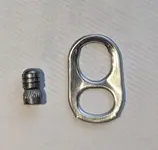
The first thing I did (and I'm not so sure it didn't come out of the box this way) was snap the head off the sad little 4-40 plastic screw in the power wheel. Easy enough, trip to ACE hardware and a tiny little pan head screw. The OD of the head was slightly too big for the place it needs to live so I reduced it just enough to fit on the gap. That screw serves as the indicator for where the gun is at on the hammer spring preload.
As for the hammer spring, I didn't measure it but it's probably 3/4 of an inch across and 4 inches long. It's the hammer spring that all other hammer springs want to grow up and be like. It has a little sticker taped to one of the coils and the sticker is labeled "spring dampener." I suppose that big spring could have some twang without something to kill vibrations.
Knowing that I'd want to tinker, I included what Airforce calls their Ring Loc kit in my order. It's basically as simple as a set of transfer ports of various sizes. And yes, the tps can be swapped without degassing or even removing the bottle, very easy. $50 well spent, more on that in a minute.
I've read all about spin loc versus not spin loc tanks with these Airforce guns, and finally learned what that means. The spin loc is a little ring that rotates in the rear of the gun to allow bottle attachment without having to spin the bottle onto fixed threads in the gun frame. Airforce includes a wrench specifically for this. I understand early guns didn't have gauges or fill ports (cuz they would have hit the frame when threaded on) but the current production guns DO have gauges and fill ports (foster), because of the spin loc system.
For some of the negatives.....there are some plastic parts that I'd really have preferred to have be metal. Namely the power wheel, and the collar next to it, as well as the sliding breech cover. The biggest negative ive encountered so far was that the auto-safety quit functioning around shot 50. And it created a somewhat dangerous situation. I was loaded and cocked and the safety would not slide forward to disengage to allow me to fire the shot. And the gun can also not be de-cocked when the safety is on. So I removed the air bottle (spin Loc is pretty sweet) and headed back to the gunroom to tear down the trigger.
The trigger components were finished better than I expected, no deep machining marks like I've seen on sears in much more expensive airguns. It took me a lot longer than it should have to get the gun shootable, as I kept arriving at the same point with each rebuild, non-functional safety, which means non-functional gun with how it's designed. I finally decided to just omit the auto-safety and was back to shooting within 10 minutes. I was rewarded with a less frustrating experience, since the auto-safety was annoying even when it was functional for those first few shots, but also a much better feeling trigger without those auto-safety components in there.
Before even taking a shot I concluded that the transfer port that came in the gun was MUCH too big for a .20. The sizes included in the ring loc are: .232, .166, .145, .123 and an .070. Airforce says the 0.07 is meant to be customized to a preferred size, but I decided to shoot with it as-is. 0.166 is what came installed in the gun.
Being unregulated, we're hunting for the middle of the bell curve of fps, and that seemed to be mostly 2400-1900, depending on hammer tension. So most of these fps ranges were what the gun produces around 2000-2100psi.
With the 0.070 transfer port, and the .20/13.73, I saw 590fps with no hammer spring preload dialed in, and 680 with max hammer spring preload. So a range of about 10.5-14fpe. Gun was nearly silent here, just a click.
With the 0.123 transfer port, I was seeing 980fps with the .20/13.73 with no hammer spring preload dialed in, and up to 960fos with the .20/18.9 with max hammer spring preload. So a range of about 29-39fpe.
With the 0.145 transfer port I was too fast for either JSB pellet, and was hitting 1024fps with what I'm calling 10/10 on the power wheel, with the .20/18.9 NSA. So about 44fpe.
(10/10 on the power wheel is referencing 10 on both the horizontal and vertical scale. It goes up to I think 12 on the horizontal scale. The horizontal seems more of a macro adjustment, and the vertical scale a micro adjustment. So with the 0.145 tp, there'd be even more than 44fpe available from the .20/18.9).
I didn't even try the 0.166 or 0.232 and don't think I'll need to with the .20 barrel.
As for accuracy, it was trying to storm while I was shooting so the wind was crazy. It was blowing pellet tin lids off my table and I had to have my notebook paper weighed down with a bunch of full pellet tins to keep it from whipping around. Ie it wasn't the day for accuracy testing. However, the .20/18.9gr NSA showed quite a bit of promise as fast as 980, and the .20/15.89 we're really good at 930-950 with the 0.123 tp and minimum hammer spring tension. In fact, at the end of the day I left the gun at that 930-950fps with .20/15.89s and 0.123 tp for now. It's a happy medium of conserving air and pleasantness on the shot cycle. Filling to 2050 and shooting down to 1600 kept the fps in that 930-955 range and is currently producing sufficient consistency and accuracy to make it fun. And quite a few shots there too. AND I can get to 960 with the .20/18.9s by just dialing in more hammer spring tension.
I wasn't a fan of how the gun felt and sounded with the 0.145 transfer port, but I know I'll come back around to that for shooting higher fpe at some point.
The gun is long.
I like how much power it can produce with such low fill pressure.
I like the trigger now that the auto-safety crap is removed.
I like the adjustability. Those transfer ports allow for a very wide spread of power output.
I like the simplicity.
Airforce calls these their "utility" airguns, and I see why, and that's not necessarily a bad thing. I was talking to a brother in law recently about how complicated trucks are. He commented that he prefers trucks with roll up windows, among other pieces of older tech, "less to go wrong and less to break." And I kinda agree with him. Our world is complicated these days that it's kinda nice to step back to a simpler time by enjoying a straightforward gun.
Work on progress, already has different scope and different rings on it ...
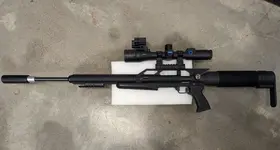
Public thanks to @fderry for the very helpful Airforce PMs in the last few days.
I'm not going to try to make a case for the Airforce guns being the "best" gun currently available. Many of the advancements made in airguns in the last 20 years are exactly that, advancements. But I am planning on periodically sharing the process of getting to know my new gun, and my opinions and impressions and thoughts as I do so. Much of what I learn and am going to share can be found scattered throughout the internet, representing 20 years worth of guys that have "been there, done that." So I understand that possibly none of this will be "breaking news."
So why did I buy a gun that is arguably outdated and considered by many to be "less than"? Simple answer is because it was a good enough deal to finally push me over the edge to satisfy the curiosity I've had about the gun since I got into airguns around 2010. More complicated answer is because I wanted to, which opens up the can of worms about how all of these airguns we own and shoot and enjoy and spend so much time and money on are wants, not needs.
From a financial standpoint, my new on-sale Condor was only slightly more than the going rate of buying a Lothar blank and having it machined to fit a gun. But for that $395 I got the whole gun, WITH a Lothar barrel, not JUST the barrel.
So why a .20, well, back to wants and needs. It's simply my favorite caliber and that's the caliber I wanted. In the interest of purchase justification, this Condor will allow me to revisit the .20/25.4gr experiment I was working on a while back. That was .22 Monster RDs sized down to .20. None of my other .20s could push them very fast. I will also be able to see how the .20/18.9gr slugs do at faster speeds. I've shot A LOT of those 18.9s @ 870-925 and they're really dang good there, so I'm curious to see how they are at even faster speeds.
And that's where the Condor, even for a 20 year old design, still has the upper hand on many of the more recently released airgun designs: power. As I was debating the decision to buy this gun I did some internet searching, and like I said before, found a veritable plethora of info. In all that I stumbled on a video of Ton Jones shooting a .25 and getting 1200fps with 34grain pellets, in a stock Condor. That is some serious power! Many of the airguns used at the top levels of competition aren't that powerful. And of course that much speed for that particular pellet is simply silly, as that's not where they shine anyway, but the fact that it could push them that fast was somewhat surprising to me. And THEN he swapped a smaller transfer port into the gun and was still getting 1000fps with that same .25/34grain. And this was on pressures from 3000 down to 2000, which is much easier to attain that than the big 250+ bar fill guns so common today.
So the gun arrived late yesterday evening. First order of business was to pull the barrel and figure out what I had. Of course the brown/red cosmolene needed removed first. Pushed a couple pellets through and figured out that the first 2.5 or so inches where the 16mm blank is turned down so much had a much larger bore than the rest of the barrel. Turning them down opens them up. So there was the same feel as a choke right at the point the barrel OD is the full 16mm. Then steady resistance, than the choke, and it's a heck of a choke. So all the important features of a barrel are there, gradual increase of tightness till the choke, it's just currently in exaggerated steps. And that's fine, I can work with that. Some focused polished with aggressive abrasives at a later date can smooth all that up to make it somewhat tapered from breech to muzzle. I was also surprised to find more shallow grooves/less aggressive lands than what I consider normal for a 12 groove Lothar barrel, and that's probably a good thing.
Barrel is fixed in a method I've not seen before. For years the typical airgun configuration was barrels glued into the breech. That has changed to be lots of barrels held in the breech block by set screws, with a few outliers of barrels threaded into the receivers. BUT the Airforce guns are neither. Yes there are set screws, but they're not at the breech block like in so many guns. Instead, they are threaded into the side of the gun's space-age looking frame and into collars that are grub screwed to the barrel. So two grub screws through the the side of the gun, into those collars on the barrel, and then three more grub screws along the bottom of the frame (one of which also holds the frame endcap), and finally a grub screw on the top of the frame that holds the endcap for the frame, which is itself another collar helping center the barrel. Ie the barrel is fixed to the gun in the middle, not at the rear/breech like in most other designs.
There are dovetail rails along the top and bottom of the length of the frame, not just where the scope would mount. So I'm recycling a dovetail to picatinny adaptor on the forearm to create a place to mount a bipod.
And I'm currently using a longer (also recycled) dovetail to pic adaptor for the scope. @fderry was kind enough to send me some PMs with helpful tips and tricks and he suggested a longer dovetail to pic adaptor for the scope to aid in the notorious frame flex for which these guns have a reputation. So I've got a $16 10 inch one of those on order from Amazon.
The first thing I did (and I'm not so sure it didn't come out of the box this way) was snap the head off the sad little 4-40 plastic screw in the power wheel. Easy enough, trip to ACE hardware and a tiny little pan head screw. The OD of the head was slightly too big for the place it needs to live so I reduced it just enough to fit on the gap. That screw serves as the indicator for where the gun is at on the hammer spring preload.
As for the hammer spring, I didn't measure it but it's probably 3/4 of an inch across and 4 inches long. It's the hammer spring that all other hammer springs want to grow up and be like. It has a little sticker taped to one of the coils and the sticker is labeled "spring dampener." I suppose that big spring could have some twang without something to kill vibrations.
Knowing that I'd want to tinker, I included what Airforce calls their Ring Loc kit in my order. It's basically as simple as a set of transfer ports of various sizes. And yes, the tps can be swapped without degassing or even removing the bottle, very easy. $50 well spent, more on that in a minute.
I've read all about spin loc versus not spin loc tanks with these Airforce guns, and finally learned what that means. The spin loc is a little ring that rotates in the rear of the gun to allow bottle attachment without having to spin the bottle onto fixed threads in the gun frame. Airforce includes a wrench specifically for this. I understand early guns didn't have gauges or fill ports (cuz they would have hit the frame when threaded on) but the current production guns DO have gauges and fill ports (foster), because of the spin loc system.
For some of the negatives.....there are some plastic parts that I'd really have preferred to have be metal. Namely the power wheel, and the collar next to it, as well as the sliding breech cover. The biggest negative ive encountered so far was that the auto-safety quit functioning around shot 50. And it created a somewhat dangerous situation. I was loaded and cocked and the safety would not slide forward to disengage to allow me to fire the shot. And the gun can also not be de-cocked when the safety is on. So I removed the air bottle (spin Loc is pretty sweet) and headed back to the gunroom to tear down the trigger.
The trigger components were finished better than I expected, no deep machining marks like I've seen on sears in much more expensive airguns. It took me a lot longer than it should have to get the gun shootable, as I kept arriving at the same point with each rebuild, non-functional safety, which means non-functional gun with how it's designed. I finally decided to just omit the auto-safety and was back to shooting within 10 minutes. I was rewarded with a less frustrating experience, since the auto-safety was annoying even when it was functional for those first few shots, but also a much better feeling trigger without those auto-safety components in there.
Before even taking a shot I concluded that the transfer port that came in the gun was MUCH too big for a .20. The sizes included in the ring loc are: .232, .166, .145, .123 and an .070. Airforce says the 0.07 is meant to be customized to a preferred size, but I decided to shoot with it as-is. 0.166 is what came installed in the gun.
Being unregulated, we're hunting for the middle of the bell curve of fps, and that seemed to be mostly 2400-1900, depending on hammer tension. So most of these fps ranges were what the gun produces around 2000-2100psi.
With the 0.070 transfer port, and the .20/13.73, I saw 590fps with no hammer spring preload dialed in, and 680 with max hammer spring preload. So a range of about 10.5-14fpe. Gun was nearly silent here, just a click.
With the 0.123 transfer port, I was seeing 980fps with the .20/13.73 with no hammer spring preload dialed in, and up to 960fos with the .20/18.9 with max hammer spring preload. So a range of about 29-39fpe.
With the 0.145 transfer port I was too fast for either JSB pellet, and was hitting 1024fps with what I'm calling 10/10 on the power wheel, with the .20/18.9 NSA. So about 44fpe.
(10/10 on the power wheel is referencing 10 on both the horizontal and vertical scale. It goes up to I think 12 on the horizontal scale. The horizontal seems more of a macro adjustment, and the vertical scale a micro adjustment. So with the 0.145 tp, there'd be even more than 44fpe available from the .20/18.9).
I didn't even try the 0.166 or 0.232 and don't think I'll need to with the .20 barrel.
As for accuracy, it was trying to storm while I was shooting so the wind was crazy. It was blowing pellet tin lids off my table and I had to have my notebook paper weighed down with a bunch of full pellet tins to keep it from whipping around. Ie it wasn't the day for accuracy testing. However, the .20/18.9gr NSA showed quite a bit of promise as fast as 980, and the .20/15.89 we're really good at 930-950 with the 0.123 tp and minimum hammer spring tension. In fact, at the end of the day I left the gun at that 930-950fps with .20/15.89s and 0.123 tp for now. It's a happy medium of conserving air and pleasantness on the shot cycle. Filling to 2050 and shooting down to 1600 kept the fps in that 930-955 range and is currently producing sufficient consistency and accuracy to make it fun. And quite a few shots there too. AND I can get to 960 with the .20/18.9s by just dialing in more hammer spring tension.
I wasn't a fan of how the gun felt and sounded with the 0.145 transfer port, but I know I'll come back around to that for shooting higher fpe at some point.
The gun is long.
I like how much power it can produce with such low fill pressure.
I like the trigger now that the auto-safety crap is removed.
I like the adjustability. Those transfer ports allow for a very wide spread of power output.
I like the simplicity.
Airforce calls these their "utility" airguns, and I see why, and that's not necessarily a bad thing. I was talking to a brother in law recently about how complicated trucks are. He commented that he prefers trucks with roll up windows, among other pieces of older tech, "less to go wrong and less to break." And I kinda agree with him. Our world is complicated these days that it's kinda nice to step back to a simpler time by enjoying a straightforward gun.
Work on progress, already has different scope and different rings on it ...
Public thanks to @fderry for the very helpful Airforce PMs in the last few days.


 .
.

 Very thorough review
  ) A few guys on Ham grabbed one on that July sale, a good buy, keep us updated sir