Install the app
How to install the app on iOS

Follow along with the video below to see how to install our site as a web app on your home screen.

Note: This feature may not be available in some browsers.

Ballistic Theory Changing My Thinking About Slugs

rsterne

HAM Shooter
41
145
HAM Points
245.25
Country flag
One very cool thing about airguns is that I never stop learning something new, or at least a new way of looking at something!.... There have been a few things happening lately that have changed my thinking about airgun slugs and the velocity we shoot them at.... Here are the "new" developments....

It turns out that the G1 drag model we have been using to calculate the Ballistics Coefficient of our slugs is not a very good fit to the drag curve of the slugs.... This first showed up as higher than expected BC's for our slugs when they were shot at higher velocities.... Manufacturers were claiming high BC(G1) values for their slugs, to the point of being hard to believe.... When tested at 800-900 fps, we got much lower values than claimed.... Then articles started showing up claiming that the faster slugs were shot, the higher the BC(G1) was.... If the drag model being used to calculate the BC (in this case the G1 model) is a poor match, then BC values change with velocity, whereas they should remain constant.... This was a warning flag that something was wrong.... When we started investigating the actual drag of slugs, by shooting them over a LabRadar chronograph, we quickly found out that the drag in the low Transonic region, between Mach 0.8-0.9, was lower than the G1 model.... This was the reason that as the velocity was increased, the calculated BC(G1) increased, because the slugs were being compared to a drag model where the drag was increasing faster than it was with our slugs....

Miles Morris, UK ballistician, calculated what the drag should be doing for our typical slugs (a tangent ogive with meplat design), and confirmed that what we were seeing in fact had a base in theory.... He called this new drag model SLG0, and while it is a work in progress, it gives more constant BC's than does the G1 drag model.... However, it is only available in one Ballistics Calculator, the "MERO" developed by another UK chap, George Conway.... We have found that the RA4 Ballistics Model, which was intended for the .22LR rimfire bullet, is not a bad match for our slugs, and far better than the G1 model.... Slug manufacturers would be doing a great service to their customers if they quoted the BC(RA4) instead of, or at least in addition to, the BC(G1).... Unfortunately the "quoted BC" using the RA4 model is lower than by using the (flawed) G1 model, so they can't brag as much!....

Those who have followed my writings over the years will remember that I have proposed that there is an "optimum" velocity to shoot pellets at to minimize the wind drift.... It turns out that is about 900 fps, plus or minus a bit, depending on the range you are shooting.... Since the G1 and GA drag models have similar drag curves, then the same thing should apply to slugs, optimum velocity for minimum wind drift should be similar to pellets.... Well, it looks like I got that wrong, because our slugs do NOT follow the G1 drag curve.... Follow this thread as I add to it, and you will see why....

Bob
 
Thank you Bob for your past and continuing work on this topic! I have been following yours (and now Centercut's) threads since forever. I find it amazing how many people just refuse to believe about wind drift at different speeds, I think of them as our own flat-earther contingent. Maybe someday it will sink in but for now I applaud you, and all, for continuing to try.
 
"I find it amazing how many people just refuse to believe about wind drift at different speed"

I think most of them are the dont shoot past 20y

Personly i curse the wind g0ds daily past 50y ..lol. Like .177 just a wiff out past 50 is all it yakes to blow a good grouping .

You concider rapid energy loss as you go out you can kinda see it dont take much to push one off.
Imho
 
Yep.

I have 2 builds for long range rifle hunting-beyond 400 yards.

The newer VLD bullets like Hornadys ELD-X use a G7 drag coefficient, as the G1 was basically developed for flat base bullets, and becomes a less accurate model starting with boat tail bullets.

A lot of this math has been done, by and for long range rifle shooters, that may save you time and trouble as it's relevant.

A manufacturers quoted BC is a starting point, actual BC out of YOUR rifle must be determined by shooting, for actual velocity and adjusting your calculator thru adding the difference in ACTUAL point of impact out of your rifle at extended ranges versus what it was SUPPOSED to be.

The BC varies with velocity and range, and most ppl avg. their BC in their calculations using the mid range BC.

Factor in air temp, barometric pressure and humidity as well.
 
Following Bobs topic. I’ve learned most of what I know of pellet and slug ballistics from his articles.

FYI, I have downloaded the drag models for the SLG0 (slugs) and SLG1 (boat tail slugs) into the new ChairGun Elite+ app. Haven’t tested them out yet but got the info from Miles. He also has a GA2 pellet drag model to update the current GA profile that most of us use for pellets.
 
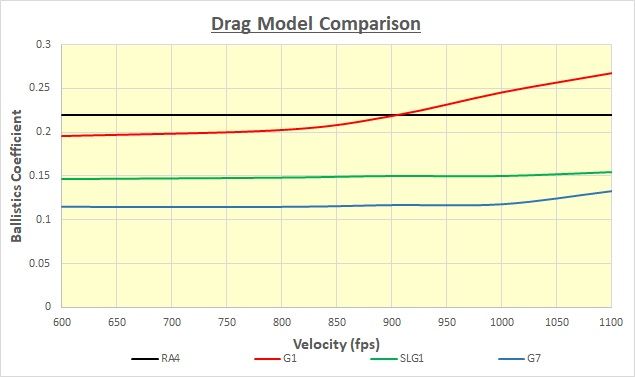
OK, I hope you are with me so far.... Here is a chart showing what the BCs would be for a slug that matched the RA4 Drag Model perfectly, and using that model had a BC of 0.22.... That is the black line on this chart....


The red line represents the BC's you would calculate, for the same slug, if you used the G1 Drag Model.... Instead of being a straight, horizontal line, it shows pretty good consistency below 800 fps, but the faster you drive the slug above that, the higher the BC is.... NOTE, this does not mean it has less drag, only that the BC's above 800 fps using the G1 model are faulty, if the slug drag follows the RA4 proflie.... The other two lines are for the G7 (boattail) model, and Miles' SLG1 model, which he has developed for my "Bob's Boattails".... Both the G1 and SLG1 models agree pretty closely with the RA4, and you could use any of the three with this slug with minimum error.... However, the G1 model simply does not work well for this slug above 800 fps....

I am following this post with another dealing with why this is important in determining the optimum velocity to shoot a slug at for minimum wind drift....

Bob
 
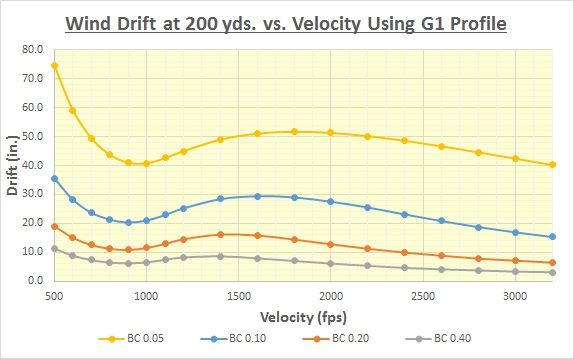
OK, so here is the meat and potatoes of this thread.... Since the drag of any projectile rises quickly in the Transonic region (Mach 0.8-1.2), and the wind drift of a projectile is proportional to the "Lag Time", which is the DIFFERENCE in flight time between in a vacuum and in the real world, the worse the drag is, the faster the projectile slows down, and the more it drifts.... This results in an "Optimum Velocity" for any projectile, to minimize the wind drift.... These curves take this general form....


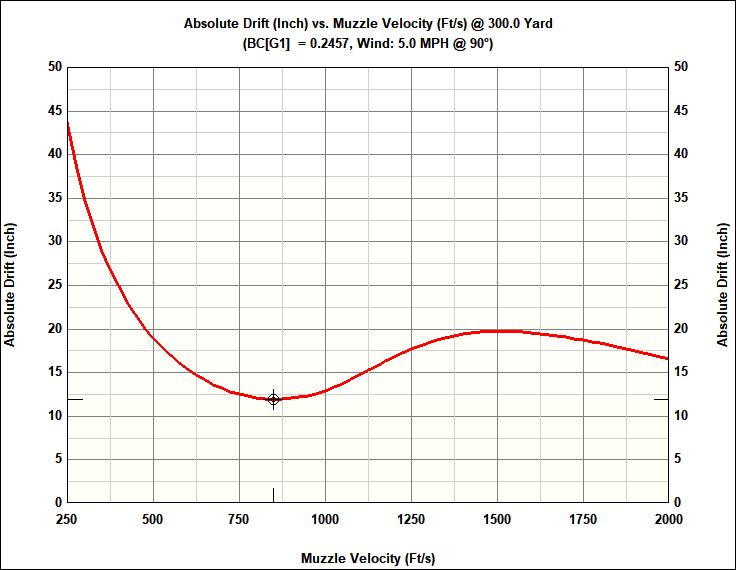
However, the specific shape of the curve depends on the SHAPE of the drag curve of the projectile.... If we use the G1 profile to predict the optimum velocity, and that is a poor match, we get the wrong answer for the optimum velocity.... Here is the curve of wind drift for the projectile in the previous post, predicted using the G1 drag profile....


These curves are part of the "MERO" Ballistics Calculator developed by George Conway, and available for most platforms at: GPC Ballistics Applications for Windows, MacOS and Linux

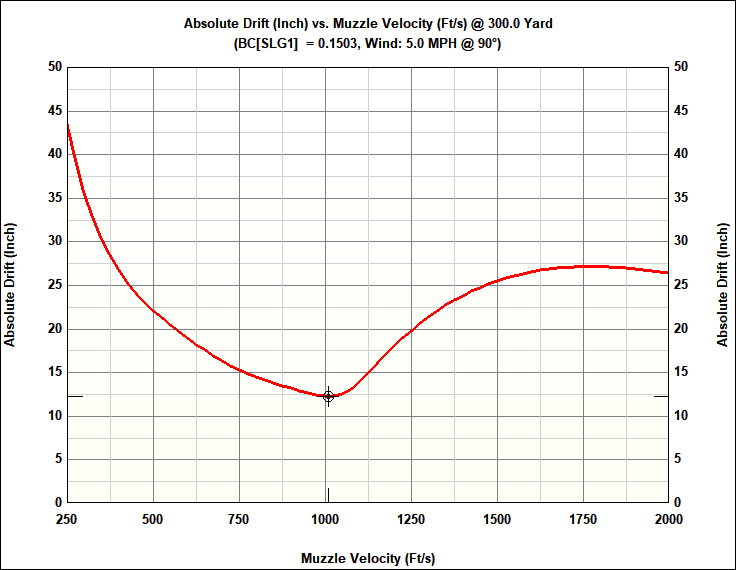
Note that the optimum velocity to minimize wind drift (using G1) is only 850 fps over a distance of 300 yards!.... Now let's see what happens if we use the RA4 drag model....


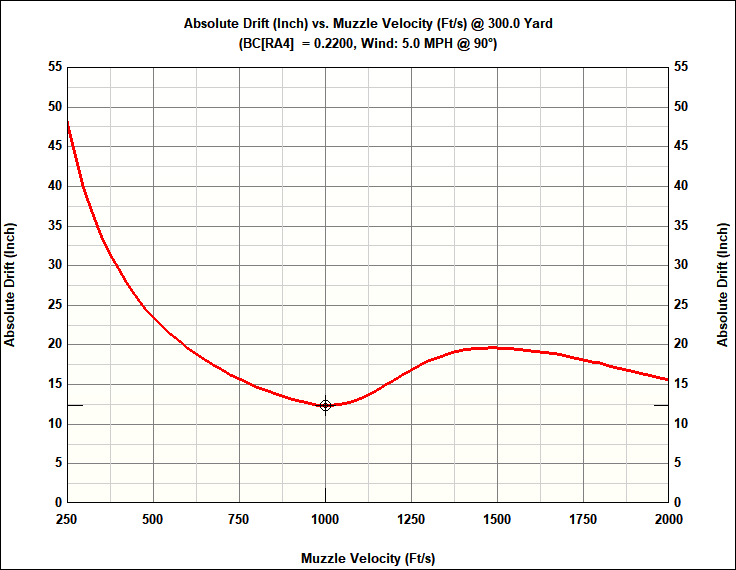
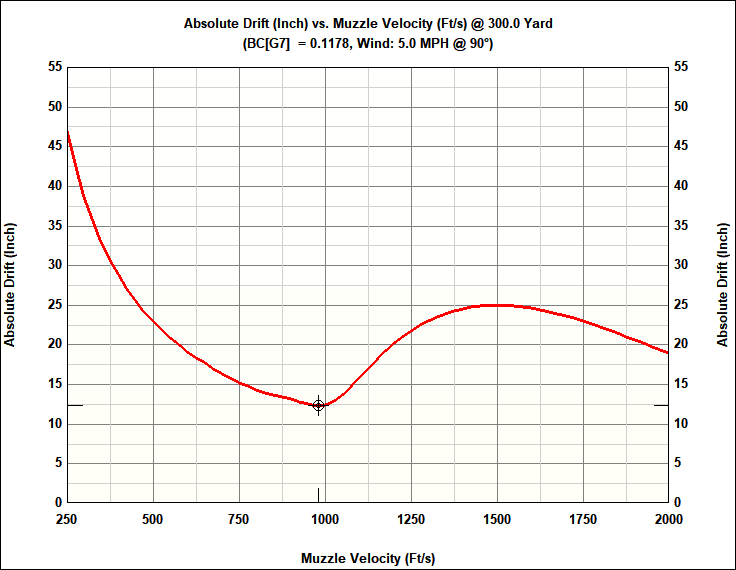
Note that the optimum velocity for minimum wind drift is now 1000 fps, instead of 850 fps.... If we use the wrong drag model, we get the wrong results.... Here are two more charts, for the SLG1 and G7 drag models....


These two drag models also predict an optimum velocity of close to 1000 fps.... The eagle-eyed among you will have noticed that the value of the BC used for each chart changes with the drag model chosen.... If you look at the chart in the previous post, the BC values for 1000 fps change as you change drag models, and MERO selects the correct value for the other drag models at the velocity you are looking at, in this case 1000 fps....

So, all the articles I have written previously, where I talk about 900-950 fps as being the optimum velocity to minimize wind drift are in error! (for slugs).... That is true for pellets, which largely follow the GA drag model pretty closely, but our slugs do NOT follow the G1 model very well, so the RA4 (or the G7 or SLG1) is a far better choice.... Now which one you choose will give you a completely different NUMBER for the BC, but as long as you use the same drag model to calculate your BC as you do to use it in your Ballistics Calculator, you will be fine....

OK, so I have changed my mind, for slugs, I now would prefer to shoot that at around 1000 fps (assuming they are accurate at that speed).... Does that make a difference in how I design them or choose them?....

You bet it does!.... Stay tuned!....

Bob
 
Those of you who have been following my articles will remember that there is a way to calculate the absolute maximum FPE that a PCP can produce.... You take the bore area times the pressure, and multiply by the barrel length, and you end up with the total FPE that can be produced.... However, that number includes all the energy lost to friction, etc., plus the biggest loss of all, which is the energy required to accelerate the mass of air that in turn accelerates the projectile.... I came up with a "lofty goal" of 50% of that for a maximum power shot, a number which is seldom achieved in practice.... My own guns usually fall about 10% short of that goal for a full power shot (ie 45% of maximum), and in fact by the time I detune to a level where it isn't wasting huge quantities of air on every shot, 40% of the theoretical maximum is pretty typical, for the way I shoot them....

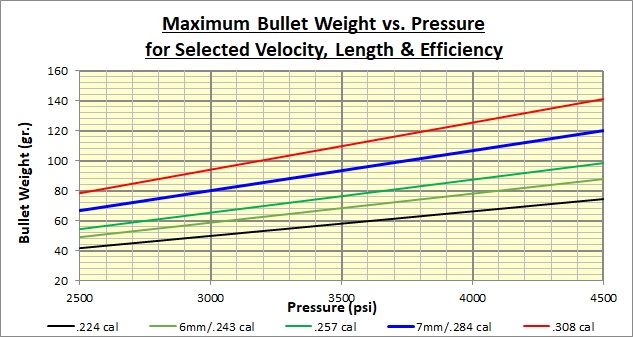
So, since we can calculate the maximum possible, if we take 40% of that as the likely result, we can get a pretty good idea of how much FPE one of my "high power" PCPs is likely to produce.... If we work the FPE equation backwards, instead of calculating the FPE based on weight and velocity, we can pick a velocity, and knowing the likely maximum FPE, we can come up with the heaviest slug I am likely to be able to drive at that velocity, knowing the barrel length and pressure.... I built a spreadsheet to do this for me, where I can input the velocity desired, the pressure, and my 40% typical efficiency factor, and it will spit out the maximum slug weight.... That can then be converted to the Sectional Density of the slug, and that number will be a constant, regardless of calibre.... Here is the first chart giving maximum slug weight, for .224 through .308 cal.... using 1000 fps, 28" barrel, and 40% efficiency....


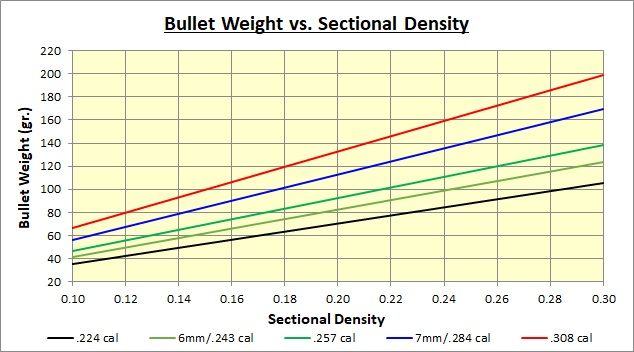
Here is the next chart, showing the how slug weight varies with the SD.... Similar lines can be drawn for any calibre.... I chose .224 through .308 as they are the most likely I would use for a long range, maximum power PCP....


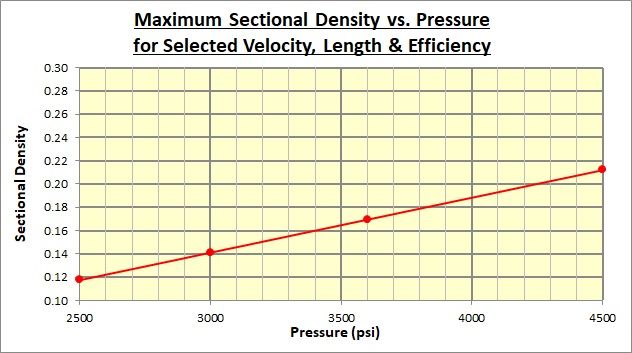
And here is the conclusion, a single chart showing maximum SD vs pressure, again for 1000 fps, a 28" barrel, and 40% efficiency....


Note that the calibre is no longer important.... It is the SD that matters, and there is a maximum SD depending on the pressure.... Notice the dot at 3600 psi, at an SD of 0.17.... that is my new "design point".... While this may seem a rather conservative SD, it is about the heaviest slug I will be able to drive at 1000 fps using a reasonable pressure (3600 psi) and barrel length (28").... This will influence my choice of calibre....

Since I will be limited by an SD of just 0.17, the larger calibres are a poor choice, unless you want to run more pressure or a longer barrel.... This doesn't mean you can't use a 7mm of .308, just that you will have to accept less than 1000 fps, or as Scott Hull did on his contest winning rifle, a longer barrel (he uses a 48", at only 2800 psi).... Scott shoots a 106 gr. 7mm BBT (SD = 0.188) at 1055 fps, for 260 FPE, which incidentally is 37% of the theoretical maximum FPE.... When I put all those numbers in my spreadsheet, it confirms that 106 gr. weight, by the way!....

My choices for calibre are now limited (personally) to .257 cal and smaller to reach 1000 fps using 3600 psi and a 28-30" barrel.... Stay tuned and I will tell you what the slugs will look like, depending on the calibre I choose....

Bob
 
OK, so down to the nitty-gritty of how this new thinking results in a range of calibres I find best for the job at hand.... a long range slug gun....

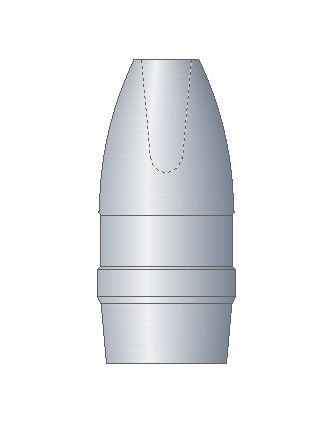
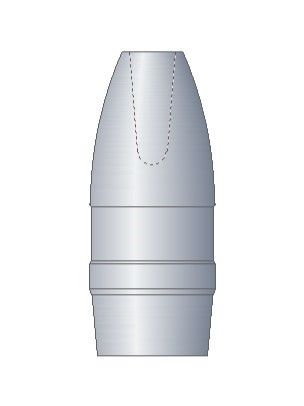
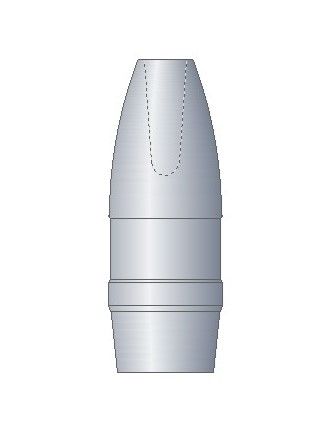
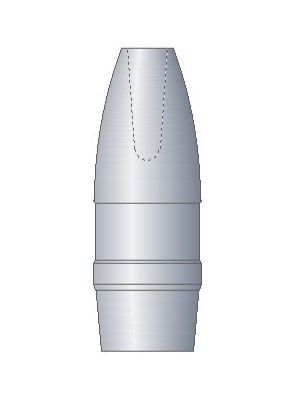
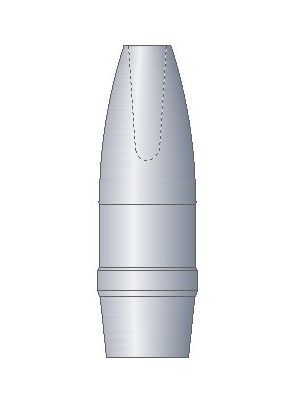
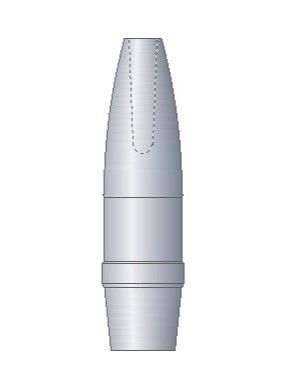
If you look at the first chart in the last post above, and determine the maximum slug weight for each calibre, you will find the following for 3600 psi (using a 28" barrel at 40% efficiency).... These all have an SD of 0.170.... They will all be close to the same length overall (because they all have the same SD).... However, their shapes will be vastly different....

.308 cal - 113 gr.


.284 cal.... 96 gr.


.257 cal.... 80 gr.


.243 cal.... 70 gr.


.224 cal.... 60 gr.


.183 cal.... 40 gr.


I added this calibre because I have a barrel coming for this, with a 5.9" twist rate!.... Any guesses as to which slug will have the best BC?.... Remember, they all have the same SD....

Bob
 
One thing I was taught years ago about long range shooting, especially at subsonic velocity, is "time of flight." The amount of time for conditions to change before you hit your target.
 
That is a common misconception about wind drift.... It is not proportional to the time of flight, but the "lag time", which is the difference between the actual time of flight and what it would be in a vacuum.... This is why the sudden increase in drag in the Transonic region (Mach 0.8-1.2) has such a detrimental effect on drift.... We are fortunate shooting slugs in the 1000-1050 fps range, as our wind drift is actually less than it would be unless the MV is over 2500 fps.... Strange but true!....

Bob
 
Following Bobs topic. I’ve learned most of what I know of pellet and slug ballistics from his articles.

FYI, I have downloaded the drag models for the SLG0 (slugs) and SLG1 (boat tail slugs) into the new ChairGun Elite+ app. Haven’t tested them out yet but got the info from Miles. He also has a GA2 pellet drag model to update the current GA profile that most of us use for pel
OK, so down to the nitty-gritty of how this new thinking results in a range of calibres I find best for the job at hand.... a long range slug gun....

If you look at the first chart in the last post above, and determine the maximum slug weight for each calibre, you will find the following for 3600 psi (using a 28" barrel at 40% efficiency).... These all have an SD of 0.170.... They will all be close to the same length overall (because they all have the same SD).... However, their shapes will be vastly different....

.308 cal - 113 gr.


.284 cal.... 96 gr.


.257 cal.... 80 gr.


.243 cal.... 70 gr.


.224 cal.... 60 gr.


.183 cal.... 40 gr.


I added this calibre because I have a barrel coming for this, with a 5.9" twist rate!.... Any guesses as to which slug will have the best BC?.... Remember, they all have the same SD....

Bob
Id guess the last 1 because of its length
 
Actually, they are all nearly the same length, and they all are the same SD.... However, the smallest calibre slug should have lower form drag, and since BC = SD / FF, a higher BC....

Bob
 
Actually, they are all nearly the same length, and they all are the same SD.... However, the smallest calibre slug should have lower form drag, and since BC = SD / FF, a higher BC....

Bob
I have a question about the SD that Miles uses for the SLG0 and SLG1 drag models. Once I input them into Chairgun Elite+, how are they used since there is nowhere to input the FF to get a BC... Just using the GA2 or SLG0 doesn't work with drag factor alone in the solver...
 
Sorry, I don't know anything about Chairgun Elite+.... The FF is the CD of your slug divided by the CD of the drag model chosen at that velocity.... Therefore the FF is different when you change drag models.... Most ballistics calculators don't allow you to input the CD, because it is difficult to calculate, and depends on the atmospheric conditions at which you tested.... They usually just ask you to input the near and far velocities, figure out your CD at the average velocity, and compare that to the CD of your chosen drag model to get the FF.... Then they calculate the BC by figuring out the SD for your slug and dividing by the FF.... The CD is independent of the SD....

You can download MERO for free, it has most drag models in it, including SLG0 and SLG1....


It is available for most platforms.... You sometimes get a warning from Windows because it isn't downloaded often....

Bob
 
Running the number, the .22 will have 120 fpe and would penetrate 24 inches, similar to the 60 gr Aguila rimfire ammo, which is heavy for calibers requiring 1in9 twist.
The 30, on the other hand, would be light for its caliber, requiring a 1in14 twist and close to a 32 H&R in performance. I doubt it could be used at any useful range to justify owning.
 

Create an account or login to comment

You must be a member in order to leave a comment

Create FREE account

Create a FREE account on our community. It's easy!

Log in

Already have an account? Log in here.

Trending in this forum

Back
Top