
Install the app
How to install the app on iOS

Follow along with the video below to see how to install our site as a web app on your home screen.

Note: This feature may not be available in some browsers.

Ballistic Coefficient: A Real World Example

Franklink

HAM Wizard
1,125
4,167
HAM Points
4,897.50
Country flag
Last edited:
I’ve blabbered about this gun and these two projectiles enough so I’m not going to make them the focus…

Last week I doped out 10-300 yards, comparing a pellet with a BC in the 0.046-0.049ish range, to a slug with a BC in the 0.09-0.1ish area. This was about a 6 hour project, spread over two days. The dope was actual on-paper results from 10-130 yards, and then on small dirt clods from 130-230 yards, and then using assistance from ballistics apps and continuation of the trajectory curve seen from actual results, to get those last 70 yards. Conditions weren’t amazing, but I shot enough of both the pellet and the slug at the various distances to have a fair level of confidence in the results.

Scope height over bore is null in this comparison (same gun, same scope, same barrel). Starting FPE is also fairly similar, just shy of 35 fpe with the slug and just shy of 30fpe with the pellet. Nearly the same average speed from both, 900-915 with the slug, and 910-920 with the pellet. Scope zero worked out to essentially 30-50 yards for the slug (2/10 mil hold-under for 37-40 yards) and 30-40 yards for the pellet (no hold-under). So pretty much the same scope zero.

The main differences in this comparison are of the BC, with the slug having roughly double the BC of the pellet.

Here’s the data, in the dope sheet-stickered-to-bottle format. Left column is distance, middle column is clicks (1/10mil) for the slug, right column is clicks for the pellet. (yes, combo of holdover and clicks to get to some of those farther distances).

1741213644911.webp

Everything is fairly similar out to about 45 yards, at which time the slug starts to pull away, requiring less holdover. By 100 yards the pellets require more than a mil more elevation than the slug. By 150 yards the difference is almost 2 mils (1.8). At 200 yards, there’s more than 3 mils of elevation difference (3.3). And at 300 yards there is almost 9 mils more holdover required for the pellet than for the slug (8.8)! The pellet is quite literally dropping out of the sky at that point. One might even say that the slug shoots flatter than the pellet. ;)

As for fpe retention. I added two columns to illustrate that…
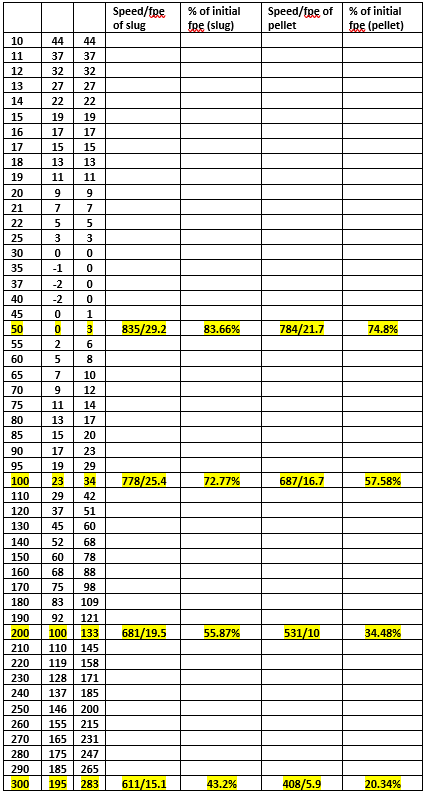
1741213160303.png


By now, this shouldn’t be news to anybody in the industry, but SEEING it, is still quite thought-provoking. It also makes much more sense now that I can reconcile the numbers on paper with how many pass throughs I get on prairie dogs even out to 150+ yards.

And we’ve certainly got an orders of magnitude effect at play. In my little comparison, we’ve got a 34.9fpe projectile still quite dangerous out to 400+ yards. (11.7fpe left at 400 yards for mine). That fpe is all I want or need. But scale up the power levels to 100-120 or more FPE, and the even better BCs that are available from some of the .22 slugs these days…and you’ve got to be concerned about anything for what? Something like 1300-1400yards downrange? Or roughly 0.75 of a mile. That’s of course max range and with something like a 30 degree angle, similar to what we’d see if we were shooting starlings or euro doves out of a tree.

I apologize for the tangent, didn’t mean for this to be a “the sky is falling” but rather a reminder that….

BC is king.
 
I’ve blabbered about this gun and these two projectiles enough so I’m not going to make them the focus…

Last week I doped out 10-300 yards, comparing a pellet with a BC in the 0.046-0.049ish range, to a slug with a BC in the 0.09-0.1ish area. This was about a 6 hour project, spread over two days. The dope was actual on-paper results from 10-130 yards, and then on small dirt clods from 130-230 yards, and then using assistance from ballistics apps and continuation of the trajectory curve seen from actual results, to get those last 70 yards. Conditions weren’t amazing, but I shot enough of both the pellet and the slug at the various distances to have a fair level of confidence in the results.

Scope height over bore is null in this comparison (same gun, same scope, same barrel). Starting FPE is also fairly similar, just shy of 35 fpe with the slug and just shy of 29fpe with the pellet. Nearly the same average speed from both, 900-915 with the slug, and 910-920 with the pellet. Scope zero worked out to essentially 30-50 yards for the slug (2/10 mil hold-under for 37-40 yards) and 30-40 yards for the pellet (no hold-under). So pretty much the same scope zero.

The main differences in this comparison are of the BC, with the slug having roughly double the BC of the pellet.

Here’s the data, in the dope sheet-stickered-to-bottle format. Left column is distance, middle column is clicks (1/10mil) for the slug, right column is clicks for the pellet. (yes, combo of holdover and clicks to get to some of those farther distances).
View attachment 11880

Everything is fairly similar out to about 45 yards, at which time the slug starts to pull away, requiring less holdover. By 100 yards the pellets require more than a mil more elevation than the slug. By 150 yards the difference is almost 2 mils (1.8). At 200 yards, there’s more than 3 mils of elevation difference (3.3). And at 300 yards there is almost 9 mils more holdover required for the pellet than for the slug (8.8)! The pellet is quite literally dropping out of the sky at that point. One might even say that the slug shoots flatter than the pellet. ;)

As for fpe retention. I added two columns to illustrate that…

1741213160303.png


By now, this shouldn’t be news to anybody in the industry, but SEEING it, is still quite thought-provoking. It also makes much more sense now that I can reconcile the numbers on paper with how many pass throughs I get on prairie dogs even out to 150+ yards.

And we’ve certainly got an orders of magnitude effect at play. In my little comparison, we’ve got a 34.9fpe projectile still quite dangerous out to 400+ yards. (11.7fpe left at 400 yards for mine). That fpe is all I want or need. But scale up the power levels to 100-120 or more FPE, and the even better BCs that are available from some of the .22 slugs these days…and you’ve got to be concerned about anything for what? Something like 1300-1400yards downrange? Or roughly 0.75 of a mile. That’s of course max range and with something like a 30 degree angle, similar to what we’d see if we were shooting starlings or euro doves out of a tree.

I apologize for the tangent, didn’t mean for this to be a “the sky is falling” but rather a reminder that….

BC is king.

Thanks for the excellent data and analysis (y)
 
Hi cole. Was wondering if you ever did any experiments with pellets and velocity and their effect on bc. Today i was trying to get strelock to line up with what my pellets were doing @100 yds so i had a crono on both ends and started with a muzzle velocity of 925 and had a 100 yd velocity of like 680 and it gave me a bc of .044 then i dropped muzzel velocity to 880 and got a 100 yd velocity of 670 which gave me a bc of .048! These velocitys were a 5 shot average. I was surprised at the varance of velocity @100 even though the sd was like 2 or 3 at the muzzel
 
Last edited:
Hi cole. Was wondering if you ever did any experiments with pellets and velocity and their effect on bc. Today i was trying to get strelock to line up with what my pellets were doing @100 yds so i had a crono on both ends and started with a muzzle velocity of 925 and had a 100 yd velocity of like 680 and it gave me a bc of .044 then i dropped muzzel velocity to 880 and got a 100 yd velocity of 670 which gave me a bc of .048! These velocitys were a 5 shot average. I was surprised at the varance of velocity @100 even though the sd was like 2 or 3 at the muzzel
I have done some of what you're talking about.

As you already know, our easiest way to measure/assess BC is by down-range speed retention. As distance increases, the more of starting speed that is retained, the higher the BC. And that's somewhat flawed...

Generally speaking, most true pellets have a fps limit where pushing them faster is just pointless. The badmitton birdie nature of a diabolo pellet is akin to when a drag racing car throws the parachute, but it's the whole time the pellet is in flight. In other words, a particular pellet design can only handle so much speed. In your example, your 100 yard velocity was 670 and 680, a 10fps difference. But they started with a 45fps difference. So when you plug all that into the "speeds at two distances" calculators, the BC generated is lower for the one that started faster.....because it lost a greater percentage of its starting speed. And that's why I say it's flawed....whatever pellet you're talking about is still doing basically the same speed at 100, whether it started at 925 or 880. So what that tells us is that that particular pellet design makes shooting it at 925 pointless, wasting air and making more noise than necessary. It's still doing basically the same speed when it gets to 100, so the BC isn't necessarily lower from when it started faster, you're just wasting air, and skewing the BC calculator to think that the BC is lower. Either way, that pellet settles into how it behaves and ends up at nearly the same speed at 100 yards. There's a point downrange where internal ballistics become external ballistics, and the results are out of our control or ability to tinker with.

That oft-repeated comment about pellets performing best in the 870-915fps window is generally true, with some caveats. Some caveats and exceptions that I've come across...
  • The JSB .22/25.4 MRD BC peaks out around 960-980fps, with a slow twist, polygonal rifled barrel. So there's still benefit to pushing them that fast b/c they give a higher BC at 960 than they do in the window of normally accepted pellet speeds. (Any faster than about 920 and they don't shoot for crap with a 12 land and groove standard 1:17.7")
  • The JSB .177/16.2 BC seems to continue climbing up to about 930-940fps
  • Polygonal barrels generally produce higher BCs than 12 land and groove barrels.
  • Polygonal barrels seems to have a slightly higher window of speeds where pellets fired from them produce the peak of BC that that particular pellet is capable of.
  • Slow twist barrels generally produce higher BCs than the standard 1:17.7" twist rates.
  • A subset of pellets (be that a particular speed/design/tin/batch/etc) with the tightest ES of downrange measured speeds will be more accurate/precise than a subset of pellets with a big ES of downrange measured speeds. Even if the ES at the muzzle is tight.
    • This goes back to that internal becoming external ballistics....example: my Vet Long has a ES at the muzzle in the 30fps range. But at 100 yards pellets that come from its favorite batch from its favorite barrel at its favorite speed have a downrange extreme spread in the 10-12fps range. This was the gun/pellet used to win one of the 2024 Extreme Grand Prixs. Extreme spread at the muzzle is large, but for whatever reason, they stabilize themselves and "fall to sleep" downrange more consistently than other combinations that I've tested. And the BC is a bit better than a typical .22 MRD b/c of the 1:32 polygonal rifled barrel.
Going the other way, slower, can also be detrimental to performance. If you're not starting with a high enough muzzle fps for them to still have at least the 670-680 (for this particular pellet/example) than you're leaving performance on the table.

In conclusion, it's not the faster speed that's producing a lower BC. The performance of your particular pellet is pretty much the same regardless of muzzle speed. The "speed at two distances" method makes the BC look lower from the pellet that started faster.

(You'll see guys saying they're having excellent accuracy/precision results from .22/18.13s with muzzle speeds of 990 or 1010 fps. if they were to measure downrange speeds they'd find that the pellet is going the same speed by the time it gets to Xyards, whether it started with 1000fps, or the more reasonable 900 fps. Plug those two variables into a calculator that bases the BC off of % of fps retained and it'll look like shooting them faster produces a lower BC, but in reality the pellet will be at very similar speeds downrange, just plodding along, doing its thing. Cuz by then it's settled into how it's going to behave in flight and simply doesn't care how fast it started).

If you really wanted to, you could skew your BC to look like crap by pushing them even faster. Get em rocking to 1000fps (whatever it is that you're shooting) and you'll probably still find them going around 680ish at 100 yards. Plug that into the speed at two distances calculator and the BC number it spits out will be even lower than the 0.044.
 
Thanks that helps explain some of my findings. It was an interesting test that gave some unusual results. I intend to per-sue this further as i tried some 25 cal 30.2 gr aea slugs thru the ghost and i just thought they shot poorly because they shot no better than pellets but checking this way the slugs only have a .05 bc almost identical to the pellets.
 
I have done some of what you're talking about.

As you already know, our easiest way to measure/assess BC is by down-range speed retention. As distance increases, the more of starting speed that is retained, the higher the BC. And that's somewhat flawed...

Generally speaking, most true pellets have a fps limit where pushing them faster is just pointless. The badmitton birdie nature of a diabolo pellet is akin to when a drag racing car throws the parachute, but it's the whole time the pellet is in flight. In other words, a particular pellet design can only handle so much speed. In your example, your 100 yard velocity was 670 and 680, a 10fps difference. But they started with a 45fps difference. So when you plug all that into the "speeds at two distances" calculators, the BC generated is lower for the one that started faster.....because it lost a greater percentage of its starting speed. And that's why I say it's flawed....whatever pellet you're talking about is still doing basically the same speed at 100, whether it started at 925 or 880. So what that tells us is that that particular pellet design makes shooting it at 925 pointless, wasting air and making more noise than necessary. It's still doing basically the same speed when it gets to 100, so the BC isn't necessarily lower from when it started faster, you're just wasting air, and skewing the BC calculator to think that the BC is lower. Either way, that pellet settles into how it behaves and ends up at nearly the same speed at 100 yards. There's a point downrange where internal ballistics become external ballistics, and the results are out of our control or ability to tinker with.

That oft-repeated comment about pellets performing best in the 870-915fps window is generally true, with some caveats. Some caveats and exceptions that I've come across...
  • The JSB .22/25.4 MRD BC peaks out around 960-980fps, with a slow twist, polygonal rifled barrel. So there's still benefit to pushing them that fast b/c they give a higher BC at 960 than they do in the window of normally accepted pellet speeds. (Any faster than about 920 and they don't shoot for crap with a 12 land and groove standard 1:17.7")
  • The JSB .177/16.2 BC seems to continue climbing up to about 930-940fps
  • Polygonal barrels generally produce higher BCs than 12 land and groove barrels.
  • Polygonal barrels seems to have a slightly higher window of speeds where pellets fired from them produce the peak of BC that that particular pellet is capable of.
  • Slow twist barrels generally produce higher BCs than the standard 1:17.7" twist rates.
  • A subset of pellets (be that a particular speed/design/tin/batch/etc) with the tightest ES of downrange measured speeds will be more accurate/precise than a subset of pellets with a big ES of downrange measured speeds. Even if the ES at the muzzle is tight.
    • This goes back to that internal becoming external ballistics....example: my Vet Long has a ES at the muzzle in the 30fps range. But at 100 yards pellets that come from its favorite batch from its favorite barrel at its favorite speed have a downrange extreme spread in the 10-12fps range. This was the gun/pellet used to win one of the 2024 Extreme Grand Prixs. Extreme spread at the muzzle is large, but for whatever reason, they stabilize themselves and "fall to sleep" downrange more consistently than other combinations that I've tested. And the BC is a bit better than a typical .22 MRD b/c of the 1:32 polygonal rifled barrel.
Going the other way, slower, can also be detrimental to performance. If you're not starting with a high enough muzzle fps for them to still have at least the 670-680 (for this particular pellet/example) than you're leaving performance on the table.

In conclusion, it's not the faster speed that's producing a lower BC. The performance of your particular pellet is pretty much the same regardless of muzzle speed. The "speed at two distances" method makes the BC look lower from the pellet that started faster.

(You'll see guys saying they're having excellent accuracy/precision results from .22/18.13s with muzzle speeds of 990 or 1010 fps. if they were to measure downrange speeds they'd find that the pellet is going the same speed by the time it gets to Xyards, whether it started with 1000fps, or the more reasonable 900 fps. Plug those two variables into a calculator that bases the BC off of % of fps retained and it'll look like shooting them faster produces a lower fps, but in reality the pellet will be at very similar speeds downrange, just plodding along, doing its thing. Cuz by then it's settled into how it's going to behave in flight and simply doesn't care how fast it started).

If you really wanted to, you could skew your BC to look like crap by pushing them even faster. Get em rocking to 1000fps (whatever it is that you're shooting) and you'll probably still find them going around 680ish at 100 yards. Plug that into the speed at two distances calculator and the BC number it spits out will be even lower than the 0.044.
@Franklink Thanks for your superb input on this!
 
Hi cole. Was wondering if you ever did any experiments with pellets and velocity and their effect on bc. Today i was trying to get strelock to line up with what my pellets were doing @100 yds so i had a crono on both ends and started with a muzzle velocity of 925 and had a 100 yd velocity of like 680 and it gave me a bc of .044 then i dropped muzzel velocity to 880 and got a 100 yd velocity of 670 which gave me a bc of .048! These velocitys were a 5 shot average. I was surprised at the varance of velocity @100 even though the sd was like 2 or 3 at the muzzel
@Solo1 I'm sure you must have already checked this...

But if you're developing bcs using the results from two different chronys - one at the muzzle, the other downrange, It's vital to calibrate both units to confirm that they both read the same . Typically, no two chronographs will give identical readings, so understanding the difference between their results for "the same" actual velocity will be important generating accurate bcs.
Yes i have shot with both on at the muzzle and they read within 1 or 2 fps of each other. This was the first time shooting through 1 at 100 yds though.
 
Tailwind or headwind can really muddy the waters too. I remember trying with a solid tailwind once, from a gun I was pretty familiar with. BCs were in the 0.07 range, lol, for a .22 MRD! Much higher than usual. Same concept as a jet with a tailwind getting there faster and using less fuel. Pellet was just going with the flow, direction of air molecules.
 
Was out again today with my tiapan to verify it to strelok and found that my 34.9 nsa ended up giving me a bc of .9 instead of the listed .11 also shot the 30.2 aea and got a bc of 0.056 instead of 0.05 but this time started at 1032 fps instead of 950 i think. Good to finally have my hp ft guns matching strelok perfectly.
 

Create an account or login to comment

You must be a member in order to leave a comment

Create FREE account

Create a FREE account on our community. It's easy!

Log in

Already have an account? Log in here.

Trending in this forum

Back
Top