Install the app
How to install the app on iOS

Follow along with the video below to see how to install our site as a web app on your home screen.

Note: This feature may not be available in some browsers.

PCP Seneca Aspen

Tomcat 357

HAM Competitor
19
33
HAM Points
102.50
Country flag
I have a Seneca Aspen that quite frankly I sorely wish I never bought. The built in pump is, well a piece of crap. After 2 rebuilds it still binds up basically making the gun useless. Is there anyone or has anyone made a conversion where the pump along with the small air tank has or can be replaced with say a conventional PCP air cylinder. Else this gun may well be parted out for use elsewhere. Any thoughts on this?
 
I have a Seneca Aspen that quite frankly I sorely wish I never bought. The built in pump is, well a piece of crap. After 2 rebuilds it still binds up basically making the gun useless. Is there anyone or has anyone made a conversion where the pump along with the small air tank has or can be replaced with say a conventional PCP air cylinder. Else this gun may well be parted out for use elsewhere. Any thoughts on this?
As far as I know the gun does have a fill just in front of the trigger guard if I remember that you can use to fill the gun directly as you would a conventional PCP. The oring overheats and wears out because people pump the gun far to fast, that's the downside to the design. Imo it's not worth a conversation, best to buy another gun if that's the function you have in mind.
 
Thanks for your reply. I have other PCPs and this was kind of a novelty. For no more shots than you can get out of the thing it’s hardly worth dragging the pump out. Maybe 6 good shots before a recharge is needed. Oh well, to the scrap heap.
 
Thanks for your reply. I have other PCPs and this was kind of a novelty. For no more shots than you can get out of the thing it’s hardly worth dragging the pump out. Maybe 6 good shots before a recharge is needed. Oh well, to the scrap heap.
The aspen was my first airgun, biggest piece of garbage, had the same problems, sold it for parts. It did get me sucked into this sport though lol, I never looked backed since the aspen and my bank account has suffered because of getting me hooked 😀😀
 
I have a Seneca Aspen that quite frankly I sorely wish I never bought. The built in pump is, well a piece of crap. After 2 rebuilds it still binds up basically making the gun useless. Is there anyone or has anyone made a conversion where the pump along with the small air tank has or can be replaced with say a conventional PCP air cylinder. Else this gun may well be parted out for use elsewhere. Any thoughts on this?
I've got an Aspen and still do. Love the thing. I accidentally overpumped mine and sent it back to PA (Where I bought it) which they rebuilt and it's been fine ever since. If you wanna ship it to me, I'll take it as parts and fiddle with it.
 
Last edited:
Hi everybody,

Last holiday I repaired my Air Venturi Aspen Seneca. This was the first time I took an air rifle apart for repair. It was fun to do, but it took me a lot of patience and (too much) time. I learned a lot from it, next time it certainly would go faster.
I have taken photo's when taking the rifle apart, I thought it was quite a complicated . I would like to post them here in the hope they help somebody else.

The thing is, I could not do it without the help of information found on multiple forums. On all those forums, there were bits and pieces of information provided by many kind people; for me quite some time was necessary to understand what should be done before even touching the rifle.

Since this forum had the newest post I could find on these repairs, I would like to add my information to this discussion and hopefully help others out.

Although this rifle obvious has it's challenges (maintenance wise), it is still by far the second coolest air rifle ever! What is the first you ask? An old Sheridan Blue Streak of course!
The fact that it has a build in pump and thus fully autonomous (and more than accurate for my aiming skills...), is unmatched by almost every other air gun in my humble opinion.

For me, there were two issues I had to fix on my rifle.
1/ The pump got 'stuck' if the rifle was unused for about 2 days; It takes a lot of effort to open, only opens halfway and will not move from there. For me it helped to degas the rifle and then I could pump again. This is a well known problem and from different sources I understood that this was do to a leaking check valve.
2/ The seal on the 'pre-charge' tube leaked. And therefore the gun was dropped in air pressure pretty quickly.

This post is about the first problem.

First things first:
A/ !!!!IMPORTANT!!!!: degas your rifle in TWO places:
  1. On the underside of your gun is the 'normal' degas screw, use it.
  2. On the front side of the gun, on the tube that is just below the barrel is a degas point (no pictures added). This tube is some kind of pre-pressure-air-'spring'. NOTE: you need a special fill probe (different than the normal fill probe) to actually fill this air-spring with air again. Obviously you also need a pump to fill it up. This write up assumes that you have such a fill probe and pump.
B/ From information and photo's on the internet I found, it seems that older and newer rifles have some minor differences.

C/ I used the assembly instructions document I found on the internet, and one which was send to me by Air Venturi. In a post a few posts below I have uploaded both files. I found at least the following 'subtle' differences between the documents:
  1. The rubber rings have the inner ring dimensions in the one, and outer ring dimensions in the other. Remember this if you want to order o-rings.
  2. For the check valve, the order of the metal ball and o-ring is wrong in the one, and correct in the other! Remember this when assembling.
D/ I photographed everything straight after disassembly. This means that everything is greasy and some o-rings are deformed. note: So far all seals are actual o-rings, except for the ones on the high pressure piston.

E/ You don't need to disassemble the whole pump if you only want to get to the check valve! I choose to, so I can change all the o-rings (not the high pressure o-tube-rings, they seemed to be still OK, see pictures)

F/ I assume that you have removed the plastic stock

G/ When assembling, I cleaned everything, and applied new grease.

H/ I found that it is useful to create special tools:
  • Remember the special fill probe mentioned under A-2 ? A nice neighbor with a lathe helped me create that.
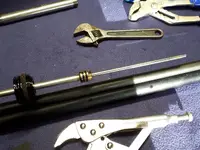
  • To open up part of the pump (on two places), I filed the tips of 90deg angled pliers. See pictures.

Hopefully this information is helpful to somebody. now enjoy the pictures.
There is a max of 20 pictures. so the rest will be in next posts.
Information on the picture, is written below it


01.webp

02.webp

03.webp

05.webp

06.webp
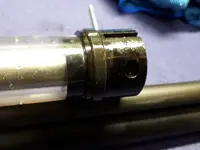
See the light metal ring with the 4 holes in it? This is what you have to screw loose if you want to get to the check valve directly (without fully disassemble the pump). See later pictures.
07.webp

08.webp

09.webp

10.webp

12.webp

13.webp

14.webp
This clip is plastic. you have to open it (widen it) and slide it off. Don't brake it.
15.webp

16.webp

17.webp
I first screwed loose the metal part, with the pin (that connects to the high pressure rod) still in. Not sure if this is needed or even beneficial.
18.webp

19.webp
This pin connects the black part and the rod. This rod is the high pressure part of the pump.
21.webp
This metal tube part was really hard to get loose. See the flat pieces? that is where there is some grip. I had a really hard time, but used the self-locking pliers with a rubber sheet in between shown on the picture. Use the special made pliers to hold the black metal ring part, see next pictures. I had to really use some force by the way.
 
Hi everybody,

Last holiday I repaired my Air Venturi Aspen Seneca. This was the first time I took an air rifle apart for repair. It was fun to do, but it took me a lot of patience and (too much) time. I learned a lot from it, next time it certainly would go faster.
I have taken photo's when taking the rifle apart, I thought it was quite a complicated . I would like to post them here in the hope they help somebody else.

The thing is, I could not do it without the help of information found on different fora I could find on the internet. On all those fora, there were bits and pieces of information provided by all kinds of kind people; for me quite some time was necessary to understand what should be done, even before touching the rifle.

The thing is; although this rifle obvious has it's challenges (maintenance wise), it is still by far the second coolest air rifle ever! (what is the first you ask? An old Sheridan Blue Streak of course!)
The fact that it has a build in pump and thus fully autonomous (and more than accurate for my aiming skills...), is unmatched by almost every other air gun in my humble opinion.

If you have looked up some information online about the Air Venturi Aspen Seneca, it is also obvious that it needs some repairs now and then. If you know how to do them, the repairs are not that hard and consists mostly of cleaning and changing the rubber rings / seals. I did not know how to do them...

Since this forum had the newest post I could find on these repairs, I would like to add my information to this discussion and hopefully help others out.

For me, there were two issues I had to fix.
1/ The pump got 'stuck' if the rifle was unused for about 2 days; It takes a lot of effort to open, only opens halfway and will not move from there. For me it helped to degas the rifle and then I could pump again. This is a well known problem and from different sources I understood that this was do to a leaking check valve.
2/ The seal on the 'pre charge' tube leaked. And therefore the gun was dropped in air pressure pretty quickly.

This post is about the first problem.

First things first:
A/ !!!!IMPORTANT!!!!: degas your rifle in TWO places:
1/ on the underside of your gun is the 'normal' degas screw, use it.
2/ on the front side of the gun, on the tube that is just below the barrel is a degas point (no pictures added). This tube is some kind of pre-pressure-air-'spring'. NOTE: you need a special fill probe (different than the normal fill probe) to actually fill this air-spring with air again. Obviously you also need a pump to fill it up. This write up assumes that you have such a fill probe and pump.
B/ From information and photo's on the internet I found, it seems that older and newer rifles have some minor differences.
C/ I used the assembly instructions document I found on the internet, and one which was send to me by Air Venturi. I found at least the following 'subtle' differences between the documents:
1/ The rubber rings have the inner ring dimensions in the one, and outer ring dimensions in the other. Remember this if you want to order o-rings.
2/ For the check valve, the order of the metal ball and o-ring is wrong in the one, and correct in the other! Remember this when assembling.
D/ I photographed everything straight after disassembly. This means that everything is greasy and some o-rings are deformed. note: So far all seals are actual o-rings, except for the ones on the high pressure piston.
E/ You don't need to disassemble the whole pump if you only want to get to the check valve! I choose to, so I can change all the o-rings (not the high pressure o-tube-rings, they seemed to be still OK, see pictures)
F/ I assume that you have removed the plastic stock
G/ When assembling, I cleaned everything, and applied new grease.
H/ I found that it is useful to create special tools:
- Remember the special fill probe mentioned under A-2 ? A nice neighbor with a lathe helped me create that.
- To open up part of the pump (on two places), I filed the tips of 90deg angled pliers. See pictures.

Hopefully this information is helpful to somebody. now enjoy the pictures.
There is a max of 20 pictures. so the rest will be in next posts.
information on the picture, is written below it


View attachment 18446View attachment 18447View attachment 18448View attachment 18450View attachment 18451
See the light metal ring with the 4 holes in it? This is what you have to screw loose if you want to get to the check valve directly (without fully disassemble the pump). See later pictures.
View attachment 18452View attachment 18453View attachment 18454View attachment 18455View attachment 18457
View attachment 18458

View attachment 18459
This clip is plastic. you have to open it (widen it) and slide it off. Don't brake it.
View attachment 18460

View attachment 18462View attachment 18463View attachment 18464View attachment 18465
This pin connects the black part and the rod. This rod is the high pressure part of the pump.
View attachment 18466
This metal tube part was really hard to get loose. See the flat pieces? that is where there is some grip. I had a really hard time, but used the self-locking pliers with a rubber sheet in between shown on the picture. I had to really use some force.

Outstanding post! Thank you 👍
 
Last edited:
23.webp
The pliers are ground to smaller points, to be used as a tool to open the two rings with '4 holes in a circle'. For the black ring (see 4 pictures down).
25.webp

26.webp
this brass (?) part is also hard to screw off.
30.webp
The middle rod can be pulled out ( it is the high pressure part of the pump) but not all the way. The tip of this rod (with the o-rings) will not fit through the brass part. First screw off the brass part.
31.webp
On the right is the high pressure rod. The three rings ('tubulars' ?) on the tip looked good, so I have not replaced them. The decision was made easy since I did not have these rings as spare parts. The dimensions are not shown on the assembly manual document.
32.webp
This is how the pliers fit the ring
33.webp

35.webp

36.webp
The part on the left and in the middle both have o-rings inside. These are hard to remove and may even be harder to put back.
37.webp

38.webp
Overview
40.webp
use the modified pliers (mentioned at the beginning of this post) to remove this ring
41.webp
There is an o-ring inside
44.webp
The big black metal part is not tightened but was stuck. it needed some persuasion with a hammer. I used some wood in the middle, since there was no assembly hammer available.
47.webp

48.webp

50.webp
Screw loose this black part, to get to the check valve. I did not disassemble the metal tube in the foreground and kept it attached the the aforementioned metal part.
51.webp

52.webp
Check valve parts inside

53.webp
Also check valve parts inside, the metal ball and the o-ring. This o-ring was (i think) the trouble on my rifle. It is badly deformed and partly disintegrated. See later pictures. I had problem buying this specific o-ring. The standard supplier did not have it. I found another supplier which had only the softer 70, instead of needed 90 grade. I chose to go with the softer o-ring and will see how long it will last. After the assembly of the rifle, I finally found one supplier on aliexpress which sold packages of 100 o-rings with the correct hardness. The rifle can be repaired well beyond another 100 years :)
 
Wow, that was intense! And needed. Thanks for posting this. I've got an Aspen with a poppet valve that's blown. It's lost all it's air, so I'm assuming it's safe to change.... I'm not sure where to start with it, but would appreciate anything you could advise.
 
Last edited:
Wow, that was intense! And needed. Thanks for posting this. I've got an Aspen with a poppet valve that's blown. It's lost all it's air, so I'm assuming it's safe to change.... I'm not sure where to start with it, but would appreciate anything you could advise.
I would be happy to help, but I am by no means a professional rifle repair guy. To which part do you refer exactly if you say 'poppet' ? Can you post a picture to clarify ?
I'll post (or edit the original post) with some more information I have. Maybe that also helps.

edit: I've looked it up; it is the valve that releases the short burst of air to propel the pellet. I have not changed or repaired that part of the rifle (yet), but please look at the assembly instructions in the documents that are uploaded in the post below. Maybe that helps.
 
Last edited:
Please see attached two assembly instruction manuals for the Air Venturi Aspen Seneca.
Note that the 'AssemblyForSenecaAspen_small.pdf' file has been compressed, otherwise it was too big to upload (it might have affected the quality).
As I mentioned in my original post; One document I found on the internet, and one which was send to me by Air Venturi. I found at least the following 'subtle' differences between the documents (I'll add to the list if more are found):
  1. The rubber rings have the inner ring dimensions in the one, and outer ring dimensions in the other. Remember this if you want to order o-rings.
    • AssemblyForSenecaAspen_small.pdf --> outer dimensions (OD)
    • P2 PNEUPUMP synthetic stock Assembly Instructions 11062020.pdf --> inner dimensions (ID)
  2. For the check valve, the order of the metal ball and o-ring is wrong in the one, and correct in the other! Remember this when assembling.
  3. The documents do not mention the dimensions of the o-ring-sleeves on the high pressure rod of the pump.
  4. The assembly of the high pressure rod of the pump is different (also the amount of o-rings). My rifle is the same as shown in 'P2 PNEUPUMP synthetic stock Assembly Instructions 11062020.pdf'
  5. On the part "Air chamber extension tube rear connector" with Item Code "000P2-046-W-01" there are two o-rings, of which the larger one has the wrong thickness dimension. In the manual it is stated ID10x2 mm o-ring (= OD14x2), but is should be ID10x2.5 mm. See a future post: PCP - Seneca Aspen

specifically for the 'P2 PNEUPUMP synthetic stock Assembly Instructions 11062020.pdf' document I found the following:
  1. about the o-ring to use for the pump check valve: Item with item code "PS-013-X-00" is used twice in the instruction manual:
    • for the check valve as: NBR O-ring φ 3 Xφ 1.5 hardness 90°
    • for the power adjustment valve stem: NBR o-ring φ 4 Xφ 1.5 hardness 90°
    • ruling from the diameter of the check valve, I think correct is: "PS-013-X-00" = "NBR o-ring φ 4 Xφ 1.5 hardness 90°"
  2. About the o-rings of the middle stage pressure of the pump: I think NO of the two (types of) o-rings below are swapped:
    • NODESCRIPTIONSITEM CODEUSE QTY
      2NBR O-ring φ 10Xφ 2 hardness 90°000P2-077-X-002
      3NBR O-ring φ 5Xφ 2 hardness 90°PS-009-X-001
 

Attachments

A little information on the pre-charge fill probe.
As mentioned in a previous post, the normal fill probe does not fit (diameter is too large). I bought a standard fill probe for a rifle brand I can't remember. The diameter of this probe is 6.6mm. Unfortunately the o-rings were too far apart to be usefull as a pre-charge fill probe on the Aspen Seneca.
A neighbor of me with a lathe, made some extra slits, just next to the hole of the fill probe. I used the spare o-rings to fill those slits. See picture below. So far this works fine. Maybe this can inspire others to create their own. good luck!

pre_charge_fill_probe.webp
The two middle slits with o-rings not original but created with a lathe. Maybe some steady hand work with a metal saw will also work?

There is also some good information on this probe (and other stuff) in the link below:
 
Thanks for your reply. I have other PCPs and this was kind of a novelty. For no more shots than you can get out of the thing it’s hardly worth dragging the pump out. Maybe 6 good shots before a recharge is needed. Oh well, to the scrap heap.
I have 3 aspens/freedoms. After owning it's cousin the Nova Liberty which gives 60 plus shots in 22 and 80 in 177, I realize the only Aspen worth leaving is the 177 since it's more efficient. The 25 cal gets 3 shots B4 falling off, the 22 cal will shoot h & n 21.14s 900-870 fps for 4-5 shots before I have to pump. The 177 Nova freedom(same exact gun as Aspen just different name printed on it) gets 7-8 shots before falling off. The 25 cal and 22 cal would be better ported and converted. I've wondered since it's basically and air venturi avengers Daddy if the tubes match up for a conversation or what's the simple way to convert. Because when ported these rifles Hit Hard, the action is buttery smooth. I'm going to be taking apart a Nova Liberty and Aspen soon and see how easy it is to swap the pump for the tube. If it works out I got the tube from a new, unused 177 Liberty I'll install on the 25 cal so I can get that 200 cc tube on it and make it a serviceable rifle. If you want to sell it let me know I am collecting them.
 
Last edited:
The biggest mistake people make when shooting the Aspen/freedom is they shoot 5 or 6 shots and then pump it back up to fast and to many. 1 shot and pump 5 to 6 times. Another shot and pump 5 to 6 times. Over oil the pump with silicone oil. It keeps the pump from heating up and keeps it well lubed. BB Pelter did a complete test of the Aspen and came up with that. You are the regulator. I found it most accurate at between 2800 and 2900 psi. My problem is the check valve didn't work quite like it was designed and it was my first PCP and didn't want to return it. The leaking check valve continued to get worse and then I tried fixing it and couldn't get it to seal. It's been a paper weight for the last 5 years. The pump never gave me problems but would get very hard to move because the valve was leaking.
 
Okay, thna
The biggest mistake people make when shooting the Aspen/freedom is they shoot 5 or 6 shots and then pump it back up to fast and to many. 1 shot and pump 5 to 6 times. Another shot and pump 5 to 6 times. Over oil the pump with silicone oil. It keeps the pump from heating up and keeps it well lubed
I totally agree. I only pumped slow and randomly on mine: 5-6 pumps here, 3 pumps there, no pumps for a while etc. And oil the pump sponge
 

Create an account or login to comment

You must be a member in order to leave a comment

Create FREE account

Create a FREE account on our community. It's easy!

Log in

Already have an account? Log in here.

Trending in this forum

Back
Top