Install the app
How to install the app on iOS

Follow along with the video below to see how to install our site as a web app on your home screen.

Note: This feature may not be available in some browsers.

What Does it Take To Successfully Hunt Hogs with Airguns?

Ezana4CE

Master HAMster
1,731
3,627
Texas
HAM Points
5,276.75
Airguns of Arizona - 10% discount
Country flag
Last edited:
This is a question I’ve seen that pops up enough times on forums. I read conflicting information, questionable motives, spectacular stories with little evidence, unrealistic expectations, and posts that read like straight bullshit. The main thing that pisses me off are people claiming to want to get rid of problematic hogs and pigs, but continue to feed them. Realistically I’m of the opinion that unless you wage all out war on wild hogs on a daily basis, hunting and hunting pressure alone will not eradicate them. To be completely realistic our efforts only contribute to population management. In my region industrial activity is frequently disturbing the environment and/or changing the landscape. As a result animals are forced to relocate due to reduction or destruction of resources. Where I hunt hogs, whitetail deer hunting is a huge business so the hogs roam and take from the same food sources as the deer and then some. For anyone considering hunting wild hogs, the first thing I suggest you do is learn your local airgun hunting laws and regulations and obtain a hunting license if you don’t already have an up-to-date license. Then learn the animal’s anatomy. Look up a domestic pig chart if you cannot find consistent material detailing wild hog anatomy.

A little about my background:

I am not an expert, nor am I a professional hunter. As a hunter I learned to hunt with dogs in my youth. The dogs were the trackers. As an airgun hunter I’ve been after hogs for maybe 3 years, I have not kept count. I didn’t have a mentor or partner. I recently started airgun hunting with a dog. I learned a lot utilizing the internet, getting out in the woods, and trying to hunt them. My first year was a complete bust. I didn’t shoot one hog. I had trouble finding them. I put a lot of pressure on a hog I’d caught on camera by constantly disturbing the area by trekking through it. I don’t think I saw the hog in the flesh. I did learn a lot about where they were, some of why they were there, and the damage that they cause to land. Since then I’ve done some reading and watched a plethora of hog hunting videos. I also have been in communication with other hunters online and within my region. My reasons for hunting hogs are to protect property and for sport. The latter is mostly why I like to use an air rifle.

In my pursuit of hunting hogs, the only time I can recall using bait was to condition the hogs for baited traps. That aside, when I see signs I go after them. I have learned to track them. I also use trail cameras. Tracking often takes me into their comfort zone, which is usually uncomfortable for me, thick and thorny cover close to water. Other times they’re in the woods. I can only think of a few times I have seen them in the open. Another thing, I DO NOT do canned hunts. Perhaps I may when im unable to get out like I can now.

What I Have Used:
Over the last 12 months I can distinctly recall shooting three wild hogs with air rifles. There may have been one or two more and a few that I shot at and missed completely, and a gun jam resulting in a dry fire. I have been primarily using a thermal hand scanner and/or a thermal rifle scope, rifle mounted green lights, a head lamp, and a Benjamin Bulldog M357, and airgun slugs 110 - 145 grains. I have also shot them with a Western Airguns Rattler 357. I aim for the lungs. Generally what has occurred is that the hogs will get hit and run prompting the other hogs in proximity to run. I’ve seen one walk off into cover. I should’ve have shot that one in the head because it came out and tried to cross a dirt road on private property. With body shots from a .357 I have not seen a single blood trail. I have shot one in the face with a .25 Edgun R5M. I do not recommend doing this. I was in a vulnerable position and felt the need to get this hog away from me ASAP. I was not in a position to retreat quietly, it didn’t know I was there, and was coming toward me. Almost all scenarios that came to mind resulted in me getting injured. I shot the hog in the face to scare it in order to create space to protect myself. Thankfully it worked. I’ve been in situations where I opted not to shoot because I couldn’t see because the sun had set or the cover was too thick but hogs were very close and on 3 sides of me. I’ve also had hogs smell or hear me before I could get a bead on their exact locations. I’ve also shot livestock unintentionally mistaking it for a hog. I squared that away with the owner quickly. Now I am experimenting with other guns to see if I can yield more desirable results. This is a little about my background hunting wild hogs with airguns.


Questions for Experienced Airgun Hog Hunters:
1) How do you hunt hogs with airguns?
2) What are you willing to share with others interested in getting into hog hunting with airguns?
3) What is the bare minimum equipment that you would suggest that a beginner use?
4) Which factors do you believe are most important to consider before hunting wild hogs?
 
This is a question I’ve seen that pops up enough times on forums. I read conflicting information, questionable motives, spectacular stories with little evidence, unrealistic expectations, and posts that read like straight bullshit. The main thing that pisses me off are people claiming to want to get rid of problematic hogs and pigs, but continue to feed them. Realistically I’m of the opinion that unless you wage all out war on wild hogs on a daily basis, hunting and hunting pressure alone will not eradicate them. To be completely realistic our efforts only contribute to population management. In my region industrial activity is frequently disturbing the environment and/or changing the landscape. As a result animals are forced to relocate due to reduction or destruction of resources. Where I hunt hogs, whitetail deer hunting is a huge business so the hogs roam and take from the same food sources as the deer and then some. For anyone considering hunting wild hogs, the first thing I suggest you do is learn your local airgun hunting laws and regulations and obtain a hunting license if you don’t already have an up-to-date license. Then learn the animal’s anatomy. Look up a domestic pig chart if you cannot find consistent material detailing wild hog anatomy.

A little about my background:

I am not an expert, nor am I a professional hunter. As a hunter I learned to hunt with dogs in my youth. The dogs were the trackers. As an airgun hunter I’ve been after hogs for maybe 3 years, I have not kept count. I didn’t have a mentor or partner. I recently started airgun hunting with a dog. I learned a lot utilizing the internet, getting out in the woods, and trying to hunt them. My first year was a complete bust. I didn’t shoot one hog. I had trouble finding them. I put a lot of pressure on a hog I’d caught on camera by constantly disturbing the area by trekking through it. I don’t think I saw the hog in the flesh. I did learn a lot about where they were, some of why they were there, and the damage that they cause to land. Since then I’ve done some reading and watched a plethora of hog hunting videos. I also have been in communication with other hunters online and within my region. My reasons for hunting hogs are to protect property and for sport. The latter is mostly why I like to use an air rifle.

In my pursuit of hunting hogs, the only time I can recall using bait was to condition the hogs for baited traps. That aside, when I see signs I go after them. I have learned to track them. I also use trail cameras. Tracking often takes me into their comfort zone, which is usually uncomfortable for me, thick and thorny cover close to water. Other times they’re in the woods. I can only think of a few times I have seen them in the open. Another thing, I DO NOT do canned hunts. Perhaps I may when im unable to get out like I can now.

What I Have Used:
Over the last 12 months I can distinctly recall shooting three wild hogs with air rifles. There may have been one or two more and a few that I shot at and missed completely, and a gun jam resulting in a dry fire. I have been primarily using a thermal hand scanner and/or a thermal rifle scope, rifle mounted green lights, a head lamp, and a Benjamin Bulldog M357, and airgun slugs 110 - 145 grains. I have also shot them with a Western Airguns Rattler 357. I aim for the lungs. Generally what has occurred is that the hogs will get hit and run prompting the other hogs in proximity to run. I’ve seen one walk off into cover. I should’ve have shot that one in the head because it came out and tried to cross a dirt road on private property. With body shots from a .357 I have not seen a single blood trail. I have shot one in the face with a .25 Edgun R5M. I do not recommend doing this. I was in a vulnerable position and felt the need to get this hog away from me ASAP. I was not in a position to retreat quietly, it didn’t know I was there, and was coming toward me. Almost all scenarios that came to mind resulted in me getting injured. I shot the hog in the face to scare it in order to create space to protect myself. Thankfully it worked. I’ve been in situations where I opted not to shoot because I couldn’t see because the sun had set or the cover was too thick but hogs were very close and on 3 sides of me. I’ve also had hogs smell or hear me before I could get a bead on their exact locations. I’ve also shot livestock unintentionally mistaking it for a hog. I squared that away with the owner quickly. Now I am experimenting with other guns to see if I can yield more desirable results. This is a little about my background hunting wild hogs with airguns.


Questions for Experienced Airgun Hog Hunters:
1) How do you hunt hogs with airguns?
2) What are you willing to share with others interested in getting into hog hunting with airguns?
3) What is the bare minimum equipment that you would suggest that a beginner use?
4) Which factors do you believe are most important to consider before hunting wild hogs?
Since no one has responded, I'll post a few answers.

1) I track, spot, and stalk unless I am also trapping them. Then tactics change a bit.

2) I have no training in this style of hunting hogs with airguns. The best advice I can offer is to remain active in hunting and be persistent so that you can build upon your mistakes and experiences.

3) The bare minimum I'd suggest one takes are as follows: Permission to hunt the area you intend to hunt on (written and signed permission is best). First aid items (antiseptic, a tourniquet, sterile gauze, some sort of wrapping tape to secure it to you). A cell phone. A compass. A big-bore air rifle producing no less that 150 fpe for close to medium range shots to the head. Heavy pellets 80 grain and up for brain shots. Slugs for shots to the vitals, the heavier the better. Vitals shots can be tricky if you don't know the anatomy of the animal or the sex of a hog prior to shooting it. I don't hunt under feeders so I'll let hunters who do advise you all in that area. I Aldo carry an extremely sharp 6" blade for worst case scenario protection if I end up on the ground beneath a hog. I also recommend a back up gun like a PB pistol. If you want to do a pure airgun hunt something should be a semi-auto shooting slugs, especially if you're hunting from the ground. Also I highly recommend a thermal hand held scanner with at least a 384 sensor and a low base magnification of 2.5x or less. A night vision scope or a traditional rifle scope with a rifle-mounted torch/flashlight affixed. I suggest using a quality high-powered headlamp with a green or red bulb. Of course you're going to need ammo and an air source. You never know how many shot opportunities you may have in a night, especially with a semi-auto when the animals start running. At least one spare battery (or set) per device. A pair of disposable gloves (rubber, latex, or nitirile). Finally it is a good idea to put trail cameras out to witness activity that you may never see.

4) Some of the most important factors to consider before hunting wild hogs are: understanding the hog behavior (travel routes, habits, signs of aggression, food preferences, where water sources are, locations of wallows), how to read tracks and signs. I think you should also consider your physical condition if you intend to be on the ground tracking and stalking. You have to be in some sort of shape because you can do a lot of walking before you see something. Some nights you may not see a pig hair. Another important thing to have a basic understanding is the anatomy of a wild hog. If you can't find diagrams, look at the anatomy of a domestic pig. Above all, know the capabilities, holds, and important details about your gun and its tune before hunting. Know what to expect when you press the trigger. Hunt using ammo and a scope that has proven reliable and that you have DOPE on.

I'm not a professional hunter, but these are things that I recommend anyone interested should consider before hunting wild hogs with big bore airguns (spot and stalk style). I'm sure I forgot something. Experienced folks help me out.
 
Last edited:
This is a question I’ve seen that pops up enough times on forums. I read conflicting information, questionable motives, spectacular stories with little evidence, unrealistic expectations, and posts that read like straight bullshit. The main thing that pisses me off are people claiming to want to get rid of problematic hogs and pigs, but continue to feed them. Realistically I’m of the opinion that unless you wage all out war on wild hogs on a daily basis, hunting and hunting pressure alone will not eradicate them. To be completely realistic our efforts only contribute to population management. In my region industrial activity is frequently disturbing the environment and/or changing the landscape. As a result animals are forced to relocate due to reduction or destruction of resources. Where I hunt hogs, whitetail deer hunting is a huge business so the hogs roam and take from the same food sources as the deer and then some. For anyone considering hunting wild hogs, the first thing I suggest you do is learn your local airgun hunting laws and regulations and obtain a hunting license if you don’t already have an up-to-date license. Then learn the animal’s anatomy. Look up a domestic pig chart if you cannot find consistent material detailing wild hog anatomy.

A little about my background:

I am not an expert, nor am I a professional hunter. As a hunter I learned to hunt with dogs in my youth. The dogs were the trackers. As an airgun hunter I’ve been after hogs for maybe 3 years, I have not kept count. I didn’t have a mentor or partner. I recently started airgun hunting with a dog. I learned a lot utilizing the internet, getting out in the woods, and trying to hunt them. My first year was a complete bust. I didn’t shoot one hog. I had trouble finding them. I put a lot of pressure on a hog I’d caught on camera by constantly disturbing the area by trekking through it. I don’t think I saw the hog in the flesh. I did learn a lot about where they were, some of why they were there, and the damage that they cause to land. Since then I’ve done some reading and watched a plethora of hog hunting videos. I also have been in communication with other hunters online and within my region. My reasons for hunting hogs are to protect property and for sport. The latter is mostly why I like to use an air rifle.

In my pursuit of hunting hogs, the only time I can recall using bait was to condition the hogs for baited traps. That aside, when I see signs I go after them. I have learned to track them. I also use trail cameras. Tracking often takes me into their comfort zone, which is usually uncomfortable for me, thick and thorny cover close to water. Other times they’re in the woods. I can only think of a few times I have seen them in the open. Another thing, I DO NOT do canned hunts. Perhaps I may when im unable to get out like I can now.

What I Have Used:
Over the last 12 months I can distinctly recall shooting three wild hogs with air rifles. There may have been one or two more and a few that I shot at and missed completely, and a gun jam resulting in a dry fire. I have been primarily using a thermal hand scanner and/or a thermal rifle scope, rifle mounted green lights, a head lamp, and a Benjamin Bulldog M357, and airgun slugs 110 - 145 grains. I have also shot them with a Western Airguns Rattler 357. I aim for the lungs. Generally what has occurred is that the hogs will get hit and run prompting the other hogs in proximity to run. I’ve seen one walk off into cover. I should’ve have shot that one in the head because it came out and tried to cross a dirt road on private property. With body shots from a .357 I have not seen a single blood trail. I have shot one in the face with a .25 Edgun R5M. I do not recommend doing this. I was in a vulnerable position and felt the need to get this hog away from me ASAP. I was not in a position to retreat quietly, it didn’t know I was there, and was coming toward me. Almost all scenarios that came to mind resulted in me getting injured. I shot the hog in the face to scare it in order to create space to protect myself. Thankfully it worked. I’ve been in situations where I opted not to shoot because I couldn’t see because the sun had set or the cover was too thick but hogs were very close and on 3 sides of me. I’ve also had hogs smell or hear me before I could get a bead on their exact locations. I’ve also shot livestock unintentionally mistaking it for a hog. I squared that away with the owner quickly. Now I am experimenting with other guns to see if I can yield more desirable results. This is a little about my background hunting wild hogs with airguns.


Questions for Experienced Airgun Hog Hunters:
1) How do you hunt hogs with airguns?
2) What are you willing to share with others interested in getting into hog hunting with airguns?
3) What is the bare minimum equipment that you would suggest that a beginner use?
4) Which factors do you believe are most important to consider before hunting wild hogs?
Since no one has responded, I'll post a few answers.

1) I track, spot, and stalk unless I am also trapping them. Then tactics change a bit.

2) I have no training in this style of hunting hogs with airguns. The best advice I can offer is to remain active in hunting and be persistent so that you can build upon your mistakes and experiences.

3) The bare minimum I'd suggest one takes are as follows: Permission to hunt the area you intend to hunt on (written and signed permission is best). First aid items (antiseptic, a tourniquet, sterile gauze, some sort of wrapping tape to secure it to you). A cell phone. A compass. A big-bore air rifle producing no less that 150 fpe for close to medium range shots to the head. Heavy pellets 80 grain and up for brain shots. Slugs for shots to the vitals, the heavier the better. Vitals shots can be tricky if you don't know the anatomy of the animal or the sex of a hog prior to shooting it. I don't hunt under feeders so I'll let hunters who do advise you all in that area. I Aldo carry an extremely sharp 6" blade for worst case scenario protection if I end up on the ground beneath a hog. I also recommend a back up gun like a PB pistol. If you want to do a pure airgun hunt something should be a semi-auto shooting slugs, especially if you're hunting from the ground. Also I highly recommend a thermal hand held scanner with at least a 384 sensor and a low base magnification of 2.5x or less. A night vision scope or a traditional rifle scope with a rifle-mounted torch/flashlight affixed. I suggest using a quality high-powered headlamp with a green or red bulb. Of course you're going to need ammo and an air source. You never know how many shot opportunities you may have in a night, especially with a semi-auto when the animals start running. At least one spare battery (or set) per device. A pair of disposable gloves (rubber, latex, or nitirile). Finally it is a good idea to put trail cameras out to witness activity that you may never see.

4) Some of the most important factors to consider before hunting wild hogs are: understanding the hog behavior (travel routes, habits, signs of aggression, food preferences, where water sources are, locations of wallows), how to read tracks and signs. I think you should also consider your physical condition if you intend to be on the ground tracking and stalking. You have to be in some sort of shape because you can do a lot of walking before you see something. Some nights you may not see a pig hair. Another important thing to have a basic understanding is the anatomy of a wild hog. If you can't find diagrams, look at the anatomy of a domestic pig. Above all, know the capabilities, holds, and important details about your gun and its tune before hunting. Know what to expect when you press the trigger. Hunt using ammo and a scope that has proven reliable and that you have DOPE on.

I'm not a professional hunter, but these are things that I recommend anyone interested should consider before hunting wild hogs with big bore airguns (spot and stalk style). I'm sure I forgot something. Experienced folks help me out.
I started here


Below are links to 2 recent airgun hog hunts and links to some busts. I’m still relatively new to this on my 3rd year hunting feral pigs/wild hogs with big bore airguns.


I’m still anxious to read what other airgun hog hunters are doing. I’m particularly interested in folks using different or unorthodox methods.
 
Last edited:
I recently had a night where I shot 3 hogs with an airgun in wooded pastureland. After further reflection of that night, here are some take aways:

Use your ears. A lot of feral hog activity occurs at night. Learn how hog movement sounds in different terrain. Contrast those sounds to the sounds of other animals. When they are vocal, they are pretty loud. If you hear them, go to them. It can be a bit frightening when you hear them fighting. If they aren’t in the open when a battle ensues, this may not be a good time to approach the group. I’ve gotten in and backed out of some areas when I didn’t feel safe. I’ve heard them fighting and thought to myself, “I’m not going over there right now.” I’m not saying this is the way to go, but it’s how I approached things.

Where do they frequent? If you find an area that the hogs have visited multiple times there is a reason. Find out why they are there.

Do not doubt yourself. If you think you heard or saw something, you most likely did. Investigate the source.

Learn what these animals do to keep themselves safe. Then devise methods to counter these habits.

If you can hear and see them without the use of long-distance optics, they can probably hear and/or smell you.

Know how to play the wind. Their noses are probably their most keen sense.


Considering these factors you should be able to stalk within reasonable proximity (60 yards) to a feral hog or group of hogs if you are able bodied, somewhat fit, and understand basic stalking techniques as a hunter. You can get closer, but that depends upon your comfort level.
 
Last edited:
I forgot to mention that I went back to look for a hog in the area I shot two hogs with my Western Rattler within about an hour of each other. I shot both in the neck. One hog I hit with a follow up shot to the ribs after the neck shot. Some may wonder why I didn't retrieve the hogs that night. Well I was only sure that one ran and dropped. I could hear her squealing. I shot her as a boar was sniffing and probably was about to attempt to breed her. He was upset when she ran off and fell. They both made a good amount of noise in the woods. I wasn't going into the dark woods with a mortally wounded animal and a pissed off boar hog. So I continued to try to track the sounder to kill more. I shot three that night. Of the three I believe two died.

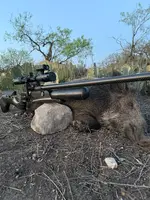
I did smell and find remains next week when I had time to return to the property. By the time I found what was left it was mostly skin, hair, liquids, and hooves when I got to it. I think the photos are the remains of one pig. It may possibly be the remains of two, but one for sure. I view this as evidence that my belief was correct on those being lethal shots. I still do not think that NSA .357, 110 grain slugs are the best choice to shoot hogs with, but they can be effective with the right tune, opportunity, and decent shot placement.Remains of Shot Feral Pig1.webpRemains of Shot Feral Pig.webp

How did I find these remains? I remembered where I shot the hogs. After the shot I remained kneeling from my shooting position looking for another shot opportunity as I continued to observe sounds and movement. I also recalled the direction they ran and I had an idea of where the squealing was coming from after the shot. It did not seem to have traveled far. When I returned I had my dog with me and we entered the woods from the opposite side of the area I shot from. I could smell the decaying remains. Pinning down the source of the decay was a task because they were so far gone. This resulted in me circling the area and returning to the area where the stench was strongest. From there it didn't take long, I just didn't expect to find so little. After I located the remains, I walked out into the clearing I shot from and realized that the pig may have traveled 20-30 yards from where I shot it.

It is also helpful to have video of the sequence of events, which I had. After watching the video so many times this was not a difficult tracking job. Memory, video, sense of smell, and a dog all are helpful tools in tracking an animal that runs off and dies away from the site in which it was shot.
 
A decent example of something that can go wrong when hunting feral hogs with airguns - not enough gun.

Start watching from the 2:18 mark until around 3:17
To view this content we will need your consent to set third party cookies.
For more detailed information, see our cookies page.
Then pick up again from the 3:21 mark or just let it play.

The first shot looks like it went through brush and may have hit low around the jaw. Stuff happens, but he stayed with the shot animal and that's what you're supposed to do for as long as you can and can remain safe in doing so in order to put the hog down for good. Then learn from your experience.
 
Last edited:
On a night shortly after mistakenly shooting livestock, I was back on that same permission. When I went back to that same pasture I noticed an odd shape on the ground in the middle of the pasture. I thought something was dead at first because I could see a group of cows off in the distance with this lone animal in the middle of the pasture laid out. I estimate the cows were probably 150-200+ yards away. I didn't see a point in ranging them.
Cattle in Distance While Hog Hunting.webp
I started to write it off as a calf and leave, but where was its mother? Something just didn't sit right with me about the way this animal looked. 45 yards is how far it was when I initially ranged it when I spotted it.
Pic of Pig Asleep in Middle of Pasture.webp
It was the shape of the ear of this animal that stood out to me. It didn't look like a cow's ear. Also the animal appeared to be laying on it's side. Healthy cows don't do this. Also, deer have been known to bed in the area, however I had not seen any deer lay on their sides either. I decided to investigate before I left the area. I ended up stalking up bit by bit. As you can see in the photo there are some pretty tall plants and after covering a maybe 20-25 yards I finally stepped on something that cause a crunching sound. This woke the animal prompting it to stand up. When it did, it was evident that this indeed was a feral pig. It turned away from me and began walking off in the opposite direction. My immediate reaction was to aim and shoot. I aimed between its shoulders and connected which sent the pig running off. From there I walked in the direction that it ran. I didn't think it was a fatal shot, but figured it may cause it to lay down, pass out, or slow it down at best providing me with the opportunity to finish it off. This didn't happen. The benefit of this pig running off was that it led me to the others that I shot later that night. The debacle with shooting livestock really made me feel bad and think about how to approach similar situations in the future. As a result, I upgraded some gear. I will go into that more in depth about this in the future.

What I took away from the night I shot the 3 hogs and previous nights were:

1) Be patient. Take your time to adequately assess the situation and your environment. Pay attention to things like: visibility, which animals are present, where they are, how far away are they, what's behind them, and how you can position yourself for a suitable shot considering these aforementioned factors..

2) The importance of positive identification (ID). You must know what you are shooting before you take your shot. This may cause you to pass on shot opputnities. I would've liked to have shot this pig in that head as it slept, but I was unsure what the animal was until I stalked closed. This is where optical quatlity of your night vision and thermal optics come into play. It is important to know how these function in various weather conditions.

3) Hogs DO intermingle with cattle. Prior to this night, I'd only seen the two species mix in videos on YouTube. The hogs rooted up a good portion of this pasture, but that doesn't stop the cattle from grazing on the grass that still grows.
 
Last edited:
I had not watched this video in a while, but after reviewing it, it is still relevant to the theme of this thread. In the following video Dana of @MountainSportAirguns and @TerryE1 take on the task of hunting hogs from the ground on foot in a different type terrain. Some of the tactics they use are things discussed in this thread. They did some scouting, set up trail cams, and set a blind on a hog trail close to a wallow. They also used a Western Rattler .357. Dana knows his zero, holds, and the range in which he is comfortable shooting these animals. This is a decent illustration of what some of what is involved with pursuing these destructive nuisance animals using an air rifle.

To view this content we will need your consent to set third party cookies.
For more detailed information, see our cookies page.

Here they are again getting after wild hogs on what appears to be the same property with the Western Rattler .357 and the Western Rattler .45. Dana stretched his shot out beyond 100 yards with the Rattler .45. Terry shoots until his hog is down.
To view this content we will need your consent to set third party cookies.
For more detailed information, see our cookies page.
 
Since no one has responded, I'll post a few answers.

1) I track, spot, and stalk unless I am also trapping them. Then tactics change a bit.

2) I have no training in this style of hunting hogs with airguns. The best advice I can offer is to remain active in hunting and be persistent so that you can build upon your mistakes and experiences.

3) The bare minimum I'd suggest one takes are as follows: Permission to hunt the area you intend to hunt on (written and signed permission is best). First aid items (antiseptic, a tourniquet, sterile gauze, some sort of wrapping tape to secure it to you). A cell phone. A compass. A big-bore air rifle producing no less that 150 fpe for close to medium range shots to the head. Heavy pellets 80 grain and up for brain shots. Slugs for shots to the vitals, the heavier the better. Vitals shots can be tricky if you don't know the anatomy of the animal or the sex of a hog prior to shooting it. I don't hunt under feeders so I'll let hunters who do advise you all in that area. I Aldo carry an extremely sharp 6" blade for worst case scenario protection if I end up on the ground beneath a hog. I also recommend a back up gun like a PB pistol. If you want to do a pure airgun hunt something should be a semi-auto shooting slugs, especially if you're hunting from the ground. Also I highly recommend a thermal hand held scanner with at least a 384 sensor and a low base magnification of 2.5x or less. A night vision scope or a traditional rifle scope with a rifle-mounted torch/flashlight affixed. I suggest using a quality high-powered headlamp with a green or red bulb. Of course you're going to need ammo and an air source. You never know how many shot opportunities you may have in a night, especially with a semi-auto when the animals start running. At least one spare battery (or set) per device. A pair of disposable gloves (rubber, latex, or nitirile). Finally it is a good idea to put trail cameras out to witness activity that you may never see.

4) Some of the most important factors to consider before hunting wild hogs are: understanding the hog behavior (travel routes, habits, signs of aggression, food preferences, where water sources are, locations of wallows), how to read tracks and signs. I think you should also consider your physical condition if you intend to be on the ground tracking and stalking. You have to be in some sort of shape because you can do a lot of walking before you see something. Some nights you may not see a pig hair. Another important thing to have a basic understanding is the anatomy of a wild hog. If you can't find diagrams, look at the anatomy of a domestic pig. Above all, know the capabilities, holds, and important details about your gun and its tune before hunting. Know what to expect when you press the trigger. Hunt using ammo and a scope that has proven reliable and that you have DOPE on.

I'm not a professional hunter, but these are things that I recommend anyone interested should consider before hunting wild hogs with big bore airguns (spot and stalk style). I'm sure I forgot something. Experienced folks help me out.
For a first‑time hog hunter with a PCP, a tree stand over a feeder is the safest and most effective way to learn. It maximizes your rifle’s strengths (precision, controlled energy) while minimizing risks (charging hogs, unpredictable movement). Once you’re comfortable, you can branch into spot‑and‑stalk or night hunts — but the feeder/stand combo is the perfect starting point.
 
For a first‑time hog hunter with a PCP, a tree stand over a feeder is the safest and most effective way to learn. It maximizes your rifle’s strengths (precision, controlled energy) while minimizing risks (charging hogs, unpredictable movement). Once you’re comfortable, you can branch into spot‑and‑stalk or night hunts — but the feeder/stand combo is the perfect starting point.
I second what was said by Grunt64. For a new hunter (or even for a veteran) hunting off a blind/feeder is safer and can be very effective. Spot and stalk can bare fruit as well but requires a lot more 'know how'. An exemplar spot and stalk hunter is Dana from Mountain Sport Airguns, which I see other members have shared some of his videos with you already.

Much can be learned hunting from a feeder such as:
- active times and how weather affects activity
- sounds they make as they are near by (a small group of hogs can be pretty loud. You can often hear a large single hog as well.
 

Attachments

  • Photo Dec 09 2025, 2 26 41 PM.webp
    Photo Dec 09 2025, 2 26 41 PM.webp
    712.7 KB · Views: 7
  • Photo Dec 08 2024, 9 17 06 PM.webp
    Photo Dec 08 2024, 9 17 06 PM.webp
    418 KB · Views: 7
  • Photo Aug 09 2025, 6 27 44 PM.webp
    Photo Aug 09 2025, 6 27 44 PM.webp
    641.8 KB · Views: 6
  • Photo Apr 27 2025, 10 41 43 PM.webp
    Photo Apr 27 2025, 10 41 43 PM.webp
    348.5 KB · Views: 7
  • Photo Apr 14 2025, 8 10 31 PM.webp
    Photo Apr 14 2025, 8 10 31 PM.webp
    1.4 MB · Views: 7
  • Photo Apr 13 2025, 12 35 26 AM.webp
    Photo Apr 13 2025, 12 35 26 AM.webp
    439.2 KB · Views: 7
  • Photo Apr 13 2025, 8 23 02 PM.webp
    Photo Apr 13 2025, 8 23 02 PM.webp
    549.8 KB · Views: 7
  • Photo Feb 07 2024, 12 50 33 AM.webp
    Photo Feb 07 2024, 12 50 33 AM.webp
    94.7 KB · Views: 6
Oh my heavens! I added a lot more information to my initial post but somehow it was not saved and did not send… well, that’s not fun. Let me try again:

Benefits from hunting off a feeder are:
  • Learning to differentiate hog and deer tracks
  • Clearer shooting lanes for a more ethical shot
  • Safer to hunt from at night

I have ‘spot and stalk’ and used feeders successfully, both of which I have done in the day and night. Night hunting has proven to be most successful. An hr before sunset, an hr after sunset, 10pm, and 12am-2am have been great times to hunt for me. Using a thermal at night while spot and stalk will allow you to get uncomfortably close to hogs if you play the wind right. I have noticed that skittish hogs have run off while using night vision IR scopes (not all hogs, just skittish ones). It has been extremely rare for me to see hogs feeding at sunrise but I have seen them. Hogs do not sweat, so as temperature rises, they will bed down in cool places. Great place to find their bedding areas are in south facing hills where the cooler breeze blows, and in well shaded areas, at the base of low hanging trees. If you find rooting, you are headed in the right direction. I know others have found them near water during hotter times of day but I have not.

Here are some things to keep in mind:
  • It’s reported that hogs do not have great eye sight, but good enough to see movement in the day. At night, they don’t seem to care as much
  • Hogs have great hearing and sense of smell
  • Study the anatomy of a hog skull, you’ll be surprised where the brain actually is located and its size
  • Hogs are known to charge hunters, so be cautious when approaching an injured hog. Double tap is best
  • Keep gloves with you, as you handle the hog and its meat/skull. Hogs are known to have many parasites

Bare minimum equipment that is most likely to have higher returns? Try the following:
  • Bait such as corn
  • Be creative with your bait station (many ideas shared on YT such as ‘rolling barrel’ feeder). Consider even creating a ‘natural’ station using only deadfall
  • Set a blind about 50 yds away and clear a few shooting lanes. Blind can also be made ‘naturally’ out of deadfall/vegetation.
  • Game camera and a lock box
  • If budget allows, day/night scope such as a DNT (non LR model as they are more affordable)
  • Rangefinder or kill two birds with one stone and get a LR day/night scope
  • Std hunting equipment in backpack
  • If budget allows, thermal monocular. Check out Rix Optics, they offer a fairly affordable therm. Monocular. I use one and they are pretty good
  • Use what airgun you currently have but practice shooting off shooting sticks

That being said, let me share what I have learned and tested in regard to shot placement, caliber, distances, FPE, and results:
  • .30 caliber producing 80-110FPE, head shots only. The furthest distance has been an 80yd frontal shot. I have only used pellets (44gr & 50gr) as solid projectiles will crush bone better and give you better penetration. Although I have successfully taken multiple hogs with head shots, I will say it had to do more with luck than skill. Hogs move their heads A LOT while feeding so these shots can be difficult; imagine shooting a moving tennis ball right in the center… that is what you are up against. Honestly, my success rate for dropping a hog with a headshot must be 50/50 due to the hog making a last second movement or me pulling the shot. If you shoot a hog in the head and it ultimately takes off running, don’t bother looking for it. There will not be a blood trail to follow, that hog will survive… trust me. My suggestion: if you want to increase your odds of successfully harvesting a hog, use a higher FPE airgun where you do not have to rely on a headshot
  • .35 caliber (I do not recall FPE), head and body shots using 81gr pellets and 110gr solid slug. I have not taken a shot further than 60yds. Honestly, I have only recovered smaller hogs (sub. 100lbs). Poorly placed head shots using this caliber will leave blood trails but again, that hog will survive… animals are tougher than you think. Do not expect to find a blood trail if you take a shot in the vitals. If you are confident in your shot placement in the vitals, and do not find it within 100yds from where the hog was hit, your odds of finding it are very slim. My suggestion: if you can afford to buy a big bore airgun that you plan to strictly hunt with, just get a .45 caliber
  • .45 caliber (do not recall FPE), body shot only, using a 360-365gr solid slug. The furthest distance has been 99 yds. I have shot several hogs, deer, and bear with different .45 caliber airguns and I have recovered all game within 50yds from where they stood and they leave a great blood trail. My suggestion: if you want serious results, get a HP .45 cal airgun
  • Arrows traveling 300-420FPS (do not recall the weight but the heavier the better). The furthest distance has been 35yds and I recommend staying around this distance. At about 30-35yds, I have noticed that big game animals begin to “jump” the shot. Luckily, I have recovered all animals taken with my arrow airgun, great blood trails. Fixed blade broadheads are best but are tricky to tune. Retractable broadheads fly great but lack the reliable penetration that fixed blade broadheads provide. Should you choose to try retractables anyway, I recommend a rear deploy head. Using an arrow airgun is my favorite way to hunt big game as I am an archer as well. My suggestion: if your budget allows owning multiple airguns and are an avid big game hunter, an arrow airgun is a must have in your arsenal

That was horrible to have to retype but hopefully it is useful to someone. Good luck!
 
Oh my heavens! I added a lot more information to my initial post but somehow it was not saved and did not send… well, that’s not fun. Let me try again:

Benefits from hunting off a feeder are:
  • Learning to differentiate hog and deer tracks
  • Clearer shooting lanes for a more ethical shot
  • Safer to hunt from at night

I have ‘spot and stalk’ and used feeders successfully, both of which I have done in the day and night. Night hunting has proven to be most successful. An hr before sunset, an hr after sunset, 10pm, and 12am-2am have been great times to hunt for me. Using a thermal at night while spot and stalk will allow you to get uncomfortably close to hogs if you play the wind right. I have noticed that skittish hogs have run off while using night vision IR scopes (not all hogs, just skittish ones). It has been extremely rare for me to see hogs feeding at sunrise but I have seen them. Hogs do not sweat, so as temperature rises, they will bed down in cool places. Great place to find their bedding areas are in south facing hills where the cooler breeze blows, and in well shaded areas, at the base of low hanging trees. If you find rooting, you are headed in the right direction. I know others have found them near water during hotter times of day but I have not.

Here are some things to keep in mind:
  • It’s reported that hogs do not have great eye sight, but good enough to see movement in the day. At night, they don’t seem to care as much
  • Hogs have great hearing and sense of smell
  • Study the anatomy of a hog skull, you’ll be surprised where the brain actually is located and its size
  • Hogs are known to charge hunters, so be cautious when approaching an injured hog. Double tap is best
  • Keep gloves with you, as you handle the hog and its meat/skull. Hogs are known to have many parasites

Bare minimum equipment that is most likely to have higher returns? Try the following:
  • Bait such as corn
  • Be creative with your bait station (many ideas shared on YT such as ‘rolling barrel’ feeder). Consider even creating a ‘natural’ station using only deadfall
  • Set a blind about 50 yds away and clear a few shooting lanes. Blind can also be made ‘naturally’ out of deadfall/vegetation.
  • Game camera and a lock box
  • If budget allows, day/night scope such as a DNT (non LR model as they are more affordable)
  • Rangefinder or kill two birds with one stone and get a LR day/night scope
  • Std hunting equipment in backpack
  • If budget allows, thermal monocular. Check out Rix Optics, they offer a fairly affordable therm. Monocular. I use one and they are pretty good
  • Use what airgun you currently have but practice shooting off shooting sticks

That being said, let me share what I have learned and tested in regard to shot placement, caliber, distances, FPE, and results:
  • .30 caliber producing 80-110FPE, head shots only. The furthest distance has been an 80yd frontal shot. I have only used pellets (44gr & 50gr) as solid projectiles will crush bone better and give you better penetration. Although I have successfully taken multiple hogs with head shots, I will say it had to do more with luck than skill. Hogs move their heads A LOT while feeding so these shots can be difficult; imagine shooting a moving tennis ball right in the center… that is what you are up against. Honestly, my success rate for dropping a hog with a headshot must be 50/50 due to the hog making a last second movement or me pulling the shot. If you shoot a hog in the head and it ultimately takes off running, don’t bother looking for it. There will not be a blood trail to follow, that hog will survive… trust me. My suggestion: if you want to increase your odds of successfully harvesting a hog, use a higher FPE airgun where you do not have to rely on a headshot
  • .35 caliber (I do not recall FPE), head and body shots using 81gr pellets and 110gr solid slug. I have not taken a shot further than 60yds. Honestly, I have only recovered smaller hogs (sub. 100lbs). Poorly placed head shots using this caliber will leave blood trails but again, that hog will survive… animals are tougher than you think. Do not expect to find a blood trail if you take a shot in the vitals. If you are confident in your shot placement in the vitals, and do not find it within 100yds from where the hog was hit, your odds of finding it are very slim. My suggestion: if you can afford to buy a big bore airgun that you plan to strictly hunt with, just get a .45 caliber
  • .45 caliber (do not recall FPE), body shot only, using a 360-365gr solid slug. The furthest distance has been 99 yds. I have shot several hogs, deer, and bear with different .45 caliber airguns and I have recovered all game within 50yds from where they stood and they leave a great blood trail. My suggestion: if you want serious results, get a HP .45 cal airgun
  • Arrows traveling 300-420FPS (do not recall the weight but the heavier the better). The furthest distance has been 35yds and I recommend staying around this distance. At about 30-35yds, I have noticed that big game animals begin to “jump” the shot. Luckily, I have recovered all animals taken with my arrow airgun, great blood trails. Fixed blade broadheads are best but are tricky to tune. Retractable broadheads fly great but lack the reliable penetration that fixed blade broadheads provide. Should you choose to try retractables anyway, I recommend a rear deploy head. Using an arrow airgun is my favorite way to hunt big game as I am an archer as well. My suggestion: if your budget allows owning multiple airguns and are an avid big game hunter, an arrow airgun is a must have in your arsenal

That was horrible to have to retype but hopefully it is useful to someone. Good luck!
Thanks for sharing your experience!
 
Oh my heavens! I added a lot more information to my initial post but somehow it was not saved and did not send… well, that’s not fun. Let me try again:

Benefits from hunting off a feeder are:
  • Learning to differentiate hog and deer tracks
  • Clearer shooting lanes for a more ethical shot
  • Safer to hunt from at night

I have ‘spot and stalk’ and used feeders successfully, both of which I have done in the day and night. Night hunting has proven to be most successful. An hr before sunset, an hr after sunset, 10pm, and 12am-2am have been great times to hunt for me. Using a thermal at night while spot and stalk will allow you to get uncomfortably close to hogs if you play the wind right. I have noticed that skittish hogs have run off while using night vision IR scopes (not all hogs, just skittish ones). It has been extremely rare for me to see hogs feeding at sunrise but I have seen them. Hogs do not sweat, so as temperature rises, they will bed down in cool places. Great place to find their bedding areas are in south facing hills where the cooler breeze blows, and in well shaded areas, at the base of low hanging trees. If you find rooting, you are headed in the right direction. I know others have found them near water during hotter times of day but I have not.

Here are some things to keep in mind:
  • It’s reported that hogs do not have great eye sight, but good enough to see movement in the day. At night, they don’t seem to care as much
  • Hogs have great hearing and sense of smell
  • Study the anatomy of a hog skull, you’ll be surprised where the brain actually is located and its size
  • Hogs are known to charge hunters, so be cautious when approaching an injured hog. Double tap is best
  • Keep gloves with you, as you handle the hog and its meat/skull. Hogs are known to have many parasites

Bare minimum equipment that is most likely to have higher returns? Try the following:
  • Bait such as corn
  • Be creative with your bait station (many ideas shared on YT such as ‘rolling barrel’ feeder). Consider even creating a ‘natural’ station using only deadfall
  • Set a blind about 50 yds away and clear a few shooting lanes. Blind can also be made ‘naturally’ out of deadfall/vegetation.
  • Game camera and a lock box
  • If budget allows, day/night scope such as a DNT (non LR model as they are more affordable)
  • Rangefinder or kill two birds with one stone and get a LR day/night scope
  • Std hunting equipment in backpack
  • If budget allows, thermal monocular. Check out Rix Optics, they offer a fairly affordable therm. Monocular. I use one and they are pretty good
  • Use what airgun you currently have but practice shooting off shooting sticks

That being said, let me share what I have learned and tested in regard to shot placement, caliber, distances, FPE, and results:
  • .30 caliber producing 80-110FPE, head shots only. The furthest distance has been an 80yd frontal shot. I have only used pellets (44gr & 50gr) as solid projectiles will crush bone better and give you better penetration. Although I have successfully taken multiple hogs with head shots, I will say it had to do more with luck than skill. Hogs move their heads A LOT while feeding so these shots can be difficult; imagine shooting a moving tennis ball right in the center… that is what you are up against. Honestly, my success rate for dropping a hog with a headshot must be 50/50 due to the hog making a last second movement or me pulling the shot. If you shoot a hog in the head and it ultimately takes off running, don’t bother looking for it. There will not be a blood trail to follow, that hog will survive… trust me. My suggestion: if you want to increase your odds of successfully harvesting a hog, use a higher FPE airgun where you do not have to rely on a headshot
  • .35 caliber (I do not recall FPE), head and body shots using 81gr pellets and 110gr solid slug. I have not taken a shot further than 60yds. Honestly, I have only recovered smaller hogs (sub. 100lbs). Poorly placed head shots using this caliber will leave blood trails but again, that hog will survive… animals are tougher than you think. Do not expect to find a blood trail if you take a shot in the vitals. If you are confident in your shot placement in the vitals, and do not find it within 100yds from where the hog was hit, your odds of finding it are very slim. My suggestion: if you can afford to buy a big bore airgun that you plan to strictly hunt with, just get a .45 caliber
  • .45 caliber (do not recall FPE), body shot only, using a 360-365gr solid slug. The furthest distance has been 99 yds. I have shot several hogs, deer, and bear with different .45 caliber airguns and I have recovered all game within 50yds from where they stood and they leave a great blood trail. My suggestion: if you want serious results, get a HP .45 cal airgun
  • Arrows traveling 300-420FPS (do not recall the weight but the heavier the better). The furthest distance has been 35yds and I recommend staying around this distance. At about 30-35yds, I have noticed that big game animals begin to “jump” the shot. Luckily, I have recovered all animals taken with my arrow airgun, great blood trails. Fixed blade broadheads are best but are tricky to tune. Retractable broadheads fly great but lack the reliable penetration that fixed blade broadheads provide. Should you choose to try retractables anyway, I recommend a rear deploy head. Using an arrow airgun is my favorite way to hunt big game as I am an archer as well. My suggestion: if your budget allows owning multiple airguns and are an avid big game hunter, an arrow airgun is a must have in your arsenal

That was horrible to have to retype but hopefully it is useful to someone. Good luck!
Welcome to Ham! Also....nice collection of airguns you got there! The Black Wolf is a .30cal i imagine? What kind of power is it putting down?
 

Create an account or login to comment

You must be a member in order to leave a comment

Create FREE account

Create a FREE account on our community. It's easy!

Log in

Already have an account? Log in here.

Trending in this forum

Back
Top