


- Original poster
- #21
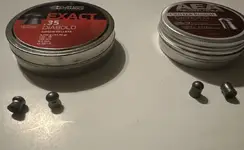
@Miles_M At the center of this discussion is the projectile on the right.Sorry, I have not been on this forum for some time so did not see this thread.
To me a diabolo pellet is simply one with full bore head, followed by a waist, and then by a flared shape at the back which provides a degree of stability and is the reason the aerodynamic centre is behind the centre of gravity for most diabolo pellets. Thus, diabolo pellets use a mixture of aerodynamic and gyroscopic stabilization and belong to a group of projectiles which are aero/gyro stabilized. I would say the term diabolo came about simply because of the shape of the pellet.
As for pellets being drag stabilized again, perhaps the drag stabilized proponents can answer this. The base drag on a pellet provides the majority of the drag of a pellet and thus the claim that it stabilizes the pellet by pulling it backwards. The base drag on a slug also provides the majority of the drag on a slug, yet that for some reason is not drag stabilized, so why is that? The drag is supposed to pull the centre of pressure back behind the centre of gravity, but for some reason does not on a slug but does on a pellet.
What the drag stabilized proponents do not seem to realise is that stability and the position of the aerodynamic centre is all about moments about the centre of gravity, not forces. You could have an infinite force acting on a projectile, but if it acted through the centre of gravity it would provide no stabilization at all. The drag force from the base of a pellet may be the largest force, but it acts through the centre of gravity and thus produces no stabilizing moments, and has no effect on the position of the aerodynamic centre. Even when the pellet is at yaw, the base pressure is still the same for small angles, so the vast majority of the drag force is still acting straight through the centre of gravity basically doing nothing for the stability. We demonstrated this many years ago in one of the wind tunnels at RARDE in the UK. A series of flared base projectile models was tested for drag and stability, with ever-increasing holes in the flare until we ended up with four fins. The base drag was considerably reduced with each increase in size of the holes, but the stability remained the same and thus could not have been due to the base drag. The holes of course made no difference to the side forces which were what was really producing the stabilizing moments about the centre of gravity.
If you really want a drag stabilized pellet, you will have to attach the flare to the front of the pellet with a ball joint to allow the flare to move and thus allow the flare drag to provide the moment arm about the centre of gravity when the pellet yaws. Alternatively, you could attach a parachute to the back of the pellet with a piece of string, which would have the same effect as the ball joint on a flare. I do not think you would want either of those on your pellets.
A flare is the shape it is to produce side forces at the back of the projectile, which have a long moment arm to the centre of gravity. Thus, small side forces, produced when the projectile is at a small yaw angle, produce large stabilizing moments. The increase in drag normally associated with flares is a by product, and is a major reason flares are not used more on projectiles, hence the reason for the wind tunnel tests mentioned above. If we wanted to have a high drag projectile, which we did for some purposes, then we would use a flare as they are cheaper and easier to make than low drag fins.
Just noticed it is gone 1 o'clock here, time I was in bed.
Advertised as the projectile pictured here
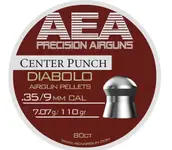
The lack of a flared skirt before the shot on the actual pellet makes me question whether this can be considered a diabolo pellet with an ever so slightly contoured waist. The projectile pictured on the tin above is obviously a diabolo pellet as are the two on the left side of the first photo.
What are your thoughts here? Is the skirt on this 110 grain AEA pellet capable of flaring out enough after being shot from a .357 big-bore air rifle to create drag?


