Install the app
How to install the app on iOS

Follow along with the video below to see how to install our site as a web app on your home screen.

Note: This feature may not be available in some browsers.

What Makes a Diabolo Pellet A Diabolo Pellet? Who Sets the Parameters and Criteria Defining a Diabolo Pellet?

Ezana4CE

Master HAMster
1,756
3,768
Texas
HAM Points
5,483.50
Airguns of Arizona - 10% discount
Country flag
Last edited:
Just as the title states. They are questions I'd like answers to. This topic is a continuation of a thread that I participated in derailing beginning in post #10 here PCP - A RAW and in.357? Not a gun i would normally be looking at!
Revew from post #10 towards the end (post #27) for context. Some of the confusion in this thread came from differing photos used on AEA 110 grain .35 diabolo pellets. I'm looking for evidence-based claims that satisfy the questions. I'm also interested in what @Miles_M has to say on the topic. Grunt64 has made some interesting claims and Billm has brought an interesting point to the conversation in sharing this thread New aea 110 grain pellets

If you're reading this can you answer the following questions:

1) What criteria/prarmaeters defines a diabolo pellet? Is there a universally accepted or industry-wide standard definition of a diabolo pellet?
2) Which authority/authorities sets the criteria/parameters?

Please share sources to your answers or evidence supporting your repossess or claims so that we may all read them to gain a better understanding on the topic.
 
Just as the title states. They are questions I'd like answers to. This topic is a continuation of a thread that I participated in derailing beginning in post #10 here PCP - A RAW and in.357? Not a gun i would normally be looking at!
Revew from post #10 towards the end for context. Some of the confusion in this thread came from differing photos used on AEA 110 grain .35 diabolo pellets. I'm looking for evidence based claims that satisfy the questions. I'm also interested in what @Miles_M has to say on the topic. Grunt64 has made some interesting claims and Billm has brought an interesting point to the conversation in sharing this thread New aea 110 grain pellets

If you're reading this can you answer the following questions:

1) What criteria/prarmaeters defines a diabolo pellet? Is there a universally accepted or industry-wide standard definition of a diabolo pellet?
2) Which authority/authorities sets the criteria/parameters?

Please share sources to your answers or evidence supporting your repossess or claims so that we may all read them to gain a better understanding on the topic.
  • Airgun Depot’s “Anatomy of a Pellet” states that all traditional pellets share three core traits:a hollow skirt, a skinny waist, and a forward center of gravity. It compares the pellet to a tiny shuttlecock, which explains its drag‑stabilized behavior.
  • Pyramyd Air’s “The Remarkable Diabolo Pellet” ties the term directly to the diabolo juggling toy: two cup‑shaped ends joined by a narrow waist. The article emphasizes that this shape is what makes pellets self‑stabilizing and accurate at airgun velocities.
  • Pellpax’s technical overview describes the diabolo form as a solid head, wide skirt, and narrow waist, with the skirt rim engaging the rifling and the waist not touching the bore at all—again reinforcing the same geometry.
  • https://www.airgundepot.com/anatomy-of-a-pellet.html (airgundepot.com in Bing)
    https://www.pyramydair.com/blog/2020/02/the-remarkable-diabolo-pellet/ (pyramydair.com in Bing)
    What are airgun pellets made of? Why are they often made of lead? (pellpax.blog in Bing)
 
Great thread, I love the discussion.
Going back to the inventor of the Diabolo pellets, it should resemble the Diabolo juggling toy, somewhat similar to a dumbbell shape with a “wasp” waist. The “wasp” waist indicates that it’s a very distinct smaller diameter in between the two ends. In my opinion, the more I research it, the AEA .35 110gr projectile is a waisted pellet, but not a Diabolo pellet. It has a waist, but not a ‘wasp” waist.

I have no historical foundation for this following opinion, other than it seems logical to me.
There should be three classes of airgun pellets:

1. cylindrical pellets, parallel straight walled with a deep hollow base with a forward CG.

2. Waisted pellets, the waist area between the head and base of the pellet is of a slightly smaller diameter. Hollow base. Very similar to a cylindrical pellet, but with the shallow waist, almost the full length of the pellet. Similar to the AEA 110gr pellet.

3. Diabolo Pellet, sharp, almost pinched waist in the middle of the pellet. That pinched waist is where the wasp comparison comes in. The pinched area really delineates the front and rear of the pellets. The base of the pellet is hollow and flared and of a slightly larger diameter than the head of the pellet.

Look at the image of the Diabolo juggling toy below and you see the distinct but exaggerated wasp waist.

It really doesn’t matter what these airgun dealers define them as, they don’t have any special repository of information that the rest of us don’t have.

IMG_2985.webp
 
Last night I looked into the rulebooks of a couple of major airgun organizations that oversee the larger airgun competitions. I also checked some other organizations' rules. I saw no language specifying what defines a "pellet," let alone a diabolo pellet aside from the adjective "diabolo." It's tough to know exactly what's meant and where the boundaries are if there is no universally accepted definition. If you see any definition within the rulebooks that lists criteria or defines exactly what the parameters are for diabolo pellets please point them out.

American Airgun Field Target - AAFTA 2026 Rulebook (last updated Dec 22, 2025)

Extreme Benchrest (EBR) Rules (for various events)

EBR - Benchrest Rules

NRA airgun rulebook

If you know of any authority that clearly lists specific parameter of what constitutes a diabolo pellet, I'm interested to read it. Post some links.
 
  • Airgun Depot’s “Anatomy of a Pellet” states that all traditional pellets share three core traits:a hollow skirt, a skinny waist, and a forward center of gravity. It compares the pellet to a tiny shuttlecock, which explains its drag‑stabilized behavior.
  • Pyramyd Air’s “The Remarkable Diabolo Pellet” ties the term directly to the diabolo juggling toy: two cup‑shaped ends joined by a narrow waist. The article emphasizes that this shape is what makes pellets self‑stabilizing and accurate at airgun velocities.
  • Pellpax’s technical overview describes the diabolo form as a solid head, wide skirt, and narrow waist, with the skirt rim engaging the rifling and the waist not touching the bore at all—again reinforcing the same geometry.
  • https://www.airgundepot.com/anatomy-of-a-pellet.html (airgundepot.com in Bing)
    https://www.pyramydair.com/blog/2020/02/the-remarkable-diabolo-pellet/ (pyramydair.com in Bing)
    What are airgun pellets made of? Why are they often made of lead? (pellpax.blog in Bing)
@Grunt64 What do you think is a reliable method of testing a projectile's center of gravity to determine if it is forward or not?
 
@Grunt64 What do you think is a reliable method of testing a projectile's center of gravity to determine if it is forward or not?
I’ve already answered the original question with three independent published sources that all define a diabolo pellet the same way. At this point it doesn’t look like you’re actually looking for answers — the goalposts keep shifting every time the evidence is provided. The definitions, geometry, and references are all there for anyone who wants to read them. I’ll end my participation in this topic here.
 
Last edited:
I’ve already answered the original question with three independent published sources that all define a diabolo pellet the same way. At this point it doesn’t look like you’re actually looking for answers — the goalposts keep shifting every time the evidence is provided. The definitions, geometry, and references are all there for anyone who wants to read them. I’ll end my participation in this topic here.
@Grunt64 I actually resent the accusation in bold, but it this not so bothersome since what I have asked is in both of the threads. I have reviewed your posts. I'm not in your head. I ask questions when I don't understand or when I have doubts. I don't know if you take this personal. You seem to be amiable when I agree with you and you can come across as defensive when I do not agree with your ideas or claims. I have noticed this about you from our interactions in public and private across two different forums. I will not stop asking questions. It's not a personal attack. As far as I can tell, this conversation is progressing overall. The disconnect may come from varied standards and/or levels of understanding. I cannot tell and I'm not too pressed to flesh out our differences in understanding or our standards. I only seek satisfactory answers. If you're satisfied, great. I am not.
 
I realize you guys stand on 2 different sides of the fence but please don’t let blow up you haven’t so far but
@Solo1 I'm fine with the conversation. I type what I mean. I thought I was making clear statements and asking clear questions. I aim to be clear and to gain an understanding. I don't expect to understand everything instantly. Learning new things takes time for me.
 
Great thread, I love the discussion.
Going back to the inventor of the Diabolo pellets, it should resemble the Diabolo juggling toy, somewhat similar to a dumbbell shape with a “wasp” waist. The “wasp” waist indicates that it’s a very distinct smaller diameter in between the two ends. In my opinion, the more I research it, the AEA .35 110gr projectile is a waisted pellet, but not a Diabolo pellet. It has a waist, but not a ‘wasp” waist.

I have no historical foundation for this following opinion, other than it seems logical to me.
There should be three classes of airgun pellets:

1. cylindrical pellets, parallel straight walled with a deep hollow base with a forward CG.

2. Waisted pellets, the waist area between the head and base of the pellet is of a slightly smaller diameter. Hollow base. Very similar to a cylindrical pellet, but with the shallow waist, almost the full length of the pellet. Similar to the AEA 110gr pellet.

3. Diabolo Pellet, sharp, almost pinched waist in the middle of the pellet. That pinched waist is where the wasp comparison comes in. The pinched area really delineates the front and rear of the pellets. The base of the pellet is hollow and flared and of a slightly larger diameter than the head of the pellet.

Look at the image of the Diabolo juggling toy below and you see the distinct but exaggerated wasp waist.

It really doesn’t matter what these airgun dealers define them as, they don’t have any special repository of information that the rest of us don’t have.

View attachment 19696
@Billm I was reading over this and the conical Sheridan pellets came up in this blog post along with photos. I thought it was fitting to add to the thread. Someone was telling me about them yesterday. I'd only shot Crosman bb and pellet guns as a child along with a Chinese springer.

 
Last edited:
  • Airgun Depot’s “Anatomy of a Pellet” states that all traditional pellets share three core traits:a hollow skirt, a skinny waist, and a forward center of gravity. It compares the pellet to a tiny shuttlecock, which explains its drag‑stabilized behavior.
  • Pyramyd Air’s “The Remarkable Diabolo Pellet” ties the term directly to the diabolo juggling toy: two cup‑shaped ends joined by a narrow waist. The article emphasizes that this shape is what makes pellets self‑stabilizing and accurate at airgun velocities.
  • Pellpax’s technical overview describes the diabolo form as a solid head, wide skirt, and narrow waist, with the skirt rim engaging the rifling and the waist not touching the bore at all—again reinforcing the same geometry.

  • https://www.airgundepot.com/anatomy-of-a-pellet.html (airgundepot.com in Bing)
    https://www.pyramydair.com/blog/2020/02/the-remarkable-diabolo-pellet/ (pyramydair.com in Bing)
    What are airgun pellets made of? Why are they often made of lead? (pellpax.blog in Bing)
@Miles_M who I believe is a bit of authority has stated the drag stabilization a bit of a Smith as I recall. I do home he chimes in.
at any point contenue
I realize you guys stand on 2 different sides of the fence but please don’t let blow up you haven’t so far but

plus one.
 
 
@Billm I was reading over this and the conical Sheridan pellets came up in this blog post along with photos. I thought it was fitting to add to the thread. Someone was telling me about them yesterday. I'd only shot Crosman bb and pellet guns as a child along with a Chinese springer.

That’s great information. I’ve never fired a .20 or a Sheridan style cylindrical pellet. I’ve always been aware of them because of their ads in the 70’s etc..
 
Last edited:

@pan60 Thanks for posting that in here.I hadn't read it in a while and I don't fully understand all that he wrote. I tagged Miles for reason in post #1. If I can follow his explanation, I think he can help clear up some confusion I may be experiencing. He can get a bit sophisticated in his explanations and that's ok. I'm playing catch up.

I just reviewed his write up again and I'm interested in the term "flare" that he uses. It seems to be a reference to the skirt that is supposed to flare out on a diabolo pellet. Now if what Grunt64 is stating about thinner thicker skirts not flaring out on a projectile like the one I posted from my AEA tin, then I can begin to start making a correlation in my mind. Granted, I haven't found evidence of specified parameters the govern exactly what a diabolo pellet is and the parameters defining it. I'd like to know how to test where the center of gravity lies. I'm curious to know if it is something that us hobbyists can test at home without specialized equipment or if we can weigh and measure a projectile to determine the CG of a diabolo pellet.
 
Last edited:
I do not 100% agree that pellets are NOT drag stabilized as miles states there. If that is false than please do a test: Shoot a 25gr .25 pellet, a 25gr .22 slug, and a 25gr .22 Mrd. Shoot all 3 at 950fps at the muzzle and report back which 3 will land where (talking height here) on a sheet of paper 100Y away. The skirt causes drag, and that drag stabilizes (and thereby slows it down), the .25 25gr pellet with its big flared skirt should hit lowest by bleeding off the most speed.
If a pellet leaves the barrel skewed ie bad crown, too big a blast of air, transonic/supersonic, etc the accuracy is lost but once in flight the pellet should begin to stabilize again, unlike a slug or bullet.
Mrds are great long range pellets not bc they are 25gr but because they have a very thick waist, long tail and are thereby less drag stabilized, giving a better B.C.

Side note, @Ezana4CE I also see manufacturers taking some liberties calling there airgun slugs 'pellets' possibly because they are designed for airguns, but they are clearly slugs; with no waist and no skirt.
 
Last night I looked into the rulebooks of a couple of major airgun organizations that oversee the larger airgun competitions. I also checked some other organizations' rules. I saw no language specifying what defines a "pellet," let alone a diabolo pellet aside from the adjective "diabolo." It's tough to know exactly what's meant and where the boundaries are if there is no universally accepted definition. If you see any definition within the rulebooks that lists criteria or defines exactly what the parameters are for diabolo pellets please point them out.

American Airgun Field Target - AAFTA 2026 Rulebook (last updated Dec 22, 2025)

Extreme Benchrest (EBR) Rules (for various events)

EBR - Benchrest Rules

NRA airgun rulebook

If you know of any authority that clearly lists specific parameter of what constitutes a diabolo pellet, I'm interested to read it. Post some links.
Just to add: No help in the ISSF rulebook either

Moving target
"Pellets of any shape, made of lead or other soft material, with a calibre of
4.5mm (.177”) are permitted."

Air Rifle .177
"Projectiles of any shape made of lead or other soft material are permitted"

Air Pistol .177
"All projectiles used must be made only of lead or similar soft material."
 
Last edited:
…Side note, @Ezana4CE I also see manufacturers taking some liberties calling there airgun slugs 'pellets' possibly because they are designed for airguns, but they are clearly slugs; with no waist and no skirt.
@Danman This was discussed earlier in posts #10 and #19 here in your thread. PCP - A RAW and in.357? Not a gun i would normally be looking at!

This is something I’ve noticed for a while. I didn’t take it as them taking “liberties.” I was under the impression that it was older nomenclature from a time when air gunners were not pressing airgun slugs so our projectiles were either classified as BBs or pellets in a broad sense; I cannot speak for why someone uses the term “pellet” in 2026 if they don’t say why. Anyhow, just as Airgun slugs are not commonly called “bullets” even though airguns can shoot some standard pistol reload bullets. Not to mention that casters purchase firearm bullet molds and shoot or size and sell these bullets as slugs to be shot from big bores. In that vein even the term “slug” is currently contentious without universal acceptance. I think governing bodies are becoming more clear in defining what a slug is. However, the point of the discussion is to:

1) focus on diabolo pellets.
2) who has the authority to determine the parameters defining a diábolo pellet
3) what the parameters/boundaries are on what defines a diabolo pellet.

I had other questions, but I have refrained from asking these questions until we can at least establish some sort of basic understanding of what constitutes a diabolo pellet. If we cannot establish that, then I believe that it is very difficult to discuss things like pellets that test or cross boundaries. I believe that what something is advertised as is less important than what it actually is in the context of this conversation. This is part of the reason why I opened my AEA tin once I got to it so I could see if my pellets looked like the advertised photo or the pellets in the AGN thread.

In Bill’s post he linked an AGN post with a pellet that looked vastly different than what was on some retailers website advertisements. That’s where I took my screen shot from. The screenshot taken from an AEA ad (which I also saw on the Pellet Shop website to my recollection) depicted what was obviously a diabolo pellet. I don’t know what type of pellet this AEA pellet is, but once I looked at it I could see more of what I think Grunt mau have been trying to say based on appearance and perhaps geometry. But again, I would like to know what actually determines what is and isn’t a diabolo pellet. I had assumed there was a body or entity that has established parameters in this regard. It appears my assumption was wrong. In this dialog I believe that I can see where some of the disconnect enters. I think that it would be helpful to come to an understanding of what the parameters are or that there are no specified and universally accepted parameters.

I asked about an authority because it makes sense to me that some sort of governing body would or could define and set acceptable parameters on what a diabolo pellet is in order to fairly facilitate competitive matches. I am of the opinion that manufacturers will makes what customers want. If a person designed a projectile, competes, and does well with it, it is understandable why others would wants to replicate or play with that design. I see this happening now with long-range slugs. Point being, I don’t see manufacturers being an authority here. I was thinking about this yesterday - if we were discussing a car manufacturer, do our governments determine what a car is or do automobile manufacturers? To satisfy this question play out the following scenario in your mind: You buy a vehicle from a dealership that is sold to you as a car. Your state’s laws clearly define what a car is. Your vehicle doesn’t meet or pushes the boundaries that the state mandates. You get a ticket. Now you have to prove to a judge (who is an actual authority) that your vehicle is actually a car. In this scenario the manufacturer does not have the authority to define a car. In the airgun world it seems the same or similar. In competition rule books they use the terms “pellets” or “diabolo pellets” without a clear definition. However, it is my understanding that a facilitator, match director, or judge can determine (arbitrarily, by consensus, or otherwise) which projectiles can and cannot be used in competition. To me, this is what an authority does. Hence my approach. Unfortunately things do not appear to be cut and dry. So here we are discussing this topic.

As for what Miles states, his explanations are in depth and he uses terminology that strikes me as technical and isn’t always familiar to me. I am still trying to learn about ballistics, specifically ballistic coefficients (BC), which is less important to me than it appears to be to several members that like to shoot at distance. I hunt and shoot at relatively close to moderate airgun distances. I simply use what works for me, but I’d like to understand more about ballistic coefficient so I read on occasion and pick up what I can. That’s another topic all together.
 
Last edited:
Just to add: No help in the ISSF rulebook either

Moving target
"Pellets of any shape, made of lead or other soft material, with a calibre of
4.5mm (.177”) are permitted."

Air Rifle .177
"Projectiles of any shape made of lead or other soft material are permitted"

Air Pistol .177
"All projectiles used must be made only of lead or similar soft material."
It appears that @Jörg Siemens post came from the International Shooting Sports Federation’s 2026 rulebook (ISSF). This is a long book.

ISSF Rulebook for 2026

The ISSF rulebook can be found on the ISSF website ISSF - International Shooting Sport Federation

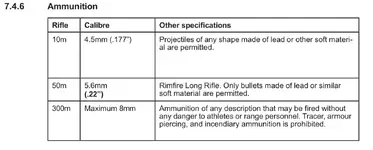
According to page 328, section 7.4.6 Ammunition (for rifles)
IMG_2186.webp
So at least the ISSF has clearer parameters by addressing shape of the projectile, while not differentiating one type of projectile from another in their rules. So for our purposes, this governing body hasn’t helped us determine the parameters of a Diabolo pellet as Jörg mentioned.
 
Sorry, I have not been on this forum for some time so did not see this thread.
To me a diabolo pellet is simply one with full bore head, followed by a waist, and then by a flared shape at the back which provides a degree of stability and is the reason the aerodynamic centre is behind the centre of gravity for most diabolo pellets. Thus, diabolo pellets use a mixture of aerodynamic and gyroscopic stabilization and belong to a group of projectiles which are aero/gyro stabilized. I would say the term diabolo came about simply because of the shape of the pellet.

As for pellets being drag stabilized again, perhaps the drag stabilized proponents can answer this. The base drag on a pellet provides the majority of the drag of a pellet and thus the claim that it stabilizes the pellet by pulling it backwards. The base drag on a slug also provides the majority of the drag on a slug, yet that for some reason is not drag stabilized, so why is that? The drag is supposed to pull the centre of pressure back behind the centre of gravity, but for some reason does not on a slug but does on a pellet.

What the drag stabilized proponents do not seem to realise is that stability and the position of the aerodynamic centre is all about moments about the centre of gravity, not forces. You could have an infinite force acting on a projectile, but if it acted through the centre of gravity it would provide no stabilization at all. The drag force from the base of a pellet may be the largest force, but it acts through the centre of gravity and thus produces no stabilizing moments, and has no effect on the position of the aerodynamic centre. Even when the pellet is at yaw, the base pressure is still the same for small angles, so the vast majority of the drag force is still acting straight through the centre of gravity basically doing nothing for the stability. We demonstrated this many years ago in one of the wind tunnels at RARDE in the UK. A series of flared base projectile models was tested for drag and stability, with ever-increasing holes in the flare until we ended up with four fins. The base drag was considerably reduced with each increase in size of the holes, but the stability remained the same and thus could not have been due to the base drag. The holes of course made no difference to the side forces which were what was really producing the stabilizing moments about the centre of gravity.

If you really want a drag stabilized pellet, you will have to attach the flare to the front of the pellet with a ball joint to allow the flare to move and thus allow the flare drag to provide the moment arm about the centre of gravity when the pellet yaws. Alternatively, you could attach a parachute to the back of the pellet with a piece of string, which would have the same effect as the ball joint on a flare. I do not think you would want either of those on your pellets.

A flare is the shape it is to produce side forces at the back of the projectile, which have a long moment arm to the centre of gravity. Thus, small side forces, produced when the projectile is at a small yaw angle, produce large stabilizing moments. The increase in drag normally associated with flares is a by product, and is a major reason flares are not used more on projectiles, hence the reason for the wind tunnel tests mentioned above. If we wanted to have a high drag projectile, which we did for some purposes, then we would use a flare as they are cheaper and easier to make than low drag fins.

Just noticed it is gone 1 o'clock here, time I was in bed.
 

Create an account or login to comment

You must be a member in order to leave a comment

Create FREE account

Create a FREE account on our community. It's easy!

Log in

Already have an account? Log in here.

Trending in this forum

Back
Top