Install the app
How to install the app on iOS

Follow along with the video below to see how to install our site as a web app on your home screen.

Note: This feature may not be available in some browsers.

JSB Jumbo Monster Light .22 Caliber 20.83 Grain Pellets Test Review

1720648489386.webp​

​

VALUE FOR MONEY​


It has to be said that JSB Jumbo Monster Light .22 Caliber 20.83 Grain pellets are relatively expensive. At the time of writing this review, the “headline” price at Pyramyd – that is before the “pay for three get four” program – is 7.5 Cents each.

However this is partially due to the fact that they are sold in small, 200-count tins. The pellet count per tin does matter. For example, 18.13 Grain JSB Jumbo Heavy pellets have a headline price of 6.0 Cents each in 250-count tins at Pyramyd. That falls to 4.6 Cents each in 500-count tins.

Yes, the Monster Light price falls to 5.6 Cents each if you order four tins from Pyramyd. However HAM Awards are “value” awards that are based on a relationship between price and performance. So they take a hit from being packed in small tins.

BUY FROM PYRAMYD​

JSB Exact Jumbo Monster Light .22 Cal, 20.83 Grains, Domed, 200ct 0.22​


JSB Jumbo Monster Light Pellets Now Shipping


TEST DATA SUMMARY​

Price per Pellet7.50 cents
Most Common Weight20.93 Grains
Pellets at That Common Weight12%
Variation in Pellet Weight (Smallest to Largest)3.79%
Most Common Head Diameter5.56 mm
Pellets at That Common Diameter54%
Variation in Diameter (Smallest to Largest)0.18%
Most Common Length8.26 and 8.27 mm
Pellets at That Common Length16%
Variation in Length (Smallest to Largest)1.72%


COMPARISON TO MAKERS CLAIMS​


The JSB Jumbo Monster Light .22 Caliber 20.83 Grain pellets tested by HAM had an average weight of 20.87 Grains. That’s less than 2% away from the claim and excellent performance, even though only 4% of the tested pellets actually weighed-in at precisely the 20.83 Grain specification.

JSB Jumbo Monster Light Pellets Now Shipping


JSB claims that there are 200 pellets in the tin. We counted 202 in the review tin.

The manufacturer makes no specific Ballistic Coefficient claims for these pellets. However independent testing to our standard HAM protocols results in a BC of 0.034. That’s a good result that’s in line with other heavy .22 caliber JSB pellets.


CONSISTENCY​


Manufacturing consistency is critically important for downrange accuracy. That’s why HAM Tester Doug Wall spends so much time weighing and measuring each individual pellet!

We need to be explicit that good manufacturing consistency does NOT guarantee that a particular barrel will “like” a certain pellet. However, it does mean that – if compatible with the barrel – the shot-to-shot accuracy on target will be better with consistently-manufactured pellets than those with less consistency.

A key component of airgun pellet manufacturing consistency is head diameter. Here the Jumbo Monster Light pellets gave excellent results!

54% of the tested pellets had a head size of 5.56mm. The remaining 46% were all 5.57mm. That means that the larger pellets had a head diameter of just about one third of one thousandth of an inch smaller than the others.

This is very good consistency, however the actual head diameters are well above the nominal 5.52 mm bore diameter for .22 caliber airguns.

JSB Jumbo Monster Light .22 Caliber 20.83 Grain Pellets Test Review


As usual, weight was somewhat more variable. The most common weight per pellet was 20.93 Grains, with 12% of the pellets tested having that weight.

The variation between the lightest and heaviest Jumbo Monster Light pellets tested was 3.79%. This is rather worse than average, based on HAM’s highly standardized, precise test protocol.

As always, all weights are measured using on Hard Air Magazine’s incredibly-precise, laboratory-grade milligram balance. This is so sensitive that it even registers a person’s breath! That’s where HAM tester Doug Wall’s many years of research laboratory experience is vital for achieving such accurate measurements…

HAM-Monster-Light-Weights-2219328.jpg


Normally in HAM testing, we find that pellet lengths are the least consistent. However, the JSB Jumbo Monster Light .22 Caliber 20.83 Grain pellets showed good length consistency. As many as 32% of the tested pellets had a length of 8.26 or 8.27 mm.

The difference between the shortest and longest pellets tested by HAM was 1.72%. Again, this was a better than average result.

HAM-Monster-Light-Lengths-5754062.jpg


Four pellets in the tin of Jumbo Monster Lights showed the effects of slight skirt damage, probably caused in transit.


DIRTINESS​


The JSB Jumbo Monster Light pellets tested by HAM had a total of 0.260 Grains of dirt per 100 pellets. Again, this is a good (low) figure.

Some residual dirt and dust is an inevitable part of manufacturing any lead pellets and a certain amount of it inevitably finds its way into the tin. The photograph below shows the amount of this “junk” which resulted from carefully washing these pellets.

HAM-Dirt-3492089.jpg


JSB Jumbo Monster Light Pellets Now Shipping


DOWNRANGE PERFORMANCE​


During HAM Ballistic Coefficient testing, JSB Jumbo Monster Light .22 Caliber 20.83 Grain pellets achieved a BC of 0.034.

As the Chairgun graph below shows, Muzzle Energy holds-up to 50% even out at around around 83 Yards downrange (50% KE).

Flatter shooting and increased hitting power downrange are the benefits of the strong Ballistic Coefficient!

JSB Jumbo Monster Light .22 Caliber 20.83 Grain Pellets


HUNTING USE​


Penetration into our standard ballistic soap block was a long 52 mm using the standard Beeman 1074 test air rifle. The diameter of the entry hole was 8.0 mm.

HAM-Soap-6413843.jpg


The photograph below shows the fired pellet after extraction from the soap – right. As we can see compared to an unfired pellet, the head diameter increased from 5.56 mm to 5.61 mm. At the same time, the length shortened from 8.28 mm before firing to 8.21 mm.

HAM-Fired-3488035.jpg


BUYING AND OWNING​


Jumbo Monster Light pellets are readily available online from from Airguns of Arizona, Airgun Depot, Pyramyd Air and more.

They are supplied in the new JSB screw top tin with a foam disk under the lid to minimize damage in transit.

HAM-Lights-6-5034900.jpg


TEST DATA​


JSB Jumbo Monster Light .22 Caliber 20.83 Grain Pellets Test Review


JSB Jumbo Monster Light .22 Caliber 20.83 Grain Pellets Test Review
For background details on HAM’s Pellet Test Review methodology, check out this link.

Chairgun is a product of Hawke Sports Optics LLC and is used with permission. Check out http://www.hawkeoptics.com

BUY FROM PYRAMYD​

JSB Exact Jumbo Monster Light .22 Cal, 20.83 Grains, Domed, 200ct 0.22​


image-100159921-13713383


Understanding HAM Pellet Awards​


HAM Pellet Awards come from the most rigorous, professional and comprehensive pellet testing by any independent publication. They are the result of much precise measurement and analysis using high precision measuring devices and highly-experienced testers.

Note that accuracy is a product of the complete “system” of airgun, scope, atmospheric conditions and shooter ability – not the pellet alone.

This means that no pellet test review can predict the accuracy of a particular pellet with YOUR individual air rifle. That’s why we do not measure accuracy in these pellet tests.

What HAM Pellet Awards do recognize is manufacturing consistency. Inconsistent pellets definitely will be inaccurate, consistent pellets are much more likely to be accurate.

HAM Awards also recognize value. There’s considerable variation in the price of airgun pellets. This means that an 8 cent pellet needs to score higher than a 2 cent pellet to achieve an award.

For full details of the HAM Pellet Award scoring methodology, please check out our Pellet Testing page.

For a full listing of HAM-tested Ballistic Coefficients, please see our Ballistic Coefficients page.

This entire article including scoring, data etc is Copyright Hard Air Magazine and may NOT in part or in whole be reproduced in any electronic or printed medium without prior permission from the publisher.


The post JSB Jumbo Monster Light .22 Caliber 20.83 Grain Pellets Test Review appeared first on Hard Air Magazine.
 
Last edited:
I just made a recent order to PA and the monster lights were available.

I chose not to purchase based on the price. Overall, I feel they are too high also If you are trying to buy different pellets at the same time to take advantage of the free can to lower the overall cost you are hurt by the lowest cost per can pellet or slug.

I have different caliber airguns, and I often purchase multiple cans of different caliber and weight. The price of these pellets would have reduced the value of my total purchase.

I am hopeful that JSB will in time make an adjustment that is in line with their other pellets.

Until then I will hold off.
 
Last edited:
I just made a recent order to PA and the monster lights were available.

I chose not to purchase based on the price. Overall, I feel they are too high also If you are trying to buy different pellets at the same time to take advantage of the free can to lower the overall cost you are hurt by the lowest cost per can pellet or slug.

I have different caliber airguns, and I often purchase multiple cans of different caliber and weight. The price of these pellets would have reduced the value of my purchase overall.

I am hopeful that JSB will in time make an adjustment that is in line with their other pellets.

Until then I will hold off.
My Brk Ghosts diet is all heavy pellets (I bought it for that so no problem!) but the lack of 4/500 round tins does bother me esp from JSB as well. Hoping if they shoot well (and therefore sell well) they will bulk them up a bit. The New Heavy Hades really got me... Bought them not paying attention and they were only 150 in a tin!? I'm afraid to shoot them much 🤣🤑 They did expand well though. Thanks for doing the Homework for us as always Steven/Doug!
 
Average fps of 575 for the BC determination is VERY VERY VERY slow.

I understand you're standardizing the process from past HAM reports, but that slow is borderline not-helpful for real-world BCs.
 
Average fps of 575 for the BC determination is VERY VERY VERY slow.

I understand you're standardizing the process from past HAM reports, but that slow is borderline not-helpful for real-world BCs.
The BCs were shot at an average of 879 FPS, as the Chairgun chart shows.
 
No problem! The BC was derived in our standard fashion using Labradar and shooting the pellets with an FX Impact. As described here HAM Publishes Most Comprehensive Database of Airgun Pellet Ballistic Coefficients

So looks like difference between muzzle speed and speed @ 30 yards. The primary reason I'm so interested is because I measured a much higher BC for m these pellets, and that higher BC tracked with Strelok predicted trajectory out to 135 yards.

There were some fundamental differences in the conditions and our data collection methods. Primary difference being the speed at which they were tested, the distance at which the downrange speed(s) were collected, and the elevation.

Of those differences I'd have to point the finger at the difference in elevation as being the culprit in why the measured BC are so different. I'm at 5600 feet above sea level, versus 244 feet.

Great example of why it's so important to measure our own versus trying to work with numbers collected with completely different variable.s

Regardless, thank you for putting in the time. A report like that represents many more hours of testing than the couple minutes of reading it would imply.
 
@Franklink, thanks for your comments!

The reason we measure BCs from 0 to 30 Yards is due to the results we found in pre-testing, before beginning our published HAM BC tests.

We found increasingly-wide variations between individual shots in a 10-shot string starting at 40 Yards and increasing considerably from there. Yes, the individual shot velocities at longer ranges could be averaged but - by the time we had reached 50 Yards - these variations had become so large (in some cases) as to make a calculated average equivalent to just a guess!

By using a maximum range of 30 Yards we are able to have average velocities that conform to a tight spread of individual FPS numbers in our 10-shot groups. That gives us a high confidence level in the calculated average FPS values and - hence - the resulting BCs.

We also always use a standard "Mark One" FX Impact as it can accept barrels from .177 to 30 cal, all using the same action. A downside of this is that the velocities with heavier pellets are relatively slow. However it increases the comparability of the individual BC values - that's our main goal. If we started using a range of different airguns for BC testing, the results would have another variable in them.

Agreed, elevation, temperature and humidity all cause changes in BC values.

And yes, these reports take TON of time and effort to produce. Thanks for recognizing that! The vast majority of the work is done by Doug Wall. He deserves our thanks for his commitment, consistency and dedication to precise, repeatable laboratory-grade practice!!!
 
In my method I've seen the same trend: as distances increase, the fps spread of the sample does too. And sometimes drastically. What doesn't make sense is that those highly variable (fps) shots downrange will often still print quite respectable groups. Logic would suggest that the slower ones would be hitting lower, but they dont always impact lower.

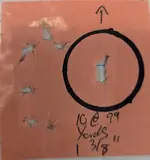
Here's an example....these ten shots were taken. @ 99yards, and shot over a chronograph. The chrono captured all ten shots, just about 2 feet in front of the paper, so call it speed at 98.1 yards. This gun has a 5-7fps spread at the muzzle, but these ten shots @ 99 yards had a 70fps ES @ 98.1yards, and still somehow grouped into 1 and 3/8." A guy would expect the shot going 709.9 to have hit much lower than the shot going 779.9, but nope, vertical spread of all ten shots is within about 1.25 inches.

PXL_20240711_160634750.webp

Doing it this way I'll calculate the BC several ways, by either throwing out highs and lows and averaging the rest, or even using the median speed as the downrange speed in the ballistics app for BC calculation.

All very interesting stuff.
 
In my method I've seen the same trend: as distances increase, the fps spread of the sample does too. And sometimes drastically. What doesn't make sense is that those highly variable (fps) shots downrange will often still print quite respectable groups. Logic would suggest that the slower ones would be hitting lower, but they dont always impact lower.

Here's an example....these ten shots were taken. @ 99yards, and shot over a chronograph. The chrono captured all ten shots, just about 2 feet in front of the paper, so call it speed at 98.1 yards. This gun has a 5-7fps spread at the muzzle, but these ten shots @ 99 yards had a 70fps ES @ 98.1yards, and still somehow grouped into 1 and 3/8." A guy would expect the shot going 709.9 to have hit much lower than the shot going 779.9, but nope, vertical spread of all ten shots is within about 1.25 inches.

View attachment 7105

Doing it this way I'll calculate the BC several ways, by either throwing out highs and lows and averaging the rest, or even using the median speed as the downrange speed in the ballistics app for BC calculation.

All very interesting stuff.
I agree with everything you said!!!
 
Last edited:
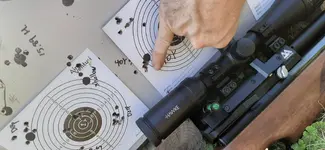
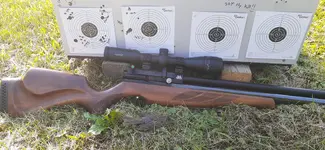
Well I got out in the humid weather and ran the new lights through both my pcps! The Ghost was just off reg but I dialed her down to min and ripped one off @50Y....it slid into the grass in front of the trap🧐🤯. Next bunch went where I was aiming but yeah not great. Then the S510 was up. WOOOW finally a pellet to compete with the JSB 18.13! Still overpriced BIG TIME vs the 18.13 but if you need a tad more energy down range these are the pellet! Started up the bbq and this sparrow (under the gun) lands 10 feet away from the trap...slid the bench rest over and ripped off a shot. He wasn't fazed, and I reloaded and just smoked em. Can't get better real world testing than that!? Best thing was I held dead on at 40Y so it's basically same hold vs the 18s. Center left card has the groups. The mess above S510 groups was the Ghosts. I will retry them again at some point through it...just for the lols.
 

Attachments

  • 20240804_181702.webp
    20240804_181702.webp
    741.9 KB · Views: 11
  • 20240804_181719.webp
    20240804_181719.webp
    241.9 KB · Views: 11
@Franklink, thanks for your comments!

The reason we measure BCs from 0 to 30 Yards is due to the results we found in pre-testing, before beginning our published HAM BC tests.

We found increasingly-wide variations between individual shots in a 10-shot string starting at 40 Yards and increasing considerably from there. Yes, the individual shot velocities at longer ranges could be averaged but - by the time we had reached 50 Yards - these variations had become so large (in some cases) as to make a calculated average equivalent to just a guess!

By using a maximum range of 30 Yards we are able to have average velocities that conform to a tight spread of individual FPS numbers in our 10-shot groups. That gives us a high confidence level in the calculated average FPS values and - hence - the resulting BCs.

We also always use a standard "Mark One" FX Impact as it can accept barrels from .177 to 30 cal, all using the same action. A downside of this is that the velocities with heavier pellets are relatively slow. However it increases the comparability of the individual BC values - that's our main goal. If we started using a range of different airguns for BC testing, the results would have another variable in them.

Agreed, elevation, temperature and humidity all cause changes in BC values.

And yes, these reports take TON of time and effort to produce. Thanks for recognizing that! The vast majority of the work is done by Doug Wall. He deserves our thanks for his commitment, consistency and dedication to precise, repeatable laboratory-grade practice!!!
I can’t even imagine the amount of time and effort that went into this project. Hats off and a huge thumbs up to Doug and HAM!
BTW, which factor has the greatest impact on BC…elevation, humidity, temperature,?
 

Create an account or login to comment

You must be a member in order to leave a comment

Create FREE account

Create a FREE account on our community. It's easy!

Log in

Already have an account? Log in here.

Trending in this forum

Back
Top