
Install the app
How to install the app on iOS

Follow along with the video below to see how to install our site as a web app on your home screen.

Note: This feature may not be available in some browsers.

Others Sightron optics

Northeastbeast

HAM Sniper
477
1,621
Usa
HAM Points
2,780.50
Country flag
I have been using sightron for some time now and feel they are one of the better brands in the industry. If you have a Sightron use this thread to speak on it good or bad.

I have the following sightron scopes and love them all.

S3 45x ED fixed magnification we use it for N50 benchrest. And it helped me finish 4th in the nation in 2022 great scope and never loses zero. Now our youngest son uses it he got his first high placement at n50 the other day with a 2nd place finish. He is 10 and beat out some very seasoned shooters

S3 10-50X60 PLR MOA We use this for 100 yard benchrest and has been to few large competitions and never let me down.

S3 6-24x50 PLR MOA this is my general purpose scope and goes where every i need it. Super crisp turrets and o so clear glass.

S8 5-40X56 ED MRAD This scope is my favorite with its monster 40mm tube size and more Clicks then you will ever use. Its the perfect airgun PRS and long range scope. I have also dragged this scope around a few major competitions and it didnt let me down was on point for every shot.
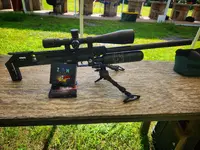
 

Attachments

  • IMG_20230727_082332_991.webp
    IMG_20230727_082332_991.webp
    929.3 KB · Views: 6
I have 3 Sightron S3s in 10-50X60 with MOA-2 and MOA-H reticles. I did have one with fine cross hairs which I used for 25M BR shooting which I no longer do. Also, I have two S-TACs in 4-20X for general shooting. All of them, I feel, are top quality. The S3s are great for any BR shooting. I now compete in 100 yard EBR at my local club.
 
I have a Sightron 4-20x SFP STAC. Love the build quality and the glass. I just don’t like the lack of numbers for approximate yardage on the parallax knob. It mostly sits in its box because of that. When I used it, it was great for shooting from known distances. Understand that I have also really moved away from using SFP scopes as well, but I held onto to that one.
IMG_3895.webp
 
I have a Sightron 4-20x SFP STAC. Love the build quality and the glass. I just don’t like the lack of numbers for approximate yardage on the parallax knob. It mostly sits in its box because of that. When I used it, it was great for shooting from known distances. Understand that I have also really moved away from using SFP scopes as well, but I held onto to that one.
View attachment 1691
EZANA: I see that you're moving away from SFP scopes. May I ask why? I've been shooting my TX200 these past 3 plus years with a Hawke SF 4-16x50 mounted on it and have been considering a 2nd focal plane scope. I don't know enough to shoot either one well, but in layman's terms, why should I shoot either one. I mostly shoot paper targets and metal HFT targets from 25 yds out to 85 yards from the bench. I appreciate any help. Orv.
 
EZANA: I see that you're moving away from SFP scopes. May I ask why? I've been shooting my TX200 these past 3 plus years with a Hawke SF 4-16x50 mounted on it and have been considering a 2nd focal plane scope. I don't know enough to shoot either one well, but in layman's terms, why should I shoot either one. I mostly shoot paper targets and metal HFT targets from 25 yds out to 85 yards from the bench. I appreciate any help. Orv.

@Hoppalong Doc I’m a hunter and I don’t like having to memorize different holdovers for different magnifications. I often don’t have time to dial scope turrets. They make noise when they click and I like to stalk in close to an animal. I don’t want to alert or spook them. I certainly don’t have time to look as a cheat sheet with various holds taped to my rifle or scope caps, especially while night hunting. I tend to change my magnification several times when I’m afield while using variable magnification scopes. With FFP scopes I don’t have to double check which magnification I’m on before taking a shot. Nor do I need to memorize more than one set of holds and distances. No matter which magnification setting I leave the scope on, the holds are the same for specific distances. I don’t care if the reticle gets smaller when I rotate the magnification ring. The reticle in the 6x-10x magnification range has served me well.

SFP scopes work ok for me when shooting from a fixed and known distance or if I don’t change the magnification. I haven’t gotten into dialing turrets and I’m not much of a long range shooter. Anything over 50 yards is considered long range to me. With and air rifle, I want to shoot animals from 50 yards or closer if I can help it.
 
Last edited:
@Hoppalong Doc I’m a hunter and I don’t like having to memorize different holdovers for different magnifications. I often don’t have time to dial scope turrets. They make noise when they click and I like to stalk in close to an animal. I don’t want to alert or spook them. I certainly don’t have time to look as a cheat sheet with various holds taped to my rifle or scope caps, especially while night hunting. I tend to change my magnification several times when I’m afield while using variable magnification scopes. With FFP scopes I don’t have to double check which magnification I’m on before taking a shot. Nor do I need to memorize more than one set of holds and distances. No matter which magnification setting I leave the scope on, the holds are the same for specific distances. I don’t care if the reticle gets smaller when I rotate the magnification ring. The reticle in the 6x-10x magnification range has served me well.

SFP scopes work ok for me when shooting from a fixed and known distance or if I don’t change the magnification. I haven’t gotten into dialing turrets and I’m not much of a long range shooter. Anything over 50 yards is considered long range to me. With and air rifle, I want to shoot animals from 50 yards or closer if I can help it.
ENZANA: I definitely appreciate your perspective. I usually shoot from a bag at the bench. All our targets are from 10 yds out to 150 yds and are from various angles as well as elevations. We'll often get together and play "horse " (like one might do playing "out" on a basketball court). Three or four of us can stretch an afternoon of challenges on for several hours of fun. Trusting my scope settings is vital to my honor during these battles. Any insight that any one of you might have will be appreciated. Orv.

MODERATOR: I'd appreciate knowing what I've said to trigger you're attention. I truly don't want to make inappropriate statements on this forum which I value highly. Clearly it would be appreciated if you would strike this comment meant for just you. Thank you, Orv
 
ENZANA: I definitely appreciate your perspective. I usually shoot from a bag at the bench. All our targets are from 10 yds out to 150 yds and are from various angles as well as elevations. We'll often get together and play "horse " (like one might do playing "out" on a basketball court). Three or four of us can stretch an afternoon of challenges on for several hours of fun. Trusting my scope settings is vital to my honor during these battles. Any insight that any one of you might have will be appreciated. Orv.

MODERATOR: I'd appreciate knowing what I've said to trigger you're attention. I truly don't want to make inappropriate statements on this forum which I value highly. Clearly it would be appreciated if you would strike this comment meant for just you. Thank you, Orv

Hello Orv,

I'm answering this "in clear" as it's actually my fault! What happened is this...

We have a "bad words filter" built-in to the software. When first set-up, it was much too aggressive and was flagging lots of words that it thought bad, but which we don't. When the software sees a "bad" word, it refers it to a Moderator who can then decide what to do.

So I went through the "bad words" software and struck out all the words it thought were bad, but which I did not.

Unfortunately it seems that I missed the word "spook". You used this word - entirely reasonably and correctly - in your post. Lee, the Moderator concerned, accepted your post entirely "as is" as soon as he saw it.

So Lee told me and we will remove "spook" from the list. Then the situation will not occur again - at least with that word!

Thanks for your understanding. I wanted to make this apology and explanation public for two reasons:
1. Because we aim to make the HAM Community as transparent as possible.
2. As there may yet be another errant word or two somewhere in that list that I have missed!

Thanks for your understanding :)

Stephen Archer
 
I shoot Field Target, hunter class. I've tried Hawke Sidewinder, Element Optics Titan, Athlon Helos, Nikko Stirling Hornet, and the Sightron FT, and don't like any of them for me. I discovered the Sightron S-Tac FFP 4-20x50 Zero Stop and this scope bats all the others. The MILL-HASH 4 reticle is excellent for holdovers. The glass is very clear, although not as bright as the Sightron FT. But, best of all for me is the scope only weighs 25oz. making those off hand shots much more manageable. The only thing is I really wish the turrets locked! Other than that, this is the perfect hunter class scope in my humble opinion.
 
I shoot Field Target, hunter class. I've tried Hawke Sidewinder, Element Optics Titan, Athlon Helos, Nikko Stirling Hornet, and the Sightron FT, and don't like any of them for me. I discovered the Sightron S-Tac FFP 4-20x50 Zero Stop and this scope bats all the others. The MILL-HASH 4 reticle is excellent for holdovers. The glass is very clear, although not as bright as the Sightron FT. But, best of all for me is the scope only weighs 25oz. making those off hand shots much more manageable. The only thing is I really wish the turrets locked! Other than that, this is the perfect hunter class scope in my humble opinion.
AIRGOON: I sure appreciate your input. I'd still really like to have some input on whether a first or second focal plane is the more appropriate scope for me, shooting paper targets from 25 to 75 yards. I also enjoy shooting our metal targets out to a hundred yards. At my age, I can hardly see out past a hundred yards, but maybe, just maybe, some good glass might make me smile. Thanks, Orv.
 
Hello Orv,

I'm answering this "in clear" as it's actually my fault! What happened is this...

We have a "bad words filter" built-in to the software. When first set-up, it was much too aggressive and was flagging lots of words that it thought bad, but which we don't. When the software sees a "bad" word, it refers it to a Moderator who can then decide what to do.

So I went through the "bad words" software and struck out all the words it thought were bad, but which I did not.

Unfortunately it seems that I missed the word "spook". You used this word - entirely reasonably and correctly - in your post. Lee, the Moderator concerned, accepted your post entirely "as is" as soon as he saw it.

So Lee told me and we will remove "spook" from the list. Then the situation will not occur again - at least with that word!

Thanks for your understanding. I wanted to make this apology and explanation public for two reasons:
1. Because we aim to make the HAM Community as transparent as possible.
2. As there may yet be another errant word or two somewhere in that list that I have missed!

Thanks for your understanding .

Thank you, sir. This forum has become my first go to, I truly appreciate it. Orv.

t

Stephen Archer
 
AIRGOON: I sure appreciate your input. I'd still really like to have some input on whether a first or second focal plane is the more appropriate scope for me, shooting paper targets from 25 to 75 yards. I also enjoy shooting our metal targets out to a hundred yards. At my age, I can hardly see out past a hundred yards, but maybe, just maybe, some good glass might make me smile. Thanks, Orv.
I can appreciate that you want someone to tell you what is best for you, but FFP vs SFP is purely personal. It comes down to what you like, more than what anyone else likes. There are lots of reasons to choose one over the other. I use both, and I usually prefer FFP because I like the reticles better. That being said, I do have some SFP for the higher mag. Some thoughts…

  1. Reticle - This (to me) is the most often overlooked aspect of a scope, but is possibly most important.
    1. Do you like a busy/plain reticle - both FFP and SFP have both, but SFP usually has more plain options.
    2. thin/thick reticle - FFP are usually thicker, once you get above a certain magnification.
    3. fixed/variable sized reticle - FFP reticle size changes with magnification, and SFP reticle stays same size all the time (don’t confuse size with reticle subtension measurement.
  2. Do you like to use your reticle for holdovers or do you prefer to click? This can work with either reticle. With FFP, the reticle has the same subtensions no matter the magnification, so it can be easier to use holdovers if you change magnifications. With SFP, the subtensions change as you change magnification. If you always keep it at one magnification and dial elevation, this doesn’t matter as much.
  3. Do you prefer really high mag, 35-50x or do you prefer to stay down in 5-25? High mags scopes are much cheaper in SFP. If you want high mag (>30x) in FFP, you have to pay for it. This could be a big deciding factor. This one is a major deciding factor for me. If I want high mag, I will buy a SFP usually to save money.
 
I can appreciate that you want someone to tell you what is best for you, but FFP vs SFP is purely personal. It comes down to what you like, more than what anyone else likes. There are lots of reasons to choose one over the other. I use both, and I usually prefer FFP because I like the reticles better. That being said, I do have some SFP for the higher mag. Some thoughts…

  1. Reticle - This (to me) is the most often overlooked aspect of a scope, but is possibly most important.
    1. Do you like a busy/plain reticle - both FFP and SFP have both, but SFP usually has more plain options.
    2. thin/thick reticle - FFP are usually thicker, once you get above a certain magnification.
    3. fixed/variable sized reticle - FFP reticle size changes with magnification, and SFP reticle stays same size all the time (don’t confuse size with reticle subtension measurement.
  2. Do you like to use your reticle for holdovers or do you prefer to click? This can work with either reticle. With FFP, the reticle has the same subtensions no matter the magnification, so it can be easier to use holdovers if you change magnifications. With SFP, the subtensions change as you change magnification. If you always keep it at one magnification and dial elevation, this doesn’t matter as much.
  3. Do you prefer really high mag, 35-50x or do you prefer to stay down in 5-25? High mags scopes are much cheaper in SFP. If you want high mag (>30x) in FFP, you have to pay for it. This could be a big deciding factor. This one is a major deciding factor for me. If I want high mag, I will buy a SFP usually to save money.
SMKO3Y: Thanks for your explanation. Your help about reticle magnification is especially helpful. Orv.
 
@Hoppalong Doc I just read through this thread again. In your meet-ups you said that your group has shooting competitions fashioned after the playground basketball game of “horse.” In this competition you mentioned shooting from different angles and elevations. I’m curious, what sort of adjustments do you find yourself having to make when shooting a stationary paper target from various angles?
 
@Hoppalong Doc I just read through this thread again. In your meet-ups you said that your group has shooting competitions fashioned after the playground basketball game of “horse.” In this competition you mentioned shooting from different angles and elevations. I’m curious, what sort of adjustments do you find yourself having to make when shooting a stationary paper target from various angles?
I'm happy to answer questions about what I enjoy most. First of all, where I live we're privileged to have a bench rest set-up with a dozen covered shooting stations. When shooting, nobody is permitted to move in front of this line. Out on our target stations we have both paper targets as well as standard metal ones set at varied distances out to over 200 yards (in practical terms, 100 yards is what we use). Our shooting area is set up in a long canyon with rolling hills. Targets are set at various heights (15-20') and in an array in the canyon roughly 80 yards side to side of the canyon. We're nicely set for safety as the hillsides on either side of our range are high enough to discourage hiking upon them. In addition there is barbed wire fencing at 200 yds. in the distance. Understanding now how we're arranged, you ask how we meet our shooting challenges. First of all, being located in a desert canyon, the wind is our chief nemesis; it typically blows from a calm 5 mph up to 25 or 30 mph. When the winds reach that much, it's definitely too challenging for air guns. For the targets on the rolling hills, I've just pretty well learned my holdovers. I'm afraid that my skills are significantly challenged beyond shooting our "clown on the hill" at 85 yds. That hill is actually on the side of our canyon up just over 15 feet in height. We have posted accurate yardage markers from 10 yards out, and then every 5 yards out to 75 yards and then every 10 yards out the rest of the way to 200 yards. Our targets are the typical metal FT ones you see at any competition, except that the strings to re-set them are no longer usable. Setting those back up would take a mite of elbow grease and lubrication that we just haven't kept up. Our bright yellow painting does make everything shine nicely. Does this help you visualize our range a bit now? Come on out to see us and bring your kit. Should you be lacking, we have a half dozen loner rifles and plenty of pellets and BBs. We used the FT range description that Tom Gaylord (The Godfather of Airguns) described in his blog). Should you ever find yourself in Southern California, drop by and visit us in Aguanga, near Temecula. Orv.
 
I'm happy to answer questions about what I enjoy most. First of all, where I live we're privileged to have a bench rest set-up with a dozen covered shooting stations. When shooting, nobody is permitted to move in front of this line. Out on our target stations we have both paper targets as well as standard metal ones set at varied distances out to over 200 yards (in practical terms, 100 yards is what we use). Our shooting area is set up in a long canyon with rolling hills. Targets are set at various heights (15-20') and in an array in the canyon roughly 80 yards side to side of the canyon. We're nicely set for safety as the hillsides on either side of our range are high enough to discourage hiking upon them. In addition there is barbed wire fencing at 200 yds. in the distance. Understanding now how we're arranged, you ask how we meet our shooting challenges. First of all, being located in a desert canyon, the wind is our chief nemesis; it typically blows from a calm 5 mph up to 25 or 30 mph. When the winds reach that much, it's definitely too challenging for air guns. For the targets on the rolling hills, I've just pretty well learned my holdovers. I'm afraid that my skills are significantly challenged beyond shooting our "clown on the hill" at 85 yds. That hill is actually on the side of our canyon up just over 15 feet in height. We have posted accurate yardage markers from 10 yards out, and then every 5 yards out to 75 yards and then every 10 yards out the rest of the way to 200 yards. Our targets are the typical metal FT ones you see at any competition, except that the strings to re-set them are no longer usable. Setting those back up would take a mite of elbow grease and lubrication that we just haven't kept up. Our bright yellow painting does make everything shine nicely. Does this help you visualize our range a bit now? Come on out to see us and bring your kit. Should you be lacking, we have a half dozen loner rifles and plenty of pellets and BBs. We used the FT range description that Tom Gaylord (The Godfather of Airguns) described in his blog). Should you ever find yourself in Southern California, drop by and visit us in Aguanga, near Temecula. Orv.
I left out one last response to the questions asked: when taking one's turn playing horse at our range, the shooter is allowed to move laterally, behind the line marked by the concrete slab and laterally between the stake markers. Of course, the shooter may not step back beyond the marked line, and the non shooter must not step forward of that line. All gun handling rules are stringently observed. Orv.
 
I left out one last response to the questions asked: when taking one's turn playing horse at our range, the shooter is allowed to move laterally, behind the line marked by the concrete slab and laterally between the stake markers. Of course, the shooter may not step back beyond the marked line, and the non shooter must not step forward of that line. All gun handling rules are stringently observed. Orv.
@Hoppalong Doc Interesting rule. The ability to position oneself laterally definitely changes things. I really don't mean to hijack the thread. I was just wondering if you other competitors at your events, or anyone reading this observes a noticeable POI shift when shooting paper targets at an angle.
 
@Hoppalong Doc Interesting rule. The ability to position oneself laterally definitely changes things. I really don't mean to hijack the thread. I was just wondering if you other competitors at your events, or anyone reading this observes a noticeable POI shift when shooting paper targets at an angle.
I enjoy your questions. When shooting across range, ie laterally, the poi certainly changes, just as the algebraic angle changes. For me, when shooting from say 25 yards as marked by the yardage stakes, I must take into my shot plan that the angle formed by my lateral move will definitely change my point of impact. Orv.
 

Create an account or login to comment

You must be a member in order to leave a comment

Create FREE account

Create a FREE account on our community. It's easy!

Log in

Already have an account? Log in here.

Trending in this forum

Back
Top