
Install the app
How to install the app on iOS

Follow along with the video below to see how to install our site as a web app on your home screen.

Note: This feature may not be available in some browsers.

How Airguns Have Improved Since 1980 – Part One

1716810824465.webp

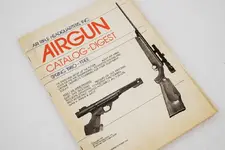
Today, we’re looking at a historical document from the airgun industry. It’s the 132-page, Spring 1980 catalog from the Air Rifle Headquarters Inc. and it’s an ideal opportunity to see how airguns have improved since that time.

So, yes, that’s 44 years ago and – frighteningly – some of us (including me) can still remember that far back!

Long-time US air gunners will remember the Air Rifle Headquarters. It was a company founded in the early 1960s by Robert Law. Based at Grantsville, West Virginia, it was one of – or maybe was – the earliest high-end US airgun dealership that attempted to promote expensive European airguns as a quality ‘adult airgun’ shooting experience.

Below. Law educated his readers about airguns. It was all part of his marketing approach.

HAM-Law-2-5982995.jpg


Robert Law achieved this by relentlessly publicizing airguns, how to shoot them and everything else associated with them.

Starting from 1972, Robert Beeman followed a similar strategy, with greater long-term success. One major difference was that Beeman branded products with his own name. Law did not, he used the brand names of his suppliers (even though they were the same as Beeman’s in many cases).

You can see that change happening in this document. Although Beeman pellets are not included in this catalog, a few are listed for sale in the price list. That must have hurt Robert Law deeply…

HAM-Law-4-3079603.jpg


Remember that this was waaaay before the Internet. So all of the material was produced as printed hard copy and shipped out by snail mail. Air Rifle Headquarters published a comprehensive catalog twice a year. Plus a monthly booklet-sized newsletter. Trust me, it was a ton of work for him!!!

Sadly this Spring 1980 catalog was nearly the end of Air Rifle Headquarters. The next edition was the final one, in which Robert Law announced his decision to move on to other challenges and close the company.

Below. Beeman catalogs were glitzier than those from Air Rifle Headquarters.

HAM-Law-10-5949816.jpg


So what can we learn from this catalog and what can it tell us about how airguns have improved since 1980?

Well, first of all, we need to appreciate that Robert Law was importing and selling high-quality, high-priced .177 caliber European spring/piston air rifles. He differentiated these from the then-current – and much cheaper – US domestic models like Crosman, Benjamin, Sheridan and Daisy on the basis of muzzle velocity, accuracy and quality.

Sounds familiar, huh?

Below. No Internet in 1980, so Robert Law’s material arrived in good old-fashioned envelopes like this.

How Airguns Have Improved Since 1980


In 1980, quality spring/piston air rifles were unusual in the USA. Domestic airgun production consisted primarily of multi-pump and CO2-powered airguns. Robert Law hammered them by proving that his break barrel- or side lever-cocking, European-manufactured airguns were incomparably superior. At least according to his writings.

It’s not the purpose of this article to go into the US versus European argument. What I’m trying to do is to take the marketing points Law was making and use them to compare the state of the 1980 US airgun market to what it is today.

Let’s take a look…


How Airguns Have Improved Since 1980 – Accuracy​


Robert Law was a great proponent of accurate airgun shooting. He segmented these into “Exceptional Accuracy”, “Match Accuracy” and “Super-Match Accuracy”.

How Airguns Have Improved


Above. That’s Robert Law at the left.

But what we see is that his definition of accuracy comprised 3-shot groups shot at just 25 Feet range! Law listed the accuracy obtainable from “top match air rifles” as being 1 1/4-Inch groups at 35 Yards – presumably his standard 3-shot groups, that is.

That’s an approach that would not compare well with current expectations for better accuracy with larger shot-count groups at much longer ranges!

By “top match air rifles”, he probably meant the Feinwerkbau F300 models that Air Rifle Headquarters sold in 1980 for between $648 and $925. Yes, they were that price forty-four years ago!

Furthermore, Law claims that “Statistics show that .177 customarily will fire a group 42% tighter than a .22 counterpart.” He goes on to predict that “During the next decade” – that is by 1990 – “we anticipate .22 caliber will phase off the market like the earlier .25 caliber.”

Hmmm…

(Hey, none of us are perfect about predicting the future, but I’m definitely not convinced about that group size argument – if he means Center-to-Center group size, that is).

Below. Here’s a selection of monthly newsletters. They were called Air Rifle Monthly (ARM).

HAM-Law-11-7904177.jpg


But some of his advice was spot-on, even forty-four years later. “An important key to successful pest control and field application is diligent practice – lots of it.” Law writes. “To accomplish this, we suggest concentrated practice… until the gun in question almost becomes part of you.”

Agreed. 100 per cent!


How Airguns Have Improved Since 1980 – Power​


Robert Law talks about power in his catalog. However – except in one paragraph – it’s not quantified in Ft/Lbs or any other units.

HAM-Law-13-5952361.jpg


What he does say is that the highest powered air rifle in his catalog (the Original 45) shoots with a Muzzle Velocity of 820 FPS (pellet type not mentioned). That would be something like 10.5 Ft/Lbs of Muzzle Energy. This provides – he says – “extended range, flatter trajectory, and the increased power so important for field use.”

All this is related to .177 caliber, of course. He also suggests that “.22 bore has a slim 10% edge over .177 caliber in foot pounds of energy.” Really?

Another opinion that has not proved valid over time is this: “Experts feel” he says, “that power in excess of the present sporter level is undesirable. It would only result in pushing the recoil, noise, cocking effort and parts stress to an unacceptable level. Restrictive legislation would inevitably result.”

Clearly improvements in airgun technology have far surpassed anything that Robert Law could have dreamed about back in 1980. And fortunately airguns are still not regulated in the USA at the Federal level in 2024.


Tomorrow we’ll continue to look through the Air Rifle Headquarters Inc. Spring 1980 catalog. We’ll see many other things that have improved since that time…


The post How Airguns Have Improved Since 1980 – Part One appeared first on Hard Air Magazine.
 
"Law was importing and selling high-quality, high-priced .177 caliber European spring/piston air rifles. He differentiated these from the then-current – and much cheaper – US domestic models like Crosman, Benjamin, Sheridan and Daisy on the basis of muzzle velocity, accuracy and quality.

Sounds familiar, huh?"

That kinda shows how little has changed 🤤

"Furthermore, Law claims that “Statistics show that .177 customarily will fire a group 42% tighter than a .22 counterpart.” He goes on to predict that “During the next decade” – that is by 1990 – “we anticipate .22 caliber will phase off the market like the earlier .25 caliber.”

I've noticed that in .22 I see a more lax tolerance in leades/ bore / pellets for overall then I see in .177 .

I also notice like in forums folks finding the right pellet in .22 or loose pellets in .22
 
Feeling a bit nostalgic....I'm sure the Beeman catalog is one I poured over either just before or after receiving the C1 I ordered from them back in the early 80's. It may have come with the rifle, silver bear pellets and Beeman maintenance kit that I ordered all at the same time.
I think I had more shopping satisfaction from print catalogs I'd get . Like sears or cabelas in the mail . I just don't get that same feel on line ..lol
 
I really enjoyed reading this. I bought both guns pictured on the front cover of that Spring 1980 catalog, and I really miss those glitzy Beeman catalogs. Yeah, they got a lot wrong too. Beeman did a lot of wishful thinking, trying to sell people on .20, his arguments were sound, I still don't understand why it isn't more popular. If the internet would have been around then, the .20 would probably have taken off. Coulda, woulda, shoulda.
 
I think I had more shopping satisfaction from print catalogs I'd get . Like sears or cabelas in the mail . I just don't get that same feel on line ..lol
The only better thing about the internet is you (usually) find out if something isn't in stock immediately. Instead of ordering and getting a letter weeks later telling you "your item is out of stock".
 
The only better thing about the internet is you (usually) find out if something isn't in stock immediately. Instead of ordering and getting a letter weeks later telling you "your item is out of stock".
Back when there was the allow 4 to 6 weeks for delivery thing .. I figure now that was to help cover a out of stock till they got more in .. lol
 
View attachment 6365

Today, we’re looking at a historical document from the airgun industry. It’s the 132-page, Spring 1980 catalog from the Air Rifle Headquarters Inc. and it’s an ideal opportunity to see how airguns have improved since that time.

So, yes, that’s 44 years ago and – frighteningly – some of us (including me) can still remember that far back!

Long-time US air gunners will remember the Air Rifle Headquarters. It was a company founded in the early 1960s by Robert Law. Based at Grantsville, West Virginia, it was one of – or maybe was – the earliest high-end US airgun dealership that attempted to promote expensive European airguns as a quality ‘adult airgun’ shooting experience.

Below. Law educated his readers about airguns. It was all part of his marketing approach.

HAM-Law-2-5982995.jpg


Robert Law achieved this by relentlessly publicizing airguns, how to shoot them and everything else associated with them.

Starting from 1972, Robert Beeman followed a similar strategy, with greater long-term success. One major difference was that Beeman branded products with his own name. Law did not, he used the brand names of his suppliers (even though they were the same as Beeman’s in many cases).

You can see that change happening in this document. Although Beeman pellets are not included in this catalog, a few are listed for sale in the price list. That must have hurt Robert Law deeply…

HAM-Law-4-3079603.jpg


Remember that this was waaaay before the Internet. So all of the material was produced as printed hard copy and shipped out by snail mail. Air Rifle Headquarters published a comprehensive catalog twice a year. Plus a monthly booklet-sized newsletter. Trust me, it was a ton of work for him!!!

Sadly this Spring 1980 catalog was nearly the end of Air Rifle Headquarters. The next edition was the final one, in which Robert Law announced his decision to move on to other challenges and close the company.

Below. Beeman catalogs were glitzier than those from Air Rifle Headquarters.

HAM-Law-10-5949816.jpg


So what can we learn from this catalog and what can it tell us about how airguns have improved since 1980?

Well, first of all, we need to appreciate that Robert Law was importing and selling high-quality, high-priced .177 caliber European spring/piston air rifles. He differentiated these from the then-current – and much cheaper – US domestic models like Crosman, Benjamin, Sheridan and Daisy on the basis of muzzle velocity, accuracy and quality.

Sounds familiar, huh?

Below. No Internet in 1980, so Robert Law’s material arrived in good old-fashioned envelopes like this.

How Airguns Have Improved Since 1980


In 1980, quality spring/piston air rifles were unusual in the USA. Domestic airgun production consisted primarily of multi-pump and CO2-powered airguns. Robert Law hammered them by proving that his break barrel- or side lever-cocking, European-manufactured airguns were incomparably superior. At least according to his writings.

It’s not the purpose of this article to go into the US versus European argument. What I’m trying to do is to take the marketing points Law was making and use them to compare the state of the 1980 US airgun market to what it is today.

Let’s take a look…


How Airguns Have Improved Since 1980 – Accuracy​


Robert Law was a great proponent of accurate airgun shooting. He segmented these into “Exceptional Accuracy”, “Match Accuracy” and “Super-Match Accuracy”.

How Airguns Have Improved


Above. That’s Robert Law at the left.

But what we see is that his definition of accuracy comprised 3-shot groups shot at just 25 Feet range! Law listed the accuracy obtainable from “top match air rifles” as being 1 1/4-Inch groups at 35 Yards – presumably his standard 3-shot groups, that is.

That’s an approach that would not compare well with current expectations for better accuracy with larger shot-count groups at much longer ranges!

By “top match air rifles”, he probably meant the Feinwerkbau F300 models that Air Rifle Headquarters sold in 1980 for between $648 and $925. Yes, they were that price forty-four years ago!

Furthermore, Law claims that “Statistics show that .177 customarily will fire a group 42% tighter than a .22 counterpart.” He goes on to predict that “During the next decade” – that is by 1990 – “we anticipate .22 caliber will phase off the market like the earlier .25 caliber.”

Hmmm…

(Hey, none of us are perfect about predicting the future, but I’m definitely not convinced about that group size argument – if he means Center-to-Center group size, that is).

Below. Here’s a selection of monthly newsletters. They were called Air Rifle Monthly (ARM).

HAM-Law-11-7904177.jpg


But some of his advice was spot-on, even forty-four years later. “An important key to successful pest control and field application is diligent practice – lots of it.” Law writes. “To accomplish this, we suggest concentrated practice… until the gun in question almost becomes part of you.”

Agreed. 100 per cent!


How Airguns Have Improved Since 1980 – Power​


Robert Law talks about power in his catalog. However – except in one paragraph – it’s not quantified in Ft/Lbs or any other units.

HAM-Law-13-5952361.jpg


What he does say is that the highest powered air rifle in his catalog (the Original 45) shoots with a Muzzle Velocity of 820 FPS (pellet type not mentioned). That would be something like 10.5 Ft/Lbs of Muzzle Energy. This provides – he says – “extended range, flatter trajectory, and the increased power so important for field use.”

All this is related to .177 caliber, of course. He also suggests that “.22 bore has a slim 10% edge over .177 caliber in foot pounds of energy.” Really?

Another opinion that has not proved valid over time is this: “Experts feel” he says, “that power in excess of the present sporter level is undesirable. It would only result in pushing the recoil, noise, cocking effort and parts stress to an unacceptable level. Restrictive legislation would inevitably result.”

Clearly improvements in airgun technology have far surpassed anything that Robert Law could have dreamed about back in 1980. And fortunately airguns are still not regulated in the USA at the Federal level in 2024.


Tomorrow we’ll continue to look through the Air Rifle Headquarters Inc. Spring 1980 catalog. We’ll see many other things that have improved since that time…


The post How Airguns Have Improved Since 1980 – Part One appeared first on Hard Air Magazine.

Excellent article! Thank you!
 
I remember pouring over the Sears Catalog and dieing for one of the Ted Williams special air guns. I never did get one of those Ted Williams rifles, although I killed an awful lot of tin cans with my Americab made pumpers. I remember just pumping that gun until my arm wore out, just knowing that the more times that I pumped it, the better it would shoot. Orv.
 
Very cool article, those prices though😭😳 Wow! My TX last year cost $1200 (Canadian dollar is somewhat worthless) and l thought man its alot of dough, well back then those prices would have been a reeeallly tough sell! I mean hmmm do we buy the family car or dad buys an air rifle? I think he wasn't to far off though with the desirable power levels, as he was probably mostly selling springers?....brother has an 18fpe (Diana 350) .177 and it's ridiculous. Always need cleaning and kicks itself loose. My TX is 13ish FPE and is just right I think, but I know for competition some people are still tuning then down.
 
Very cool article, those prices though😭😳 Wow! My TX last year cost $1200 (Canadian dollar is somewhat worthless) and l thought man its alot of dough, well back then those prices would have been a reeeallly tough sell! I mean hmmm do we buy the family car or dad buys an air rifle? I think he wasn't to far off though with the desirable power levels, as he was probably mostly selling springers?....brother has an 18fpe (Diana 350) .177 and it's ridiculous. Always need cleaning and kicks itself loose. My TX is 13ish FPE and is just right I think, but I know for competition some people are still tuning then down.
DAN: I have my TX200 tuned about as your's is. Putting a Vortek PG4 SHO tune kit in it certainly took what little "twang" was still present out, but I'm curious as to what others are experiencing over the chronograph. My .22 cal is shooting in the 650 fps range, which seems a bit low to me. I'm shooting JSB 15.86 grain pellets. Tell me how your TX200 .22 cal is shooting . . . I may have to open mine up again, I don't know. It does pass the "tissue" test however. Thanks, Orv. (I haven't meant to hijack your thread, Dan. Sorry if I have).
 
Last edited:
DAN: I have my TX200 tuned about as your's is. Putting a Vortek PG4 SHO tune kit in it certainly took what little "twang" was still present out, but I'm curious as to what others are experiencing over the chronograph. My .22 cal is shooting in the 650 fps range, which seems a bit low to me. I'm shooting JSB 15.86 grain pellets. Tell me how your TX200 .22 cal is shooting . . . I may have to open mine up again, I don't know. It does pass the "tissue" test however. Thanks, Orv. (I haven't meant to hijack your thread, Dan. Sorry if I have).
Not a problem but mine is .177 actually! It was sluggish this winter and dipped to a sad 800FPS at its lowest (with an 8.44gr JSB) Brand new it was 880ish. Now its back up to 850 if I recall, so I chalked it up to the cold weather. My Brk Ghost also sped up 25fps in all this heat as well.
 
Not a problem but mine is .177 actually! It was sluggish this winter and dipped to a sad 800fps at its lowest (with an 8.44gr JSB) Now its back up to 850 ish if I recall, so I chalked it up to the cold weather. My Brk Ghost also sped up 25fps in all this heat as well.

Well, Dan, its hundred and eight here in sunny California today. Supposed to break 110 degrees tomorrow here in the high desert. We've lived here for 16 years and I can't ever remember it being any where's near this warm. Pray that the AC doesn't fail. Orv.
 

Create an account or login to comment

You must be a member in order to leave a comment

Create FREE account

Create a FREE account on our community. It's easy!

Log in

Already have an account? Log in here.

Trending in this forum

Back
Top