Install the app
How to install the app on iOS

Follow along with the video below to see how to install our site as a web app on your home screen.

Note: This feature may not be available in some browsers.

PCP Modified AEA 357 Challenger side lever, 370- 400 fpe????

Grunt64

HAM Ranger
614
1,928
HAM Points
2,680.50
Country flag
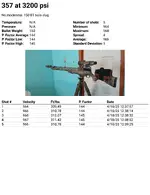
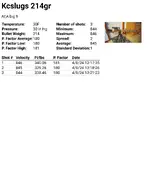
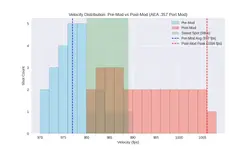
Estimated peak energy for 214 gr after mods
Based on pre‑mod 214 gr baseline around 845 fps (≈339 ft‑lbs) and the post‑mod velocity gains demonstrated on lighter slugs, a realistic peak for 214 gr after the port/valve work is in the 370–400 ft‑lbs range,
Quick verdict
Most likely peak: 380–395 ft‑lbs (≈890–905 fps), if the mod’s flow gains carry over to heavy slugs without hitting valve lock.
Stretch goal: ~405 ft‑lbs (≈925 fps) if the port and spring balance let the heavy slug ride the peak without choking. To see the 357s true numbers will have to wait until warmer weather.:rolleyes:


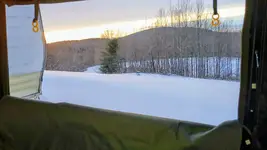
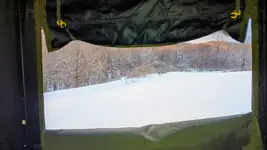
Time to switch optics and platforms for winter coyote sits.
With temps dropping into the 10–20°F range at night, my .308 Texan (modified, tuned for 3,500 psi with 150 gr slugs) is seeing pressure sag down toward 3,200 psi or lower. That drop cuts into consistency and makes it harder to hold tight groups past 100 yards.
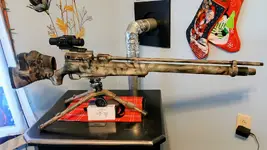
For winter, I’m moving the DNT Zulus HD 5–20x LRF with ballistic calculator over to the AEA .357 Challenger big bore. Here’s why:
AEA tune: 3,200 psi baseline with 150 gr slugs.
Fill rate: Higher capacity at 3,800 psi, which holds up better in cold temps.
Result: More stable velocity and energy across the 20–80+ yard bait ranges, with reliable penetration even when the thermometer dips.
And with the solid slugs I’ve chosen (147–150 gr flat‑point designs), the terminal effect is exactly what’s needed for coyotes:
Broadside: Clean pass‑throughs, fast bleed‑out, minimal deflection.
Shoulder hits: Enough energy to break bone, driving fragments into the chest cavity for lethal trauma.
Quartering angles: Straight penetration through ribs and muscle, often exiting behind the opposite rib cage.
Frontal shots: Sternum penetration with deep lodging in the chest cavity.
Different rifles, different seasons — but the goal stays the same: repeatable accuracy and dependable field performance when the coyotes move in.
 

Attachments

  • ee4488d5-bfee-46c2-808b-995e052b7bd3~1.webp
    ee4488d5-bfee-46c2-808b-995e052b7bd3~1.webp
    142.4 KB · Views: 3
Estimated peak energy for 214 gr after mods
Based on pre‑mod 214 gr baseline around 845 fps (≈339 ft‑lbs) and the post‑mod velocity gains demonstrated on lighter slugs, a realistic peak for 214 gr after the port/valve work is in the 370–400 ft‑lbs range,
Quick verdict
Most likely peak: 380–395 ft‑lbs (≈890–905 fps), if the mod’s flow gains carry over to heavy slugs without hitting valve lock.
Stretch goal: ~405 ft‑lbs (≈925 fps) if the port and spring balance let the heavy slug ride the peak without choking. To see the 357s true numbers will have to wait until warmer weather.:rolleyes:...

And with the solid slugs I’ve chosen (147–150 gr flat‑point designs), the terminal effect is exactly what’s needed for coyotes:
Broadside: Clean pass‑throughs, fast bleed‑out, minimal deflection.
Shoulder hits: Enough energy to break bone, driving fragments into the chest cavity for lethal trauma.
Quartering angles: Straight penetration through ribs and muscle, often exiting behind the opposite rib cage.
Frontal shots: Sternum penetration with deep lodging in the chest cavity.

Different rifles, different seasons — but the goal stays the same: repeatable accuracy and dependable field performance when the coyotes move in.
@Grunt64 Are the above terminal effects listed what you've learned from experience from shooting coyotes with 147-150 grain wadcutters? Is it what you've experienced shooting ballistic gel? Or are these the results you hope to achieve within the projected weight and velocity ranges?
 

📊 Big‑Bore PCP FPE vs. Coyote Hunting​

Posted by: Rob (AEA .357 / Texan .308 rigs) Board: Hunting Gate

My Chrono Data​

  • 147–150 gr flat‑nose slugs
  • Velocities: 950–1000 fps
  • Energy: 300–360+ FPE confirmed

FPE Comparison Chart​

AnimalMinimum FPE (published)My rigs (AEA .357 / Texan .308)
Squirrel / Rabbit4–5 FPEMassive overkill
Raccoon / Opossum9–10 FPEMassive overkill
Fox20–25 FPEMassive overkill
Coyote40–50 FPE minimum300–360+ FPE
Deer (small whitetail)150+ FPEComparable / exceeded

Sources: Gateway to Airguns hunting chart, Predator Masters field reports, Airgun Hunting Legion (2025).

Documented Shoulder Shot Results​

  • Quackenbush .308 (Predator Masters) — “Broadside shoulder hit broke bone and dropped it on the spot.”
  • .35 PCPs (Reddit r/airguns) — “Shoulder shots at closer ranges break bone and anchor them.”
  • Gateway to Airguns (Ballistik_.20) — “Broadside shoulder shots with big‑bores (.357 and up) will break the shoulder and still penetrate lungs.”
  • Airgun Hunting Legion (2025) — “Modern PCPs in .357–.45 calibers deliver enough energy to break shoulders and penetrate vitals on coyotes.”

My Takeaway​

  • At 300+ FPE, flat‑nose slugs crush scapula and ribs, then track straight into lungs.
  • Broadside shoulder shots at 50–80 yards = bone breakage + vitals penetration, often exit.
  • Quartering‑to shots are riskier; broadside or quartering‑away are consistently lethal.


👉 This thread is meant to show that energy charts alone don’t tell the story — real‑world reports confirm that big‑bore PCPs in the 300+ FPE class are fully capable of breaking coyote shoulders at 50–80 yards and delivering ethical kills. I did shoot a coyote looking straight at me in the chest 3 weeks ago 80 yards, drop it right there and that tells me sternum damage. (I never rely on hope).
 

Attachments

  • BCEI.87055991-5a53-416f-953d-2299fdb46c39.webp
    BCEI.87055991-5a53-416f-953d-2299fdb46c39.webp
    13.9 KB · Views: 1

📊 Big‑Bore PCP FPE vs. Coyote Hunting​

Posted by: Rob (AEA .357 / Texan .308 rigs) Board: Hunting Gate

My Chrono Data​

  • 147–150 gr flat‑nose slugs
  • Velocities: 950–1000 fps
  • Energy: 300–360+ FPE confirmed

FPE Comparison Chart​

AnimalMinimum FPE (published)My rigs (AEA .357 / Texan .308)
Squirrel / Rabbit4–5 FPEMassive overkill
Raccoon / Opossum9–10 FPEMassive overkill
Fox20–25 FPEMassive overkill
Coyote40–50 FPE minimum300–360+ FPE
Deer (small whitetail)150+ FPEComparable / exceeded

Sources: Gateway to Airguns hunting chart, Predator Masters field reports, Airgun Hunting Legion (2025).

Documented Shoulder Shot Results​

  • Quackenbush .308 (Predator Masters) — “Broadside shoulder hit broke bone and dropped it on the spot.”
  • .35 PCPs (Reddit r/airguns) — “Shoulder shots at closer ranges break bone and anchor them.”
  • Gateway to Airguns (Ballistik_.20) — “Broadside shoulder shots with big‑bores (.357 and up) will break the shoulder and still penetrate lungs.”
  • Airgun Hunting Legion (2025) — “Modern PCPs in .357–.45 calibers deliver enough energy to break shoulders and penetrate vitals on coyotes.”

My Takeaway​

  • At 300+ FPE, flat‑nose slugs crush scapula and ribs, then track straight into lungs.
  • Broadside shoulder shots at 50–80 yards = bone breakage + vitals penetration, often exit.
  • Quartering‑to shots are riskier; broadside or quartering‑away are consistently lethal.


👉 This thread is meant to show that energy charts alone don’t tell the story — real‑world reports confirm that big‑bore PCPs in the 300+ FPE class are fully capable of breaking coyote shoulders at 50–80 yards and delivering ethical kills. I did shoot a coyote looking straight at me in the chest 3 weeks ago 80 yards, drop it right there and that tells me sternum damage. (I never rely on hope).
@Grunt64 Is this your data or someone else’s?
 
Its mine, why would you even ask? If you can hunt hogs with a lower powered m357 why would you question the power from a modified AEA challenger big bore? when even in stock form out produces even a modified m357'
@Grunt64 Does it bother you that I asked? The second question was just one of my original questions that went unanswered. It was not meant to be antagonistic. I hope that isn’t what you assumed. I don’t recall questioning the power of an AEA airgun.
@Grunt64 Are the above terminal effects listed what you've learned from experience from shooting coyotes with 147-150 grain wadcutters? Is it what you've experienced shooting ballistic gel? Or are these the results you hope to achieve within the projected weight and velocity ranges?

The way the information is organized looks good to me. Since you have confirmed that it’s your data and conclusion, should I have future questions on the topic, I have confidence in asking you more detailed questions should you feel inclined to engage or reply.
 
@Grunt64 Does it bother you that I asked? The second question was just one of my original questions that went unanswered. It was not meant to be antagonistic. I hope that isn’t what you assumed. I don’t recall questioning the power of an AEA airgun.


The way the information is organized looks good to me. Since you have confirmed that it’s your data and conclusion, should I have future questions on the topic, I have confidence in asking you more detailed questions should you feel inclined to engage or repT
Thank you, any time you want more info just let me know and ask away.
 
@Grunt64 After thinking about it, I'm not a long-range shooter, but reading some of your posts has me curious. Producing around 300 FPE at the muzzle shooting a 147 grain slug from your Challenger (at approximately 960 fps), out to what distance can you shoot a coyote and retain enough velocity to expend 50 FPE at your POI? Let's assume that you are within 30 - 200 feet above sea level, 50ºF - 60ºF, with relative humidity 45 - 55% and wind gusts are 0-5 mph.
 
Last edited:
@Grunt64 After thinking about it, I'm not a long-range shooter, but reading some of your posts has me curious. Producing around 300 FPE at the muzzle shooting a 147 grain slug from your Challenger (at approximately 960 fps), out to what distance can you shoot a coyote and retain enough velocity to expend 50 FPE at your POI? Let's assume that you are within 30 - 200 feet above sea level, 50ºF - 60ºF, with relative humidity 45 - 55% and wind gusts are 0-5 mph.
Here are some numbers when it was stock, Hunting coyote I will call them in to 50- 80 maybe 90 yards in cold weather. I am in N.Y 10 miles from the VT border.
“With my modified .357 pushing a 147 gr around 960–990 fps, retained energy drops to ~50 FPE at roughly 210–230 yards under mild, low‑altitude conditions. If the slug’s BC is closer to 0.12, it can stretch past 230 yards; in winter cold at ~930 fps, expect ~200–210 yards.”
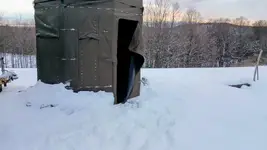
“For coyotes, I keep shots inside 120–150 yards where I’m carrying ~95–150 FPE. That’s where shoulder hits break bone. I can post pictures of a 20 plus lbs propane tank that I cut the bottom out and had it out 230 yards and caved it in a 1/2 inch when it was in stock form
 

Attachments

  • 80bd559a-6936-45b4-9ca6-478fe7e3513f~1.webp
    80bd559a-6936-45b4-9ca6-478fe7e3513f~1.webp
    178.2 KB · Views: 2
  • 54c563cf-b0c5-4272-b458-67c3af664c91~1.webp
    54c563cf-b0c5-4272-b458-67c3af664c91~1.webp
    208.7 KB · Views: 2
  • 24d37027-c9a6-49c9-b269-35ec375d1146~1.webp
    24d37027-c9a6-49c9-b269-35ec375d1146~1.webp
    183.8 KB · Views: 2
  • 357-at-3200-psi.webp
    357-at-3200-psi.webp
    93.9 KB · Views: 2
  • Kcslugs-214gr (1).webp
    Kcslugs-214gr (1).webp
    75.3 KB · Views: 2
Here are some numbers when it was stock, Hunting coyote I will call them in to 50- 80 maybe 90 yards in cold weather. I am in N.Y 10 miles from the VT border.
“With my modified .357 pushing a 147 gr around 960–990 fps, retained energy drops to ~50 FPE at roughly 210–230 yards under mild, low‑altitude conditions. If the slug’s BC is closer to 0.12, it can stretch past 230 yards; in winter cold at ~930 fps, expect ~200–210 yards.”
For coyotes, I keep shots inside 120–150 yards where I’m carrying ~95–150 FPE. That’s where shoulder hits break bone. I can post pictures of a 20 plus lbs propane tank that I cut the bottom out and had it out 230 yards and caved it in a 1/2 inch when it was in stock form
@Grunt64 Interesting. That's farther out than I'd anticipated. By then the projectile would be traveling below 400 fps and I'd be concerned about the animal's movement at that distance. I do not have the skills or confidence to be lethal from so far away. In your experience shooting big bore air rifles, how is the wadcutter's trajectory out beyond 150 yards? Is it a relatively stable slug compared to a hollow point or have you experienced more bullet drop using wadcutters?

Your comfort zone makes sense for your style of hunting them and the way you present your skillset. How far out do they generally show up? Do you find that they appear several hundred yards out and you have to call them into your preferred range?
 
Last edited:
@Grunt64 Interesting. That's farther out than I'd anticipated. By then the projectile would be traveling below 400 fps and I'd be concerned about the animal's movement at that distance. I do not have the skills or confidence to be lethal from so far away. In your experience shooting big bore air rifles, how is the wadcutter's trajectory out beyond 150 yards? Is it a relatively stable slug compared to a hollow point or have you experienced more bullet drop using wadcutters?

Your comfort zone makes sense for your style of hunting them and the way you present your skillset. How far out do they generally show up? Do you find that they appear several hundred yards out and you have to call them into your preferred range?
I understand you concern about the animal's movement but that's still close to 270 mph. I do have a cutoff of 150 - 180 yards in warm weather on coyote size critters but woodchucks I'll go the out even farther only because if you wait, they will pop back up with a whistle. Now for the flat nose vs HP I find the flat nose more stable because of their geometry stabilizes flight and reduce the yaw (side to side movement) while the 2 RN and HP introduce an imbalance i will be testing these FN 147GR whenever I can get a decent 20 plus degree day and have the free time,lol. I'm retired and for some reason it seems like I have less time than when i was working??? :oops: Oh and hear is that LP tank I had at 230 yards


 

Attachments

  • 08bba8d6-78a7-4a77-b4fe-6b58c0f7fb9d~1.webp
    08bba8d6-78a7-4a77-b4fe-6b58c0f7fb9d~1.webp
    128.4 KB · Views: 5
  • 544647067_122231514428190595_179676472458297380_n done with aea 357 stock, 230 yards.webp
    544647067_122231514428190595_179676472458297380_n done with aea 357 stock, 230 yards.webp
    200.3 KB · Views: 5
  • 543121827_122231514644190595_1349093181121969268_n aea 357 230 yards.webp
    543121827_122231514644190595_1349093181121969268_n aea 357 230 yards.webp
    96 KB · Views: 5
I understand you concern about the animal's moment but that's still close to 270 mph. I do have a cutoff of 150 - 180 yards in warm weather on coyote size critters but woodchucks I'll go the out even farther only because if you wait, they will pop back up with a whistle. Now for the flat nose vs HP I find the flat nose more stable because of their geometry stabilizes flight and reduce the yaw (side to side movement) while the 2 RN and HP introduce an imbalance i will be testing these FN 147GR whenever I can get a decent 20 plus degree day and have the free time,lol. I'm retired and for some reason it seems like I have less time than when i was working??? :oops: Oh and hear is that LP tank I had at 230 yards

@Grunt64 That is surprising to me. Thank you for the info.
 

Create an account or login to comment

You must be a member in order to leave a comment

Create FREE account

Create a FREE account on our community. It's easy!

Log in

Already have an account? Log in here.

Trending in this forum

Back
Top