Install the app
How to install the app on iOS

Follow along with the video below to see how to install our site as a web app on your home screen.

Note: This feature may not be available in some browsers.

Others MAC1 USFT Analysis/Overview

Franklink

HAM Wizard
1,135
4,210
Country flag
Repost of ongoing commentary of my USFT, if you haven't yet seen it elsewhere.

There have been a handful of recent posts that got me thinking I need to finally get around to the review of the USFT that I've been wanting to do for a while now. Questions like "regulated or unregulated" from just a few minutes ago, or the guy a few weeks ago looking for hand-made/high quality airgun related items, or the occasional posts about buying American made airguns, or the steady beat of PCP greenhorns asking how many pumps to fill x gun, or what guns can be filled with a pump, or if a SCUBA tank can be of any use to an airgunner. All of those questions can be answered with a greater familiarity of the USFT, it's design, and operation.

It just dawned on me that even the names of the maker and model of this gun sounds like a confusing jumble of alphabet soup to those unfamiliar with them. For starters, It is made by Tim McMurray, owner of MAC1 airguns out in California. The USFT stands for United Stated Field Target (I think). Tim makes each one, by hand, himself. When I ordered mine, the phone conversation was a little over an hour long. We discussed back and forth what I wanted (what side I wanted the breech to open to, barrel length, tube length, color, type of barrel, caliber, accessories, and other configuration details) and he gave me a time frame. Custom is NOT fast, by the way.

As an intro, the USFT is widely known amongst the field target and benchrest crowd, and equally foreign to the large number of airgunners not involved in the aforementioned competitive events. For that reason, I feel it might be beneficial to share what I've learned about my specimen over the past few years of ownership. And if not beneficial, perhaps at least entertaining, for the USFT is a collection of oddities in airgun design. And it truly looks the part.
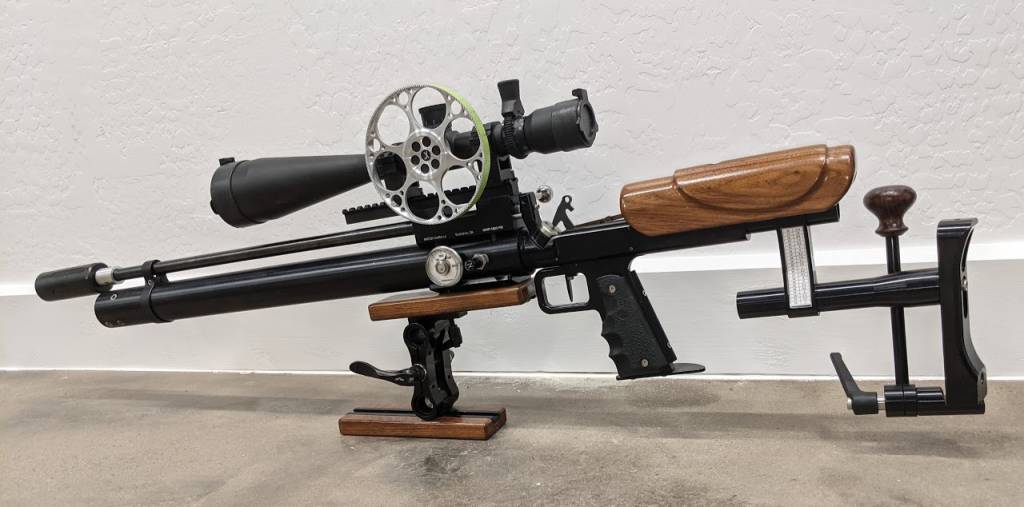
USFT.1626355582.jpg


If ever there was a less gun-looking gun, I'm unaware of it. The USFT appears to be leftovers from what you might find in the bed of a plumbers pickup after a day of replacing pipes. But what it lacks in aesthetic appeal, it more than makes up for in performance and convenience.

A detailed break down of the outstanding performance and rock-steady reliability I've experienced from this gun in the last 3 years is what I hope to achieve through an ongoing series of write-ups. I plan to take it at a leisurely pace, creating new posts as time allows. This won't be the typical "review," as there's no motivation to sell them, so there will be no "hawking of wares" in this series of posts about the venerable USFT.

If I've not got your attention yet, how does a gun that only needs to be filled to 1450psi sound? How bout a gun for which barrel swaps are so easy that 16mm Lothar blanks don't need machined to fit, just whatever smoothing you want to do to the crown? How bout a gun that allows direct access to the rear of the barrel for cleaning? What about a gun with an exposed valve stem that is hit by a revolver-esque hammer that is cocked for each shot? How bout a gun for which no regulator is necessary yet is still capable of competition winning consistency? How bout a gun with the fill port and gauge at the rear so that you don't have to look down the business end of the barrel to fill or check pressure? How bout a gun so simple in it's design that most of us have more fingers than all of the orings in the entire gun? How bout a gun with so many innovative features (when it first came out) that the rumor goes that Mike Nisch used it as inspiration for his Thomas guns? How bout the OG power plenum?

I hope to answer all of those questions and more as I analyze what makes the USFT tic, and the performance the atomic clock of ticking that the USFT is, provides.

More to come.
 
Larry D (known in airgun circles as LD) was the designer/creator/inventor of the USFT, which he called the Simple Simon. The story goes, that he first made a very small batch (can't remember exact # but 9 or 13 is coming to mind, so say 10ish). Those earliest Simple Simons were made, piece by piece in LDs garage. I do not know LD, but have seen him post occasionally, and have heard stories about him from shooting buddies who have spent time with him at matches and/or attended the Temecula Challenge and FT matches that he used to, and occasionally still hosts. My impression is that he is an eternal tinkerer, always looking for how to make things better. He also appears to be a 100% function over form sort of guy.

What he invented is perhaps the most simple and solid method of literally ANCHORING a barrel to a big block of aluminum, to which a scope can then be strapped, coupled with an again, SIMPLE, mechanism of releasing a very precise and repeatable blip of air to send the pellet on it's way. Beautiful in it's simplicity, the design allows many of the typically internal components of an airgun to be seen externally. For example, rather than a spring driven cylinder of steel "hammer" sliding within a tube to tap the valve stem (all typically INSIDE an airgun) the Simple Simon/USFT has no such sliding cylinder of metal to act as a hammer but rather a true revolver style hammer that is cocked for each shot. That hammer flys forward and taps the externally visible valve stem. Here's a visual help of that process:

To view this content we will need your consent to set third party cookies.
For more detailed information, see our cookies page.

The externally visible valve stem is circled in red here:

exposed valve stem.1626411547.JPG


More of the strange.......

  • LDs design did completely away with pellet probes. Let me repeat, there is no pellet probe for the Simple Simon/USFT. How you ask? Well the pellet is placed directly into the rear end of the barrel by the shooter. The operator of the gun can fully see the rear of the barrel, "hmmm can't remember if I put a pellet in, let me just look directly into the back of the barrel and see, nope, no pellet." Very unique, very convenient.
  • There is no transfer port machined into the barrel. Let me repeat, there is simply no transfer port machined into the bottom of the barrel like on nearly every other airgun that I've been inside. How you ask? Swing breech. Here's a couple pics....
    • rear barrel access.1626411977.jpg

      and the underside that shows the orifice by which air gets from tube to pellet
      transfer port.1626412628.jpg

      compare that to the previous picture to see that the black rectangular piece of aluminum swings out of the way to provide access to the barrel. So the "transfer port" is actually part of that swing breech mechanism. Arzrover and I share a love for the USFT (he won Nationals with his, in 2018 I believe) and we'll often go down the rabbit hole in technical discussions about airguns, him mostly teaching me. This configuration of pellet into back of barrel, with no transfer port for the pellet to bump over, with air hitting directly behind the pellet MAY have some interesting down-stream effects on the accuracy potential of a gun. You see, there is no right angle path that the air must take to hit the back of the pellet like it would with a "regular" tp machined into the barrel. Yes the air has to make some turns as it passes through the swinging transfer port, but the simple fact that the pellet doesn't have to bump over a tp to get to where it's going could also be beneficial. So, Arzrover and myself have contemplated if that directly-to-the-rear push of air on the pellet somehow causes a different obturation effect on the pellet. We were brainstorming ways to test obturation and think we came up with something, I'll likely get around to catching some pellets fired from the USFT to see if this unique method of air delivery is changing the shape of the pellet in a perhaps beneficial way.
    • Did you notice another unique design feature in those above pics? No oring groove necessary in the barrel. I understand some of the early USFT's had the groove machined into the barrel. but that was eventually done away with and the oring groove is now part of the swinging transfer port. So, any 16mm Lothar blank can just be plopped into the gun and tested for accuracy, no machining necessary.
    • Large air reservoir that acts a plenum
    • The original tubed version of the gun, like mine, operates on an extremely low fill pressure compared to most airguns.
    • Uses the air reservoir as the "spine" of the gun, versus dropping everything into a wooden stock to offer rigidity

I'll go into further detail on some of those bullet points above, but how's that for thinking outside the box when it comes to airgun design?!?!? So extremely different than everything else, yet so simple, and so logical. LD most definitely thinks a bit differently than the average bear.

Thank you LD, I've gotten lots of enjoyment out of the specimen I own, and plan to get much more.
 
I estimate there aren't more than a couple hundred in existence, based on the numbered breeches that I've seen at matches and in the rare shared photo on the forums. I suspect the guns were originally issued in a sequential fashion, with the numbered breech coinciding with how guns had been made up to that time. But at some point the numbering seems to have gotten off. Mine is technically a "Hunter" version, with a straight grip versus the canted grip like the true USFT designated models. Anyway, mine is #165, seen here:

165.1626441823.JPG


I've seen a handful with higher numbers (in the 200s) that were sold years before mine was made.

So, I'm not sure what all that means, perhaps not as many "Hunter's" have been sold and my breech sat in a pile of parts for at least a couple of years until I ordered it, with canted USFTs being issued after the creation of my breech but prior to the creation of my gun.

Memory is a bit fuzzy right now, but I'm kinda remembering seeing one numbered up around #280 at some point. I think that's the highest I've seen, so if any weight can be given to the numbering system, I'd be surprised if there are more than 300 total in existence.

You make an interesting point on the "latest and the greatest." The industry is driven by the average airgunner's insatiable desire to have the best, and the industry has created an arguable illusion that best = newest. While not the only company practicing such tactics, look at FXs business model. By hyping every new iteration of the Impact (to the point of absurdity usually) they have many of us that like to tinker (read: fiddle with reg pressures, chase impact points, consistent fps's, and chase buckets of gold at the bottom of rainbows) convinced that we're "less-than" or sub-par if we're running the prior model. Just lately when the M3 was released there have been posts guys started wondering if they can/could/should upgrade their M2 in parts to make it an M3. And there's also been posts with guys trying to argue themselves into being happy with a lowly M2 when the M3 is now out. Or the guys pissed that FX released an M3 right after they bought an M2. All of that illustrates the consumerism mentality. These companies want sales. Sales drive profit. They'd really like to sell every new version to every single airgunner, as can be seen in their marketing. Enter the USFT; solid, stable, steady, dependable. But there's no hype train and no cool kids making youtube vids featuring/showcasing it. No advertising dollars. Those of us that value things like never shifting scope zeros, very rare leaks (like once a decade maybe), couple ounce triggers, air efficiency, ease of cleaning, etc (basically a collection of features that equates to a no-hassle, pinnacle of accuracy possible in an airgun ownership experience) see the value in the USFT, and the rarity that such a collection of features is.

Like Steve123 and I were talking about at a local FT match last month, those that know about USFTs, KNOW about USFTs. People simply don't know what they're missing when it comes to the USFT.

Edit: not trying to make the case that a USFT and an Impact fill the same niche, quite the contrary actually. USFTs realm is a a Target rifle, specifically in a powe restricted discipline like benchrest or field target or even really accurate and trouble free backyard precision. I only brought up the Impact as an example of latest/greatest versus tried and true mentality. Popularity faded because of consumer mentality.
 
One of the major arguments I've seen against the USFT is the delayed lock time, or time from trigger break to pellet leaving the barrel. Yes, the early ones that I've shot have that impression. Mine does not. #165 is crisp and quick, I do not have to employ any more follow through when shooting my USFT than I do when shooting my Veteran (a gun which is know to be QUICK and SNAPPY). Furthermore, the early ones have more of a recoil/burp sort of effect when being shot. Mine is DEAD: squeeze trigger, watch pellet fly into the exact location you want it to go. I have no idea what internal changes were made for such a profound difference in cycle to have occurred in the 10-15 years that separates mine from the early ones, but the changes were a good thing, a very good thing. As for robust and accurate, agree 100% with you here.
 
Tim won EBR a few years back using a 30 cal MAC1 USFT that he built for a customer.

In 2014. I understand it was only to 75 yards that year as EBR rules have changed throughout the years.

Here's a pic of the gun he won with that year.

ebr winner.1626496978.JPG


Quite a few modifications from the standard tubed, or even bottle/regulated configurations. That bottle looks like the float in a livestock watering tank!!!
 
Left side of gun video

To view this content we will need your consent to set third party cookies.
For more detailed information, see our cookies page.

This overview video shows the swing breech in action, and another example of how the gun is cocked.

This was an average of 10 trigger pulls:

trigger weight.1626610891.jpg


The trigger on mine is really one of my favorites. Very crisp, able to know exactly when it's going to break. Really aids in accuracy.

Refer to the vid above for the following:

  • Gauge shows that I'm right in the middle of the pressure range that I usually work with, fill to 1450, refill at 1250.
  • Note the Max Working Pressure of 1800psi on the breech markings
  • Simple dust cap on the foster fitting (so nice that it's located where it is on the gun).
  • Supposedly any 1911 grip can be swapped onto the gun, mine has the grips it came with from MAC1, although I've eyed these a few times, in walnut as it seems like they'd go well with the overall look of the gun
  • Aluminum palm shelf/plate at the bottom of the grip. I was skeptical at first but being able to place the meaty part of the bottom of than hand on that shelf helps to lock the gun into place when shooting from ft position (bumbag)
  • My dope/cheat sheet on the rear "dogbone"
    • Yards in the left column, scope clicks in the right column
    • Tims term, "dogbones" refers to the anodized aluminum drop pieces that put the shoulder plate lower than the spine (tube) of the gun to align better with the shoulder
    • Dogbones can be ordered in custom lengths, I went with fairly long ones b/c I like to shoot in a more upright position, more for comfort than stability, crunching my neck down into a gun and pinching my shoulder up to make things line up gives me a sore neck, the higher dog bones help me avoid that soreness
    • I also opted for longer than standard dogbone on the knee riser
  • Thigh rest and function of such
    • I believe it was Lauren Parsons who told me these thigh rests were deemed illegal in WFTF class after they started showing up on USFTs, which blows my mind as that class allows the craziest contraptions to help with stability (foot long butthooks that curve under and over the shoulder, shooting gloves, shooting jackets, etc).
    • When seated on a bumbag the thigh rest is flipped outward and locked into place. That little round knob of walnut rests on my inner thigh, a bout 5 inches up from my knee.
    • REALLY aids in bumbag stability
    • Thigh-rest is one of the contributing factors that make my field target position with this gun nearly benchrest stable. Hardly any scope wobble.
    • Cylindrical piece of aluminum that affixes the thigh rest to the gun can be swiveled in 360 degrees, and locked into place with a large bolt on the underside. I only need to use the lever to lock it into place after swinging down to thigh. The large bolt controlling angle of the thigh rest is a set it and forget it thing.
  • Canted shoulder piece (buttpad but aluminum in this case so not much of a pad)
    • shoulder piece allows for up and down adjustment, as well as cant. I like mine canted towards me, and adjusted down quite a bit, as seen in the video
  • Mine came with an what Tim calls a "striptease" air stripper
    • airstripper.1626612923.jpg

      airstripper2.1626611868.jpg
      • VERY loud with as issued air stripper
  • I had Rocker1 over at GTA machine me an aluminum (raw aluminum in vid) adapter for a 1/2x20 moderator
  • Currently running with a DonnyFl Tatsu for a total OAL of just under 43 inches
    • oal.1626611981.jpg
    • not even slightly loud with Tatsu
    • previously had a 7.5inch Hogan Decimeter on the gun and bystanders thought the gun was broken it was so quiet, but that extra 3 inches with the Hogan made OAL up around 46 inches and was unwieldy, so compromised with Tatsu
  • Barrel band-only in name
    • barrel is free floated as the ID of the barrel band is much larger than the 16mm OD of the Lothar barrel
    • Tim told me that is to protect the gun from large/violent impacts, but not to act as a barrel band/support in normal situations
    • Tim included an additional band with a sling adaptor in case I wanted to use a bipod sling adaptor at some point
      • sling adaptor.1626612212.jpg
      • I've never used it
  • Barrel movement is minimal and goes back to original location after any force is applied
    • really takes substantial force to even get it to move as much as it does in the vid when I'm pushing on it
  • Full length barrel-I think it's 23.6inches long
  • Burst disc in endcap of tube out by the muzzle
    • have yet to have one let go-hope it stays that way
  • Endcap held in tube by numerous and substantial allen head bolts

Right side of gun vid

To view this content we will need your consent to set third party cookies.
For more detailed information, see our cookies page.

Again, refer to this vid for the following comments

  • Screws on dogbones can loosened to allow changing of angle, rear tube that supports shoulder pad and thigh rest can be rotated within the dogbone to fine tune fit of gun to shooters preference, retightening screws "lock" new setting in place. Tightening of screwes allows the semi split rings to clamp down on the tubes that run through the dogbones.
  • Round thumbshelf
    • bolt in the round, disc-shaped thumbshelf can be loosened to allow disc to rotate, effectively increasing or decreasing the distance the shelf is from the trigger (up and down as it rotates around).
    • Once preferred location is found, bolt tightened to "lock" setting in
    • I like right thumb up for shooting and I utilize the snot out of this thumbriser.
    • Odd design, but it fits all the rest of the quirkiness that is the USFT
  • Swing breech function from this side now
    • Swing breech can be changed to open to the left or the right
    • I prefer it like this, opening to the right

Sorry about both videos rotating towards the end, wasn't paying enough attention during filming.

It's not apparent when just glancing at the gun, but all those atypical adjustments allow the shooter to really make the gun fit them like a glove. For the first 6 or 8 months I made small changes here and there, figuring out what I liked and didn't like. I've not touched anything since I got it how I like it. I can sit down on a bumbag now, close my eyes and get the gun in position and open my eyes and look through the scope and have everything nearly where it should be. When used in conjunction with a shooting harness, the gun fits me so well that I can relax all my muscles and let the gun just sit there. It doesn't even require my right hand to be holding it and it will just perch in place, steady as a rock. Not needing to utilize any muscles to support the gun I think is how I can be so stable with it. The ability to change the fitment to the shooter is one of the things that many overlook as they glance at the bag-o-pipes and critically decide it's an ugly beast. The adjustment to shooter methods are so unconventional that non-owners don't even realize they're looking at extreme adjustability in all the strange disjointed components of the gun.
 
The barrel...

An airgun simply has to have a good barrel to be able to shoot well. It's also imperative that that good barrel be affixed to the gun in a stable manner if consistent point of impact/scope zero is of concern. USFT's use 16mm Lothar barrels as a standard. Tim apparently used some sort of custom barrel with a very minimal number of lands and grooves at some point early on (1 or two grooves? maybe Bobby can help with the details again here). When I ordered mine he told me that he also had gotten some really good shipments of HW barrels that went into the USFTs for awhile, but that the most consistent/best performing barrels he can get now are Lothars. So, mine has a 16mm polygonal .177 Lothar. Tim has had the "slow polys" advertised on his website and I'm curious if mine has it, or a regular twist. I guess the slow polys are 1:36 and the standard poly is a 1:17.7. I've never measured mine to know, but regardless of what it has in it, it will not be changed any time soon, as it shoots incredibly accurately. Mine also has a very gentle choke.

Barrel attachment....

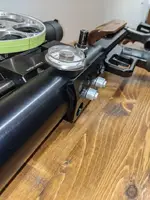
The barrel is held inside the breech by means of 4 large diameter bolts that come up through the baseplate at the bottom of the gun, through the tube, and through the threaded breech. As usual, this is an atypical airgun design feature so here are some photos to help visualize.

The two phillips head screws to the left here hold the uit rail to the wood block, but the two right phillips hold the rail/block to the gun. (referring to the 4 phillips head screws in the bottom of the Anschutz rail)

baseplate.1626685881.jpg


Removing the two phillips screws on the right allow the block to come off the gun, and gains access to the four breech bolts (black headed allen bolts here).

four allen bolts.1626685867.jpg


The next couple of pictures show those four bolts, each a couple of inches long, going up through base plate, tube, and breech.

bolts.1626685227.jpg


1773104443392.webp
1773104457971.webp


This is the extra barrel in .22 that I asked Tim to send with my gun when I ordered it. The unblued portion is the section of barrel that is held by the breech.

section of barrel in breech.1626685392.jpg


The breech is effectively a giant vise and an EXTREMELY reliable means of keeping a barrel in the same place which = 100% reliable maintaining of scope zero. We're talking about scope zeros that maintain for literal YEARS. Rare in an airgun.

So how does the aluminum breech block open enough to clamp the barrel?

A big diagonal slit

diagonal slit in breech.1626685493.jpg


Reduction of the clamping force of the breech on the barrel is mostly done by the two bolts on the same side as the slit, but the two on the opposite side of slit opening also have to be loosened slightly (at least on mine) to be able to pull the barrel.

Because I ordered two barrels, Tim provided some hand-written directions on how to replace a barrel on a USFT, in his words:

"For swapping barrels the air can be left in the gun.

To swap barrels: Remove forearm fasteners and remove wood. Loosen two large action fasteners on right hand side of lower base plate 2 turns. Make sure transfer port is closed. Hold barrel so it wont slide out. Witness mark barrel being removed at slit in barrel mount to preserve scope data. Slide barrel out of gun and slide replacement barrel in. Support muzzle by work surface with gun vertical. Pull down on grip and tighten large action fasteners. Test tension of transfer port/breech to barrel fit and adjust for engagement. Transfer port to barrel tension must be set with air charged gun."

Here is the witness mark (in blue) I added to my .177 barrel so that it can easily be returned to the same location if ever removed.

witness mark.1626685747.JPG


While I'm talking about the barrel, here is one of the really user friendly features of the design.....

After removing the cheekpiece by means of the single silver allen head bolt here

cheek piece removal.1626686215.jpg


Completely unfettered access to the rear of the barrel is achieved, talk about easy cleaning!!! (well I guess you gotta cock the gun to get the hammer out of the way, but still, easy-peasy compared to most guns)


barrel cleaning.1626686259.jpg


Here is the leade and crown of the .22 barrel

.22 crown.1626686399.jpg

.22 leade.1626686399.jpg


I ordered the extra barrel as I envisioned swapping back and forth and getting multiple uses out of the gun. In reality, this became one of a couple attempts I made at having multiple barrels for the same gun with the rose colored glasses idea of swapping back and forth. It took my stubborn self a while to learn that, while good on paper/in principle, in practice the more than one barrel for a gun concept is a poor one. Going back and forth between barrels and scope settings gets old quickly. I ultimately ended up buying a different .22 gun and it was for the better. The USFT just shoots so good as my dedicated/hard-core field target gun, and maintains all zero and thereby the dope data so well, that it's really a disservice to the gun, it's design, and intended use to be switching back and forth all the time. Rezeroing after barrel swaps simply defeats the purpose of all the unique engineering that creates such a stable point of impact.

As for the .177 poly that lives in the gun, there was a bit of a learning curve to it in those first few months of ownership. In the beginning it had a bad habit of accuracy degredation after not very many shots, 100-200 if I remember right. I could clean it after that and it'd go back to shooting really good, but another 100-200 shots and it'd start to open up a bit. Arzrover suggested a couple things. First was to JB bore paste the barrel to polish it up as much as possible. So I did that. He also suggested Slick 50 One lube. So I started washing and lubing my pellets. Perhaps it was just the barrel getting leaded up, or a combination of barrel break-in, JB Bore Paste, and cleaned/lubed pellets, but I've yet to have the accuracy degradation that I saw early on. I'll typically clean it after a tin of pellets now, but I've gone more than two tins without cleaning since the above recipe was arrived at and it still shoots well after 1000 pellets. And cleaning is simple (and unorthodox). I just push a couple qtips through the barrel, from the breech end. I'll usually wet them with the same Slick 50 one lube. The first one or two usually has a little bit of black on it, and then they're clean as a whistle. Cleaning may be more of a superstition than anything else at this point, but it shoots so well with the above prescription that I'm not changing anything, (even it is is simply superstition).
 
"Tuning"

That word means a lot of different things to us all, I'm going to use it primarily to refer to the power level and balance of the gun.

The power level/balance of the USFT can be adjusted/optimized through three main processes: hammer tension, transfer port restriction, and hammer weight. But, as the trend goes with this gun, some of these are a little unorthodox.

Hammer tension: pretty straight forward here, remove the cheekrest to access the allen key that increases/decreases the hammer tension. I view this as the coarse adjustment.

hammer tension adjustment.1626782102.jpg


Transfer port restriction: this was not an option on the earliest USFTs but later specimens have a small grub screw in the back of the transfer port that restricts airflow through obstruction, further "in" equals reduction of power. Circled in red here (The white is a little bit of teflon as insurance to keep it from moving). This is more of a fine tuning of the amount of air that hit's the pellet (power output).

port restrictor.1626782324.jpg


And the third mechanism to adjust the power: adding weight to the hammer. Again, early USFTs did not have this feature, but later specimens have a 1/4x20 threaded hole in the hammer into which bolts of various weights can be added to increase the force with which the hammer hits the transfer port. A roughly 1 and 1/4 inch long socket head bolt shown here threaded into that hole to illustrate the process.

hammer weight.1626782490.jpg


Mine came from Tim tuned to shoot the 13.43gr JSB .177 pellets. I found it to shoot REALLY well with 10.34s so I needed to do a bit of adjustments to the hammer tension and the port restrictor. I'll get into shot strings later, but the final tune makes for a a really smooth and efficient shooter. Playing with hammer tension and port restriction settings allowed me to find a balance where the gun sounds and feels happy, with chrono #s to support that impression.

For a field target legal power level I didn't need to add any weight to the hammer. I did, however, play with the .22 barrel in the first couple months of ownership of the gun. For that I did add weight to the hammer. That screw in the hammer in the photo above was used to get the gun up to around 30fpe without any changes to the hammer tension or port restriction as I knew I was going back to .177/20 fpe and didn't want to lose the settings. The 30fpe was with 18.13grain .22s. I also used these two bolts to play with 15.89s and 13.43s. I think the shortest is 3/4inch long and the middle length is 1 inch. From memory the 3/4 inch long bolt got the 13.34 .22s into the 23fpe realm, with the 15.89s around 26fpe. Accuracy from all three pellets and their respective power levels at 60 yards and groups were in the 1 inch area with all three. So, average, and maybe even "good" accuracy, but nothing spectacular from the .22 barrel. I was mostly interested in seeing the effect of the bolts as hammer weight, and whether or not that .22 barrel could shoot so I didn't do any shot strings or efficiency data, knowing full well that I was going back to .177 and field target legal power levels.

I suppose further weight could be added by putting nuts on the bolts but I never went that deep into the experiment. Also, upping the hammer tension in addition to the weights is likely to yield even greater fpe. I'm a little curious to know how high it could go, but not enough to undo the field target settings the gun lives in. (Confidence is big for competition. I've got a lot of confidence in the tune and don't want to mess with it. I'm sure I could get it back where it is, but I'd rather not need to build confidence in it all over again).

Furthermore on the power adjustments, Tim included an extra valve stem/poppet. Seen here:

poppet.1626784353.jpg


(also seen here and supplied with the gun is an extra burst disc, some extra orings (seals swing breech to the barrel I believe), and an extra "foot" which is essentially just the sacrificial piece of metal within the kneeriser that exerts pressure on the opposite rail when tightened-keeps the bolt from marring the trough of the Anschutz rail. Oh, and a patch.

So, for really serious/curious tuning, Tim sent a note with my gun that says, "0.2fpe per 0.001" diameter of valve head." I'm not sure if he meant the valve stem can be reduced by 0.001" to gain 0.2fpe or if the outer diameter of the delrin has to be reduced by that much to gain 0.2fpe. My gun is going to stay at its just under 20fpe power level so I won't every be testing out this theory, just thought I'd include it for any interested parties.
 
The field targets don't care how ugly the gun is

Tim made some comments on the phone when I ordered the gun that support the made in batch's concept. I got the impression that either when funds allow, or when he's taken enough deposits, he has a batch of parts made by whoever he outsources the machining to. I think he has to do some final shaping of the parts too, as mine has some sign's of post-machining fitment here and there, just like anything that's handmade/not commercially manufactured will have. (I remember reading a few years ago about a guy that bought one and went to Tim's shop to watch him put it together. The guy wrote that he was surprised at how much force was required to fit some of the parts-hammering pins in place and such-and just overall how tight the tolerances were for the parts to come together to make a finished gun). I have no idea if the batched machining relates to how they get numbered though. If he hasn't kept track of what numbers have been used, and just has the anodizer throw some random numbers on the breech, then who knows how many have been made. Anybody else have a #165? ha ha
 
Efficiency

For me, the "magic" of the USFT comes from its low fill pressures. This post will address this novelty in the PCP world.

When most of us take the leap into PCPs we find ourselves questioning how we're going to fill them. If it's been too long for you to remember that stage of the hobby, just take a look at any given moment on any of the forums and you'll find guys asking about pumps, compressors, tanks, fittings, fill stations, etc, as they try to figure out what is going to work best for them and their needs and wants. Occasionally we get somebody asking about 3000 psi SCUBAs, and very frequently we get guys asking about hand pumps. The typical responses to both are "NO WAY, can't even fill a PCP one time with a 3000 SCUBA," and, "ha ha, enjoy the hand pump to 250-300 bar, snort." For most guns, those responses are fairly appropriate as you truly can't fill a PCP with a +3000psi (207 bar) max fill pressure even once with a 3000 SCUBA tank, and hand pumps do really suck (suck the fun out of it) for filling high pressure guns. And the trend seems to be moving towards even higher and higher fill pressures.

Enter the tubed version of the USFT. There's a slight variation in the fill pressure that most tubed USFT's prefer to run at, but most that I've been around (mine and friend's guns) seem to like to fill up to around 1500psi. My personal example does really well with filling to 1450psi, and shooting down to 1250psi. A PCP operating in those pressure ranges is truly an oddball in the PCP world. For example, consider that many guns have 250 bar fill pressures (3626psi) and the USFT fills to only 1450, that's a difference of 2176psi! So, it's got to be a weak little 6fpe-producing 10m gun right? Nope. Mine does right under 20fpe to make it field target legal. LD recently shared here on AGN somewhere that he shot a highly modified USFT up at the long range airgun competition in Oregon a few months ago. That was a .22 shooting the MRDs (25.4grs) at around 50fpe if I remember the details correctly, and still a low fill pressure gun. I can't remember the top end he was filling to, and he may not have even said, but really impressive to get that kind of power from such a low pressure. (LD, feel free to chime in with the details on that Oregon gun, and I'd love to hear your secrets on to get such high power from such low psi.)


Here is a 2019 string.

1-79.1630309940.jpg


1-40.1630309946.jpg


I intentionally overfilled, and shot down past the 1250psi, just for the sake of collecting data. (The break in the plotted line was an error in the chrono).

The gun is good for a very consistent 40 shots and actually more than that throughout a match as the temp increases. I've shot 48 shot matches without refilling. The rising temp throughout a morning increases the tube pressure enough to get some extra shots. I've also had the opposite happen to me, with decreasing temps the gun will lose a few shots. The important thing is that I know if the gauge is between 1450 and 1250, I can 100% trust the fps to be consistent enough to have complete faith in where the pellet is going to impact at various distances.

Here's the efficiency numbers, not too bad, 1.28fpe/cu inch per shot-puts it in Lloyds "good" category. (thanks to Lloyd Sikes for making these calculators available for general public use).

efficiency.1630310937.jpg


So, how big is that tube?

tube length.1630310335.jpg


The air holding portion of the tube looks to be 19-20.5 inches long. I'm not sure where the end piece stops at the rear of the tube.

tube diameter.1630310371.jpg


Outer diameter of mine is about 1.995in or 5.07cm.

Arzrover measured the inner diameter of the tubes to be 4cm. That gives wall thicknesses of just a bit over 1cm if you're curious. And using good ole V=(pie)(r squared)h for volume of a cylinder, we're looking at a volume of around 640ccs (using radius=2cm and height = 50.8cm or 20 inches).

640cc giving 40 good consistent shots from 1450 to 1250psi.

I started out thinking this was going to be my last PCP (lol to that one, 5 or 6 other PCP's later), so I invested in a heavy 80cf, 3000 PSI SCUBA tank. It proved to be too big and heavy for mobility so I bought a slender little 19cf tank, also 3000 psi, to use as a sort of buddy bottle for my USFT. Eventually I wanted some more PCPs so ended up with an 87cf SCBA carbon fiber tank too.

Here are the numbers for those 3 tanks.

19cf shot count.1630311196.jpg


80cf shot count.1630311203.jpg


cf shot count.1630311215.jpg


The little 19cf SCUBA is about 4 inches in diameter and about 19 inches long. It's about the size of a silver and green oxygen bottle that you see people carting around. With that little 19cf tank I can fill the gun 31 times, @ 40 shots per fill, that's 1240 shots, or, nearly 2.5, 500 count tins. LOTS of shots.

The 80cf SCUBA gives 130 fills, @ 40 shots per fill, that's 5200 shots, or nearly 10.5, 500 count tins. LOTS and LOTS of shots.

The 87cf SCBA gives 186 fills, @ 40 shots per fill, that's 7440 shots, or nearly 15, 500 count tins. LOT and LOTS and LOTS of shots.

Now, that's all theoretical numbers, and I've never ONLY filled the USFT from the big 80cf SCUBA or the SCBA so cant verify anything there, but I have filled ONLY the USFT from the 19cf smaller SCUBA and I can verify that it will shoot more than 2 tins of pellets through it before the pressure gets down to lower than 1250psi. So, the #s LLoyd's calculator predicts for the bigger tanks seem plausible.

What all that means, is that for somebody who doesn't need more than 20fpe, the USFT can shoot and shoot and shoot and shoot with one fill from a simple ole 3000psi SCUBA tank. This makes the chasing of high pressure compressed air much more simple, as true 4500 psi fills in a SCBA are harder to come by than 3000 fills. And if you own the compressor, 3000psi fills are much less wear and tear on equipment than 4500psi fills.

Furthermore, many of the male fosters on my higher pressure guns eventually end up with ball bearing divots from the inside of the female foster and the pressure exerted on the female foster shoulder. The male foster on my USFT has none of that nonsense, and I don't expect it to ever get that deformation, as 1450psi is simply easier on all the fittings.

And there's no regulator to ever act wonky. Wink wink.

A true oddity in the airgun world.

(For those hand pump guys...I did fill the gun one time with a Hill MK3 hand pump, shortly after getting it. From memory it was something like 120pumps from 1250 up to 1450psi, and OH SOOO easy strokes. I used to fill a Benji Discovery up to 1900 with a hand pump and the pump strokes for the USFT made the pump strokes for the Disco seem hard, and even they're not too bad compared to trying hand pump a 250 bar PCP. So, VERY hand pump friendly gun, the tubed USFTs.).
 

Attachments

  • 1773104739901.webp
    1773104739901.webp
    12 KB · Views: 0
  • 1773104763085.webp
    1773104763085.webp
    15.3 KB · Views: 0
I've not shared much of the actual accuracy of my USFT, as I just haven't shot it much lately. It's the gun that almost feels like cheating when I compete with it, so for regular monthly matches I've usually been shooting something else (in the past year and a half or so). But this past weekend was the STATE match, so I brought out the serious field target gun..

I love to go and spend a night or two camping and hanging out and shooting and talking airguns and spending time with airgun friends. Something bout sleeping in a tent always makes me wake up with the daylight though. And because of that, I was up pretty early on Friday morning. Decided it'd be a good time for a little reaquainting with the USFT, as I intended to shoot it for the competition on Saturday.

Here's an early morning glamour shot from that brief practice session.


early morning USFT.1632807627.jpg


These groups were all from the first 20 or 30 shots that morning.

Off to the left here it took 10-15 shots to get settled into my position, then I shot the 5 shot group on the right. 27 yards from bum bag. .177 pellet sitting there, head up, for size comparison.

5  27.1632807818.jpg


And from that tight 5 shot group above, went straight to my other pellet trap, set at 47 yards, and shot this ten shot group. .177 pellet in the frame again for size comparison.

10  47.1632807877.JPG


The couple shots in the upper right that started to wander away from the center of the rest of them were shooter induced (operator error).

Shot a bit more that morning but knew the gun would simply do what it does for the comp on Sat.

Went on to shoot 48/52. I think only Lauren Parsons was the only higher first day total than that, at 49.

My 4 misses were 2 of the 6 offhand shots, and 2 of the 4 kneeling shots. So, the trusty USFT went 42/42 on the field target standard bumbag position shots, and 6/10 on the forced position shots. That says a lot more about myself being out of practice than the gun not performing up to snuff.

And that was with the same settings and scope zero that the gun had at the previous AZ state match, a year ago. Quite the testament to reliability right there.
 
I haven't updated this for quite a while since it has been quite a while since I shot the gun. I DID however, shoot it this past weekend and wanted to share how that went.

We had a field target match over in western NM.

I knew going into the match that if I shot Open class I would be the only one in that class. So I had made plans to shoot Hunter using a different gun. I practiced for a couple hrs on Thursday and again on Friday, getting acquainted with and doping out the other gun. Friday evening though, I ran into some slight flyers with the gun I was going to use for Hunter and decided I need to learn that barrel a bit better (cleaning regimen, pellet lube, etc.) and pulled out the "backup gun" USFT from the truck right before dark on Friday night. I shot the gun a bit last month just plinking, but prior to that had not shot it since the AZ state field target match back in October. Well, that 15 minute dope verification on Friday night was completely uneventful. Ole reliable USFT was stacking them, using the same dope and scope zero that I've been using for literally a couple years.

Went through and shot the match with the USFT, 56 shot match and I was just enjoying it, squadded with my boy. We were having all kinds of fun shooting and moving through the course. I knew I was doing okay but somehow the gravity of being so close to another perfect match didn't hit me until the last lane. I skimmed over my score card and it hit me, "I'm four shots way from clean!" Well, I knocked the first two down, so now I'm two shots away from a perfect score. Aaaand......I shanked the first shot on the far target. Just got nervous and jittery and yanked the trigger and gun and flat out missed. Got myself composed and knocked it down the second time but finished out with a 55/56, just that one shot away from clean.

(I couldn't have just used the USFT for Hunter class because the scope on it only has yardage marks for 50x, not the Hunter legal 16x. In fact, that scope doesn't even have a mark for 16x. Further more, the shooting sticks I use to shoot from Hunter position have too much flex for a heavy gun like the USFT.)

Just another testament to the USFT's reliability. Other than the 15 minutes the night before the match I had only shot the gun one time in the prior 8 months. Pull it out of the case and proceeded to shoot a nearly perfect score. And the miss wasn't even the guns fault. Absolutely awesome consistency and 100% reliability right there. I certainly wasn't practiced up so it speaks much more to the reliability of the gun and it's maintaining poi than to my trigger pulling skills.

Amazing guns these USFTs. Simply amazing.

1773105230252.webp
 
Made a few changes to the gun...
The raw aluminum 1/2x20 adaptor for the 16mm barrel on my USFT has always bugged me a bit. So last night I dressed it up some. Removed the set screws first, then gently went over the areas I wanted black with 500 grit sandpaper, mostly to remove the oxidation and get to fresh aluminum...


And that was in preparation for the short little Hugget Atom that just arrived in the mail today. The main goal was reduction of overall length. I've had a 7 inch Hogan Decimeter on the gun for about 75% of it's life. The gun was just shy of 46 inches long with the Hogan, and nearly silent. The rest of the time, prior to now, it had a Donny FL Tatsu. The Tatsu had that big fat can hanging on the end look and I never loved it, and I sold the Tatsu four or five months ago.

So, threw the Atom on this evening after work and took some shots in the garage. Lol. Not very quiet compared to the Hogan. BUT, it definitely reduces the sound level to tolerable, even in a closed garage. And the big pro of the Atom is that the USFTs overall length got cut down to about 42 and 1/4 inches. That 3.5ish inches feels much smaller. I noticed it right off the bat as I put the gun into and out of the gun cabinet and walked through my gun room door jam. Heck I even got in and out of my truck to see how that worked and I don't feel like I've got a 10ft stick of schedule 40 now. So, improvement in that regard. I'll shoot it for a bit with the Atom before I come to a complete conclusion. I sure like silent, but guns that feel like shop brooms are a chore when it comes to keeping awareness of both ends......sigh, such compromises with these first world problems.
PXL_20220827_055728434.jpg


I gotta say, the silver accent colors in the Hugget design go well with the hardware.
PXL_20220827_055537982.jpg
 
As a little bit of an update....I never reported on the last time I shot the USFT at a match. It was at the AZ state ft match in September of 2022.

I only shot Saturday, and scored 55/56 that day on the "red" course. The single miss was an offhand shot, otherwise the good ole USFT went 48/48 on the bumbag shots, 4/4 on the kneelers, and 3/4 on the offhand. Of the other shooters that shot the same course that day, the next highest score was a 49/56 (Lauren Parsons). On Sunday one of the Hunter class shooters (Kent) shot a 53/56 on the "red" course, the next highest overall score on the "red" course, to my 55/56,

The USFT is a dang good gun. As accurate as anything I've had the privilege to shoot (even if it's funny-looking).

(Shared more as a flex of what the USFT is capable of than being boastful of my abilities. As I've stated elsewhere, the couple of times I've lent this out to "newbies" they've also scored very high.)
 
USFT is a very niche gun, that niche being field target. And it does its job extremely well. As much as I enjoy a multi use platform, there's a lot to be said about a dedicated rig like this.
 
One of the best features of the USFT design is the ability to swap out barrels. And the kicker here is that those barrels can be nearly blanks and still be tested. VERY minimal barrel work needed for a blank to drop into a USFT....whatever crown dressing is required, and whatever barrel lapping/polishing the owner ascribes to, and the leade can be softened up to make pellets easier to load. But no actual machining of oring grooves, etc. For those truly chasing accuracy, this feature is important enough that it was carried on to other benchrest guns. One of two "identical" barrels will always shoot better than the other. Sorting barrels has proven much more beneficial than sorting pellets in my experience.
 
In the image above you can see a different barrel. We'll be calling that the "stinker barrel." I was asked to test it by my friend Larry.

I've had some learning experiences with this stinker barrel in the last few days.

I first installed it on my USFT to shoot it as-is, for a baseline. Easy peasy on a USFT, two Phillips screws to remove the wood block under the gun, then loosen the four breech bolts that go all the way through the baseplate, air tube, and breech block. The two on the side of the slit in the breech need loosened the most. Slide out my barrel, slide in Larry's barrel, tighten everything back up.

Larry had done some extensive indexing tests and documented them all, right on the barrel. His "witness" attachments can be seen in the above photo. With his prior testing, I was able to get the impact point within 4, 1/8moa clicks on the horizontal turret and within 5 clicks on the vertical, from the scope zero with my barrel. I'll deal with the slightly higher impact point, and run with the 4 horizontal clicks while I test this barrel, to aide in getting back to good with my own barrel when this experiment is over.

In the first shooting session I saw exactly what Larry described: couple good shots going going into nearly the same hole, then a couple flyers spraying around erratically, then another couple good shots.

Decided to pull the barrel for closer inspection. Pellets pushed through felt good, no catchy grabby mixed with loose, just a little bit of resistance felt through the entire length. It seems to have the typical Lothar tight spot at the breech end, although not as bad as some. And the good here was that the pellet doesn't free fall after that initial tight spot. And then it has a choke at the normal 3/4-1" in from the muzzle. Choke isn't overly aggressive. It felt quite similar to how pellets pushed through my 1:36 barrel feel, which made me optimistic for this project.

Inspection of the crown showed that it was slightly off-center. Bore itself seems centered to the blank, but the angle of the crown was deeper on one side. I decided this would be the first thing to try: new crown. I consulted @Arzrover and he had a great suggestion on how to remove the old crown while keeping everything square. Followed his recommendation and got down to virgin bore, ie took off about 1/8" of barrel to omit the offset crown.

The recrown was accomplished with the brass screw trick, although it is only a very minimal bevel.

Pushed a bunch more pellets through my magic barrel and this stinker bareel and compared them. Pushed to the choke and then back out the breech end, also all the way through, etc. Concluded that with my barrel the heads only slightly contact the grooves, leaving a defined edge on the widest part of the head of the pellet, but with Larry's barrel there was a wide ring of contact visible on the head of the pellet, ie even the rifling grooves were displacing lead. Conclusion there was that Larry's barrel was slightly tighter than mine. Got his permission to open it up with some lapping compound and then did so, also focusing on that tight spot at the breech. After that process pellets pushed through both barrels look very similar.

Reinstalled in the gun and shot these 24, 10 shot groups; 15 @ 30 yards and 9 @ 55 yards. The number next to the group is the order in which they were shot. Rings are 1".
These were taken from a bumbag, not a bench, so there is some human error in there. Also moved a few clicks here and there between groups. Also, shot the 240+ shots in less than an hour. I was really cranking them off at times. When I'd slow down and really focus id have a pretty tight group. I star'd the best ten shot groups, #10 @ 30 yards measured 3/8" CTC and # 9 @ 55 yards measured 13/16."
The seeming "flyers" correlate pretty well with pulled shots.

PXL_20240607_000032687.jpg


PXL_20240607_000049663.jpg


I've been trying to get my 80cf SCUBA down low enough to empty it and do an inspection, so I had it sitting next to me to refill every 40-45 shots. USFT uses such little air though that I'm still up around 2400psi, having started at a smidge over 2500 before these 250ish shots. Guess that mean I need to shoot some more.

I'm glad this little project came up. I was recently eye balling a really good deal in the classifieds but getting the USFT out and shooting it made me realize I've already got too many amazing guns that I still really enjoy and that I don't have time to shoot. Last thing I need is another one!

Awesome gun, these USFTs. Sublime trigger. Quite literally built to shoot from a bumbag. Chill shot cycle. Easy as pie to swap barrels when the need arises. Just overall high level of performance that makes me smile when I shoot it.

So what's next with Larry's barrel? Well I feel like it's competitive now. I sure would not have tried to shoot it in a match with how it shot before. I think there might be some gains in accuracy from a different batch....these today were 7th run of this die. And I was using a 3d printed moderator that hasn't fully earned my trust. So I think I'll try some other pellet batches and a different moderator and see how it shoots. I'm seriously considering running my USFT with Larry's barrel at the next Airgunners of AZ match 9 days from now. And I want to shoot it on a windy day to get a feel for how wind resistant pellets fired from it are, a comparison to what I call my "magic" barrel of the same specs.
 

Create an account or login to comment

You must be a member in order to leave a comment

Create FREE account

Create a FREE account on our community. It's easy!

Log in

Already have an account? Log in here.

Trending in this forum

Back
Top